



- Home
- /
- High Courts
- /
- Karnataka High Court
- /
- Karnataka High Court Refuses To...
Karnataka High Court Refuses To Stay State Gig Workers Act, Asks Platforms To Deposit Welfare Fund With Court
Sebin James
3 July 2026 7:37 PM IST
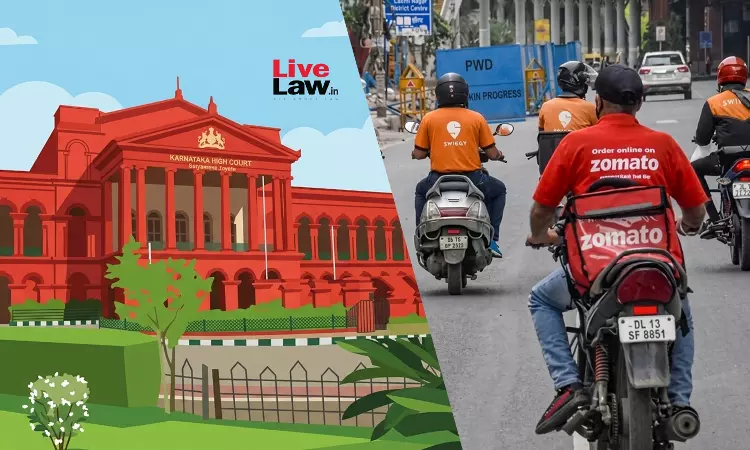
The Karnataka High Court on Friday [July 3] directed platform aggregators, including Zomato, Swiggy, Blinkit, and Zepto, to deposit the welfare fee envisaged for the gig workers in the second quarter with the Court registry, even as it refused to stay the operation of the Karnataka Platform-Based Gig Workers (Social Security and Welfare) Act, 2025 and Rules under which it has been...
This is a premium content
Available exclusively to
Our subscribers
Subscribe Premium 
INR 1099+GST
Your support helps us to bring you more content at
an affordable subscription scheme !!!
All payment options available
The Karnataka High Court on Friday [July 3] directed platform aggregators, including Zomato, Swiggy, Blinkit, and Zepto, to deposit the welfare fee envisaged for the gig workers in the second quarter with the Court registry, even as it refused to stay the operation of the Karnataka Platform-Based Gig Workers (Social Security and Welfare) Act, 2025 and Rules under which it has been stipulated.
At the outset the court said that it will not grant an interim order of stay since constitutional validity of the Act had been challenged.
The single judge bench of Justice M. Nagaprasanna passed the interim order while hearing a batch of petitions filed by the Internet and Mobile Association of India (IAMAI) and major platform aggregators challenging the constitutional validity of the State legislation on the ground that it is repugnant to the Central Government's Code on Social Security, 2020.
“…On a rethought, the court is of the opinion that the amount to be paid is to be deposited with this court. The senior counsel for petitioners would submit that if the amount is to be submitted with this court, it would leave the coffers of the petitioners and their profit and loss statement will get affected. Therefore, the amount is not being demanded by the state as a charity. It is demanded in terms of promulgation of a legislation. The constitutional validity of the legislation is being tested before this court. Therefore, to balance the interests of the petitioners, the State, and those persons who are likely to get those amounts or not, the amount of the second quarter shall be deposited with this court within 3 weeks from today. The objections shall be filed before the 30th of July. List the matter on 14th August”, the court noted in the order, partly revising the directions issued by it initially.
The amount of the welfare fee demanded in the show cause notice for the first quarter shall be kept apart in a separate account, the initial directions that were retracted by the court read. The account details of the same shall be placed before the Court within one week by the petitioners, the court had initially dictated in its order.
However, the court decided to revise its order and impose stringent conditions when the petitioners pressed for not depositing the amount with the court since it would affect the aggregators' profit and loss account.
"... In the light of the aforesaid directions and directions to deposit the amount, no coercive steps would be taken against the petitioners" the court concluded.
Though the petitioners counsel Senior Advocate Dhyan Chinnappa requested the court to allow the aggregators' for submitting an unconditional bank guarantee instead of the deposit of amounts, the court refused.
For context, as per the state's February 2026 notification, aggregators are liable to pay a welfare fee for the quarter covering April, May, and June. The notification says that to enforce the provisions of the state legislation, and rules, all platforms and aggregators shall make the payouts to the tune of 1 per cent for each ride, with a cap of 0.50 paisa, 0.75 paisa, and 1 Rs for two wheelers, three wheelers and four wheelers respectively. Similarly, food and grocery delivery services would also attract 1 per cent, with a cap of 0.5 paisa of every gig.
The bank details for making such payments would be notified in the website of Labour Department, the notification reads. Until then, aggregators and platforms were asked to self-report the payments made to each gig worker on each transaction on a quarterly basis.
Along with the 'repugnancy' challenge to the state's legislation, the plea filed by Internet and Mobile Association of India (IAMAI), Zomato, Swiggy, Blinkit, Zepto before the High Court also sought quashing the notification dated January 27, 2026, constituting the Karnataka Platform-Based Gig Workers Welfare Board. Incidentally, the petitioners also sought quashing the aforesaid Government Order dated February 13, 2026, operationalising the welfare fee mechanism as well as the IDRC Notice dated May 21, 2026, directing platforms to constitute Internal Dispute Resolution Committees
Today's Proceedings
Today, when the matter was taken up, the petitioners contended that the Act trenches upon the occupied field of the Government of India's legislation [Code on Social Security]. The petitioners also argued that the Code on Social Security (COSS) is a comprehensive legislation for the welfare of gig workers, platform workers, and the unorganised sector, and that the State Act runs repugnant to the Central law, thereby violating Article 254 of the Constitution.
However, the court enquired whether the harmonious construction of both statutes were possible or not to benefit the gig workers.
“…In Zomato and Swiggy , nothing comes at the MRP that's there. They are entitled to charge because they deliver it to house. But if you are charging 40 per cent extra, a poor man who delivers it with all problems and circumstances including rain and sun and whatever...50 paisa for him… However, if it's not going to gig workers, I will stay the Act immediately”
The Court also recorded that the petitioners had engaged in 'plethora of communications' with the respondents prior to the Act receiving the Governor's assent, and has now sought a relook on the statute on the ground that it directly trenches upon the occupied field.
However, Advocate General Shashi Kiran Shetty, appearing for the State, vehemently contended that there is no conflict between the Central law and the State law. He submitted that the petitioners were not taken by surprise, as they had participated in deliberations prior to the promulgation of the Act regarding how much gig workers would receive for a particular ride.
The AG further submitted that identical legislations have been promulgated in Rajasthan, Bihar, and Telangana.
The Additional Solicitor General, Arvind Kamath, submitted that the Act promulgated by the State is in direct conflict with Article 254 of the Constitution. He argued that every provision examined in the Central Code is a replica found in the impugned Act, and that the Act cannot be implemented in the teeth of the Constitution.
At this juncture, the court said:
"On a peripheral examination, it does look like it runs repugnant. The field is occupied by the Government of India. But if that's only a foundation and the state can improve upon the welfare of the gig workers or the welfare of those involved, whether it's permissible or not?"
The judge further elaborated: "Repugnancy should be a whole... A partial repugnancy can be justified if a particular portion... If the state wants to give them a better benefit. Can this be taken as a foundation and built up on or would it still be completely occupied?”
The Advocate General submitted that the Act requires payment of 50 paisa per ride for two-wheeler delivery personnel, 75 paisa per ride for three-wheeler delivery personnel, Rs 1 per ride for four-wheeler delivery personnel.
At this point, the court further opined:
“…I am not saying the gig workers have not been taken care of or someone has been left high and dry. Every worker of every kind including unorganised sector has been taken care of by the gov of India. What the state wants to take care of we will see…”
The AG argued that the amounts are for the welfare of delivery boys who deliver goods, and that if coercive steps are imposed, it would cause grave prejudice to workers who would now want to receive these amounts.
Senior Counsel Dhyan Chinnappa for the petitioners argued that while the amount may benefit delivery boys, the benefit is yet to be given by the formulation of a scheme for delivery of amounts to those gig workers. They further contended that there is no delivery of amount but it's only a social security measure.
The petitioners also submitted: "It's a welfare fund only milord. It has an impact on our profit loss account as well."
The Court, after considering submissions orally remarked:
“..We will see that the central policy will prevail.But if the state has come up with some welfare measures that straightaway goes to them then harmonious construction of statutes could be there…Don't these delivery boys deserve something like this?”
Senior Counsel Chinnappa replied: “… If we are to give them 50 paisa more, it's a different thing. But we are giving it to the state govt”.
“We will see to it that it goes to the delivery persons”, the judge remarked.
Case Title: Internet and Mobile Association of India (IAMAI) & Ors. v. State of Karnataka & Ors
Case No.: WP 19746/2026
Tags

Sebin James
Sebin James is a Correspondent with LiveLaw, covering the Karnataka High Court

