



- Home
- /
- High Courts
- /
- Kerala High Court
- /
- 'Justice Must Be Accessible, Timely...
'Justice Must Be Accessible, Timely And Meaningful': Justice Soumen Sen Assumes Office As 40th Chief Justice Of Kerala High Court
Anamika MJ
12 Jan 2026 4:00 PM IST
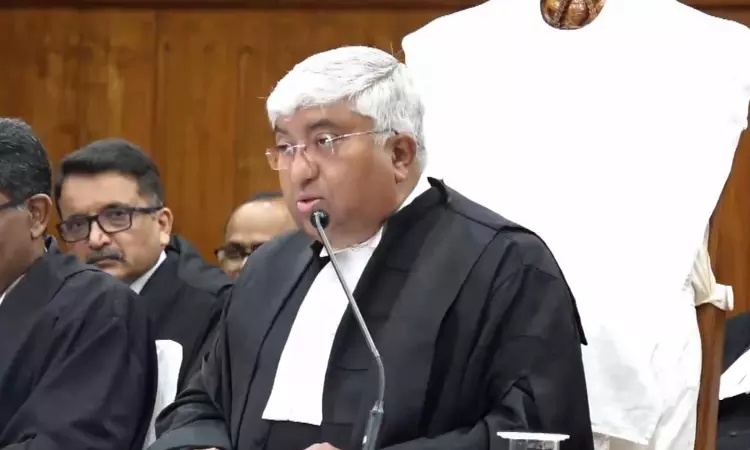
The Kerala High Court on Monday (12 January) welcomed Justice Soumen Sen, who assumed office as the 40th Chief Justice of the Kerala High Court, in a full court reference attended by judges, members of the Bar.Chief Justice Soumen Sen, beginning with a greeting in Malayalam, expressed deep gratitude for the warmth and affection extended to him. Reflecting on his journey from Calcutta,...
This is a premium content
Available exclusively to
Our subscribers
Subscribe Premium 
INR 1099+GST
Your support helps us to bring you more content at
an affordable subscription scheme !!!
All payment options available
The Kerala High Court on Monday (12 January) welcomed Justice Soumen Sen, who assumed office as the 40th Chief Justice of the Kerala High Court, in a full court reference attended by judges, members of the Bar.
Chief Justice Soumen Sen, beginning with a greeting in Malayalam, expressed deep gratitude for the warmth and affection extended to him. Reflecting on his journey from Calcutta, “the confluence of culture”, to Meghalaya, “the abode of clouds,” and now to Kerala, “God's Own Country,” he said his assumption of office was marked by humility and a profound sense of responsibility.
Justice Sen emphasized that his foremost duty is to uphold the independence of the judiciary and ensure that Justice is accessible, timely and meaningful.
“As a Chief Justice, my foremost duty will be to uphold the independence of the judiciary and ensure that Justice is accessible, timely and meaningful. We must continue to embrace technology, strengthen judicial infrastructure and promote transparency in all processes. Equally important is the need to nurture harmony between the bench and the bar for together we form the pillar upon which justice rests.” Justice Sen said.
Justice Sen paid tribute to Kerala's unique legal and constitutional tradition, describing the State as a “jurisprudential laboratory” that significantly shaped Indian constitutional law.
“While the house of justice are often seen as rigid and tradition bound. The Kerala High Court has proven itself to be a vibrant laboratory of judicial innovations. The bench and the bar of Kerala High Court enjoy an unrivaled reputation for deep legal knowledge, impeccable integrity, sound without flamboyance..” he stated
He recalled the contributions of stalwarts such as Justice V.R. Krishna Iyer, Justice K.K. Mathew, Justice Anna Chandy, Justice Fathima Beevi, and Justice K.G. Balakrishnan, noting Kerala's pioneering role in advancing social justice, human dignity, gender equality, and constitutional innovation, including the evolution of the basic structure doctrine.
He stressed the importance of technology, transparency, strong judicial infrastructure, and harmonious cooperation between the Bench and the Bar.
Reaffirming his commitment to the highest ideals of justice, Chief Justice Sen concluded by stating that justice must not only be done but must also be seen to be done for every citizen, without fear or favour.
Justice Sen practiced as an advocate in the Calcutta High Court for 20 years on both original and appellate side and also before other courts and tribunals. He appeared in a wide range of matters, including civil, constitutional, banking, and arbitration cases, representing authorities such as the RBI, SEBI, SIDBI and was also designated as Senior Advocate.
He was as appointed as Judge of Calcutta High Court on 13 April 2011 and was appointed as the acting Chief Justice of Calcutta High Court consequent upon the retirement of the then Chief Justice T. S. Sivagnanam on 15 September 2025.
He was appointed as Chief Justice of Meghalaya High Court 26 September 2025.
Justice Sen was sworn in as the 40th Chief Justice of Kerala High Court on January 10.
Speaking on behalf of the judges of the High Court, Dr. Justice Jayasankaran Nambiar described Justice Sen as an accomplished jurist with expertise in constitutional, civil, and commercial law. He observed that Justice Sen takes charge of the Kerala High Court at a time when the judiciary's role in upholding the rule of law, protecting fundamental rights, and maintaining public confidence is more vital than ever. He lauded the Kerala High Court's tradition of judicial independence, technological innovation, social sensitivity, and a strong Bar known for its intellectual rigour and ethical standards.
Advocate General K. Gopalakrishna Kurup, in his address, highlighted the deep cultural, literary, and historical links between Kerala and Bengal, observing that despite the geographical distance, the two States share remarkable similarities. From a passion for football, cinema, literature, and marine cuisine to Kerala's long-standing admiration for Bengali literary and cinematic traditions, the Advocate General noted that the relationship transcends geography and finds resonance in culture, art, and collective memory.
He recalled how generations of Malayalis were introduced to classical Bengali literature through Malayalam translations of Rabindranath Tagore's Gitanjali and to world cinema through the works of Satyajit Ray, Ritwik Ghatak, and Mrinal Sen. Despite such intrinsic connections and despite judges from Kerala having earlier served as Chief Justices of the Calcutta High Court, he noted that it took nearly seven decades for a former judge of the Calcutta High Court to assume office as Chief Justice of the Kerala High Court.
Welcoming Justice Sen, the Advocate General traced his distinguished lineage and illustrious legal career.
Advocate Generate stated that though his tenure in Meghalaya was brief, it was marked by exceptional judicial efficiency, with the disposal of nearly 60 cases and delivery of around 300 orders. The Meghalaya Bar fondly recalled him for his simplicity, humility, courtesy, and human touch.
Peeeyus A. Koottam, President of the Kerala High Court Advocates Association, welcomed Justice Sen on behalf of the Bar, describing him as a distinguished jurist shaped by the rich traditions of the Calcutta High Court. He expressed confidence that Justice Sen's leadership, legal acumen, empathy, and human sensitivity would further strengthen the justice delivery system in Kerala. He also noted the symbolic significance of the presence of Justice Sen's father at the ceremony, calling it a moment of pride for both the family and the institution.

Anamika MJ
Anamika MJ is a Correspondent with LiveLaw, covering Kerala High Court

