



- Home
- /
- High Courts
- /
- Kerala High Court
- /
- Kerala High Court Directs FIR...
Kerala High Court Directs FIR Against Ex-CM Pinarayi Vijayan, Daughter Based On ED Information In CMRL-Exalogic Case
K. Salma Jennath
9 Oct 2026 10:23 AM IST
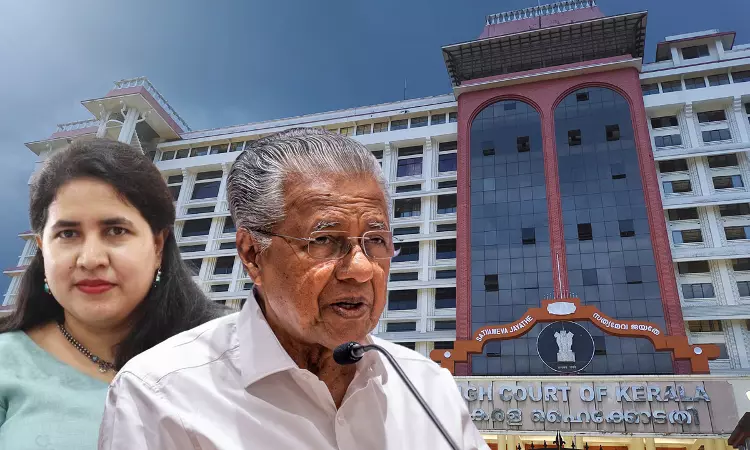
The Kerala High Court on Friday (October 9) directed the Vigilance and Anti-Corruption Bureau to register an FIR incorporating offences under the Prevention of Corruption Act against Leader of Opposition Pinarayi Vijayan, his daughter Veena and son-in-law Mohammed Riyas in the CMRL-Exalogic payoff case. [2026 LiveLaw (Ker) 567]Justice A. Badharudeen further held that the government's decision...
This is a premium content
Available exclusively to
Our subscribers
Subscribe Premium 
INR 1099+GST
Your support helps us to bring you more content at
an affordable subscription scheme !!!
All payment options available
The Kerala High Court on Friday (October 9) directed the Vigilance and Anti-Corruption Bureau to register an FIR incorporating offences under the Prevention of Corruption Act against Leader of Opposition Pinarayi Vijayan, his daughter Veena and son-in-law Mohammed Riyas in the CMRL-Exalogic payoff case. [2026 LiveLaw (Ker) 567]
Justice A. Badharudeen further held that the government's decision to conduct preliminary enquiry without registration of FIR is illegal considering the facts of the case since the Directorate of Enforcement passed on information regarding commission of PC Act offences while investigating offences under the Prevention of Money Laundering Act [PMLA].
"The decision of the Government to form a Special Team to conduct enquiry...without registering FIR is found illegal in the facts of the case and therefore, the same is set aside. Consequently,...the Director, Vigilance and Anti-Corruption Bureau, Thiruvananthapuram, is specifically directed to register FIR based on the information furnished under Section 66(2) of the PMLA for the offences disclosed therein under the PC Act, against the suspected persons specifically mentioned therein, forthwith, without any delay, and to investigate the allegations through competent officers of the Vigilance and Anti- Corruption Bureau and file the final report, without much delay."
It reasoned:
"When the information furnished by the Directorate of Enforcement, Cochin Zonal Office, under Section 66(2) of the PMLA...is considered in its entirety, it contains sufficient primary materials disclosing, the commission of cognizable offences under the PC Act by the persons referred to in the information...in the facts and circumstances of this case, no further enquiry is required in the instant case and the matters disclosed in the information under Section 66(2) of the PMLA make it obligatory for the State Police to register the FIR, ruling out the scope of any other enquiry."
The Court also directed the officer heading the SIT to hand over the information to the VACB director. The ED is directed to forward all necessary documents to the VACB. It was made clear that the VACB director is free to call for any other documents required for the purpose of investigation after registering FIR.
Last week, the Court had heard detailed arguments raised by Advocate General K. Jaju Babu, Advocate V. Sethunath for the petitioner as well as Jaishankar V. Nair who appeared for the ED. It had then reserved its verdict.
Factual Background
In the ED case, the allegation is that from 2017 to 2020, CMRL (Cochin Minerals and Rutile Ltd.), a public company, made monthly payments totalling ₹1.72 crores to Exalogic Solutions Pvt. Ltd., associated with Veena T, without any actual services being rendered.
Earlier this year, the plea preferred by the accused CMRL officials to quash the ED case was dismissed by the Single Bench as well as the Division Bench.
According to the present plea, on August 19, the ED issued a press release stating that it had collected evidence regarding hawala transactions to the tune of crores in the case and thereby, offences under the Prevention of Money Laundering Act have also been committed by the accused persons.
It is further stated that on September 7, the ED sent a letter to the Kerala Director General of Police to register an FIR under the PC Act against Pinarayi, Veena and Riyas. However, the Home Secretary issued an order to the State Police Chief to entrust the case to Crime Branch and to constitute a Special Investigation Team for preliminary enquiry and accordingly, an order was passed by the Police Chief, it is stated.
In the plea, it is stated that the State government sought the legal opinions of the Advocate General, the Additional Advocate General as well as the Director General of Prosecution, all of whom recommended immediate registration of FIR but the government went ahead to order preliminary enquiry anyway.
The plea prays for consideration of his complaints within a timeframe fixed by the Court. There is also a prayer to direct transferring of the case to the Vigilance and Anti-Corruption Bureau for registering an FIR incorporating PC Act offences.
Arguments raised
The ED as well as the petitioner had argued that there was no scope for preliminary enquiry in the facts of the present case and the State police ought to have registered an FIR at once. The petitioner also pointed out that in the present case, a Special Investigation Team was formed without a member of a Vigilance department and that cannot be done without a Cabinet decision. He contended that this was the law as provided for by a government order.
ED's counsel had also submitted that information was shared with the State Police Chief regarding commission of offences during the course of an investigation. He added that the ED came across materials showing certain transactions, which needed to be investigated, by the State Police or the Vigilance as the case maybe, as these were the predicate offences.
The AG argued that if the investigation agency feels that some verification is required, a preliminary enquiry is desirable. He also pointed out that ED is not an investigating agency like police but is only an information collecting agency. The AG also contended that the present plea is premature and it is not maintainable.
Court's observations
During the hearing of the case, the Court had observed that the legal question to be considered was whether the State police is bound to register an FIR without preliminary enquiry when an information under Section 66(2) of the PMLA [Prevention of Money Laundering Act] Act has been passed by the ED.
The answer to the same was also clarified:
"A preliminary inquiry is not mandatory if the information received by the police officer/Investigating Agency discloses the commission of a cognizable offence. However, if the preliminary inquiry is conducted, its scope is limited to determine whether the information prima facie reveals commission of a cognizable offence and does not extend to verifying its truthfulness. The necessity of a preliminary inquiry depends on the specific facts and circumstances of each case...Most importantly, the scope of a preliminary inquiry is limited to situations where the information received does not prima facie disclose a cognizable offence but requires verification. However, in cases where the information clearly discloses a cognizable offence, the police have no discretion to conduct a preliminary inquiry before registering an FIR."
It added that 2013 decision in Lalita Kumari v. State of UP does not make it a mandate to conduct preliminary enquiry in every case before FIR registration but only reaffirms that the police is obligated to register FIR when receiving information which prima facie discloses a cognizable offence.
"in a nutshell, when an information under Section 66(2) of the PMLA is forwarded for registering FIR based on the inputs in the investigation initiated by the E.D. disclosing commission of a scheduled offence or offences for which State Police is only having competence to register FIR, it is obligatory (must do) for the State Police to register FIR for the offences disclosed in the information passed under Section 66(2) of the PMLA. But, this obligation is subject to an exemption. That is to say, the disclosure by the Enforcement Directorate would not exempt the notified government agencies from undertaking an independent evaluation to ascertain whether the accused has contravened any statutory provisions, when the information passed under Section 66(2) of the PMLA lacks materials to register FIR; i.e. which did not disclose inputs for registering FIR. Thus, exemption comes into play only on the basis of the facts and circumstances of each case and the scope for addition to the information communicated under Section 66(2) of the PMLA by way of another enquiry without registering FIR is too remote and trivial," the Court said.
Thus, it allowed the plea.
Counsel for the petitioner: V. Sethunath, Thomas Abraham and Shamnas S
Counsel for the respondents: K. Jaju Babu - Advocate General, Jaishankar V. Nair - Standing Counsel - Directorate of Enforcement
Tags

K. Salma Jennath
Salma Jennath is a Principal Correspondent with LiveLaw, covering Kerala High Court

