Merely Because Paddy Land Was Left Fallow, It Cannot Be Treated As Converted Land : Kerala High Court
Anamika MJ
26 Nov 2026 8:22 PM IST
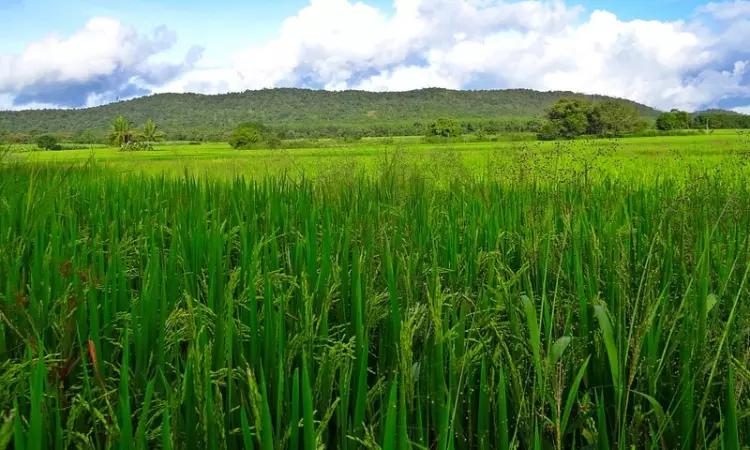
The Kerala High Court has held that land suitable for paddy cultivation but left uncultivated and fallow continues to fall within the definition of 'paddy land' under the Kerala Conservation of Paddy Land and Wetland Act, 2008.
The Court clarified that the mere fact that a paddy field has remained fallow cannot be a ground to treat it as converted land. [2026 LiveLaw (Ker) 654]
Justice Bechu Kurian Thomas delivered the judgment.
The Court was considering two petitions, one challenging a Government order directing restoration of allegedly reclaimed paddy land in Ramankary Village, Alappuzha and a connected writ petition by Adv. Anil Kumar seeking implementation of the restoration order.
The Court took the petition challenging the Government order directing the restoration as the lead case.
The dispute concerned 12 Ares of land situated in Re-survey No. 269/1 of Ramankary Village, which was part of a Padasekharam and included in the official data bank as paddy land. The dispute originated from allegations that a portion of the petitioner's property had been reclaimed by filling it with gravel and other materials


A stop memo had been issued by the Village Officer, alleging that an extent of 67. 45 Ares of property had been attempted to be converted. Meanwhile, the Revenue Divisional Officer had also initiated proceedings following a complaint by Anilkumar.
Although the District Collector had initially declined to order restoration through an order dated February 10, 2016, the matter subsequently reached the State Government in revision proceedings.
The Government initially passed an order in February 2020, which concluded that the subject property was part of the “Thenamkap Eastern Padasekharam'. This order was set aside by the High Court in July 2020 in a petition challenging the government order and has directed reconsideration of the matter.
Following reconsideration, the Government issued the impugned order dated February 11, 2022, finding that the land had been unauthorisedly converted after 2008.
The landowner contended that the property had been converted nearly ten years before the enactment of the 2008 Act and, therefore, could not be treated as paddy land under the statute. It was also argued that the presence of banana plants and coconut trees indicated that the property had already been converted.
The respondent submitted that due to the unauthorised reclamation of paddy land by the petitioner, paddy cultivation in the adjacent property was being adversely affected. It was also submitted that, in the year 2009 - 10, the petitioner has collected amounts from the Government for cultivation of paddy on land which was left fallow. It further submitted that the petitioner had obtained compensation for loss of paddy cultivation in the year 2008 - 09, which was processed after the Agricultural Officer verified the claim.
At the outset, the Court noted that the impugned order was issued after considering the reports and also opportunity of hearing to the petitioner.
The Court noted that, previously the Court had set aside the Government order directing restoration while directing reconsideration by the Government and has also observed that the report of the Convenor of the Local Level Monitoring Committee should be called to consider whether the property in question would fulfill the definition of paddy land.
The Court noted that definition of 'paddy land' under Section 2(xii) of the 2008 Act includes all types of land situated in the State where paddy is cultivated at least once in a year or suitable for paddy cultivation but uncultivated and left fallow, and includes its allied constructions like bunds, drainage channels, ponds and canals.
The Court observed that the statutory definition includes land where paddy is cultivated at least once a year, as well as land suitable for paddy cultivation but left uncultivated or fallow.
The Court thus held that merely leaving paddy land fallow cannot be a reason to treat it as converted land.
“A perusal of the above definition indicates that even though a paddy land is left fallow, the same is not a reason to treat it as a converted land.Thus, even a land that left fallow, would still fall within the definition of paddy land. Hence the only question is whether the property was converted prior to 2008.” Court noted.
The Court thereafter examined whether the property had actually been converted before the commencement of the Act on August 12, 2008. It noted that the Village Officer's report claiming that the land had been converted around ten years earlier was not supported by any material. On the other hand, a stop memo had been issued in May 2008 directing the landowner's mother to stop attempts to convert the property.
The Court also considered the report of the Additional Tahsildar, which recorded the presence of coconut trees, saplings and other plants that were approximately five years old. The Court observed that the age of the trees did not support the claim that the reclamation had taken place before 2008.
The Court took note of records indicating that the landowner had applied for Government benefits for paddy cultivation for the year 2008-09 and that compensation for loss of paddy cultivation had also been obtained for 2010-11.
The Court also observed that the property formed part of a Padasekharam, with adjoining paddy fields, and that unauthorised reclamation could adversely affect neighbouring agricultural lands and farmers dependent on paddy cultivation.
Emphasising the legislative objective behind the 2008 Act, the Court observed that the legislation was introduced to conserve paddy lands, regulate their reclamation and conversion, promote agriculture and protect the ecological system of the State. The Court noted that conversion of paddy fields had resulted in ecological degradation, affecting soil fertility, water levels and the overall environmental balance.
“The agrarian reform envisioned by the State Legislature by introducing the Act of 2008, is on the basis of an agricultural policy which is intended to advance the object of protecting the paddy fields from being converted and utilized for other purposes, thus reducing the paddy cultivation and affecting the interests of the State and the citizens of the State at large. These avowed objectives of the Statute cannot be ignored.” the Court noted.
The Court further held that the Local Level Monitoring Committee's decision to remove the disputed 12 Ares from the data bank was not legally sustainable, as the Committee had failed to verify the actual status of the property as on August 12, 2008.
The Court found that there was no patent illegality or procedural irregularity in the Government's decision, and declined to interfere with the impugned order.
Accordingly, the Court dismissed writ petition challenging the government order directing restoration and allowed the petition directing the concerned authorities to take immediate steps to restore the reclaimed paddy land by implementing the Government order dated February 11, 2022.
Case Title: Bijulal Viswanathan v State of Kerala and ors., Adv. AnilKumar M.S v State of Kerala and ors.
Case No: WP(C) 13910/ 2023, WP(C) 27500/ 2024
Citation: 2026 LiveLaw (Ker) 654
Counsel for Petitioner in WP(C) 13910/ 2023 : Millu Dandapani, Thomas C. Abraham, Ronit Zachariah
Counsel for Petitioner in WP(C) 27500/ 2024: Lindons C. Davis, E.U. Dhanya, N.S. Shamila, Chinju P. Joyies