



- Home
- /
- High Courts
- /
- Madhya Pradesh High Court
- /
- Long Cohabitation As Husband & Wife...
Long Cohabitation As Husband & Wife Raises Strong Presumption Of Valid Marriage, Heavy Burden On Party Challenging It: MP High Court
Jayanti Pahwa
8 Sept 2026 9:45 PM IST
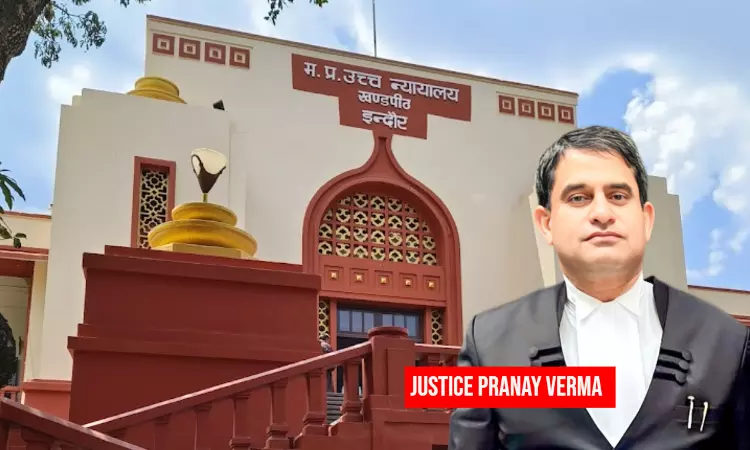
The Madhya Pradesh High Court has held that where a man and woman have lived together for a long period as husband and wife, the legal presumption would favour the legitimacy of their marriage rather than its illegitimacy. [2026 LiveLaw (MP) 353]The bench of Justice Pranay Verma stated:"There is no one in the village except defendant no.2, who does not treat defendant nos.1 and 3 as husband...
This is a premium content
Available exclusively to
Our subscribers
Subscribe Premium 
INR 1099+GST
Your support helps us to bring you more content at
an affordable subscription scheme !!!
All payment options available
The Madhya Pradesh High Court has held that where a man and woman have lived together for a long period as husband and wife, the legal presumption would favour the legitimacy of their marriage rather than its illegitimacy. [2026 LiveLaw (MP) 353]
The bench of Justice Pranay Verma stated:
"There is no one in the village except defendant no.2, who does not treat defendant nos.1 and 3 as husband and wife. The presumption would always be for legitimacy of the marriage rather than being for its illegitimacy. In the earlier suit, defendant no.2 had addressed defendant no.3 as illegal wife of defendant no.1. No evidence has been led by defendant no.2 to show that Rajiya was not wife of defendant no.1. The plaintiffs have thus satisfactorily proved that defendant no.3 was legally wedded wife of defendant no.1".
The dispute arose from the claim of the plaintiffs that they were sons of Dhunna through his wife Rajiyabai. Dhunna had earlier been married to Nimiya, who had died. According to the plaintiffs, Dhunna had married Rajiyabail under the Kari form of marriage, and the plaintiffs were both from said relationship.
The plaintiffs claimed a share in the Dhunna property, but the defendants disputed the marital status of plantiffs' mother with Dhunna. It was contended that plaintiffs' mother was not the legally wedded wife of Dhunna and that the plaintiffs were illegitimate children.
The trial court had partly decreed the plaintiffs' claim, but the first appellate court modified the decree and held that the plaintiffs had 2/5th share in the lands as well as the house and were entitled to symbolic possession. The defendant thereafter approached the High Court in a second appeal.
The appellant before the High Court argued that the plaintiffs had failed to prove that Dhunna and Rajiyabai had undergone marriage under the Kari System. Therefore, a presumption of a valid marriage cannot be drawn merely from cohabitation.
The court, however, found that the evidence established that Dhunna and Rajiyabai had lived together for a considerable period as husband and wife. The court noted that they had resided together for 26 years.
Referring to the case of Chowdamma v Venkatappa, the bench reiterated that a strong presumption arises in favour of wedlock where a couple has lived together for a long period as husband and wife.
The bench further noted that the finding that Dhunna and Rajiyabai were living as husband and wife is impeachable and cannot be interfered with at this stage. Therefore, the bench upheld the decree of the appellate court and dismissed the appeal.
Case Title: Fulla v Munna, SA-1018-1999
Citation: 2026 LiveLaw (MP) 353
For Appellant: Advocate Nitin Kumar Agrawal
For Respondents 1 and 2: Advocate Sanjeev Tuli
Tags
Jayanti Pahwa
Jayanti Pahwa is a Correspondent with LiveLaw, covering the Madhya Pradesh High Court

