



- Home
- /
- High Courts
- /
- Madhya Pradesh High Court
- /
- MP High Court Restores Permission...
MP High Court Restores Permission For Muharram Procession And Fair In Indore
Jayanti Pahwa
27 Jun 2026 6:00 AM IST
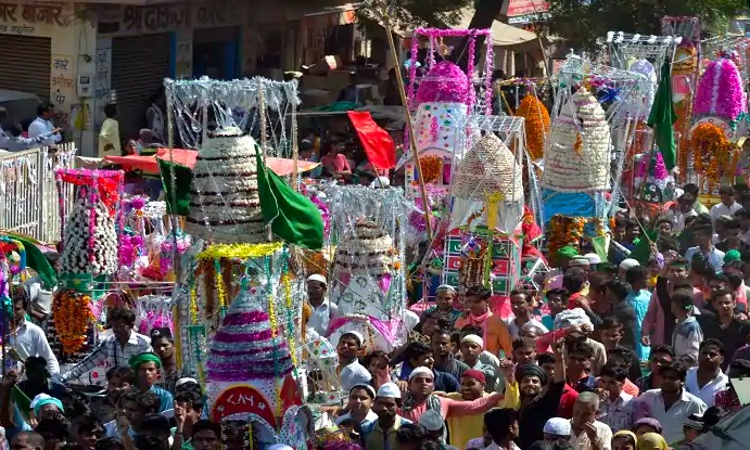
The Madhya Pradesh High Court has set aside a resolution passed by the Mayor-in-Council (MIC) of the Indore Municipal Corporation revoking the permission for a traditional Taazia procession on the occassion of Muharram and three-day fair (mela) at the Dhobi Ghat, restoring the permission originally granted by the civil body. [2026 LiveLaw (MP) 236]For context, the Taazia procession is a...
This is a premium content
Available exclusively to
Our subscribers
Subscribe Premium 
INR 1099+GST
Your support helps us to bring you more content at
an affordable subscription scheme !!!
All payment options available
The Madhya Pradesh High Court has set aside a resolution passed by the Mayor-in-Council (MIC) of the Indore Municipal Corporation revoking the permission for a traditional Taazia procession on the occassion of Muharram and three-day fair (mela) at the Dhobi Ghat, restoring the permission originally granted by the civil body. [2026 LiveLaw (MP) 236]
For context, the Taazia procession is a religious event held during the Islamic month of Muharram, wherein elaborated, handcrafted replicas of the mausoleum of Imam Husayn are commemorated to commemorate the tragic battle of Karbala.
The bench of Justice Pavan Kumar Dwivedi observed that the application seeking permission was given by the petitioner organization on 03.06.2026 which is evident from the earlier order dated 25.06.2026 itself.
However, the concerned officer waited till 25.06.2026 for granting permission for holding Mela from 26.06.2026 to 28.06.2026 and then this permission was withdrawn by the MIC without giving any notice to the petitioner in the night of 25.06.2026. It is only during the day of 26.06.2026 when the Mela has already begun, the petitioner came to know about the cancellation of the permission.
"In the considered view of this Court, the manner in which the entire issue has been handled by the Municipal Corporation is not in accordance with the proper administrative decision-making process. In all fairness, if the request was for granting permission to hold Mela from 26.06.2026 then the decisions on the same, after considering each and every aspect, should have been made well before the said date, so that if any issue crops up then the same could have been held in timely manner...
In the considered view of this Court looking to the fact that without giving an opportunity, the order passed by the competent authority has been cancelled to the prejudice of the petitioner, the petition deserves to be allowed. Consequently, the Resolution of the MIC dated 25.06.2026 is hereby quashed".
Per the petition, the committee has been organising a religious Taazia procession along with a mela at Dhobi Ghat every year after obtaining permission from the concerned authority. For 2026, the committee applied for the permission, which was granted on June 25, 2026, subject to the payment of fees of ₹1,36,007. The permission was granted, and the fair was to be held from June 26 to 28, 2026.
The petitioner alleged that later on the same evening, the Mayor-in-Council passed a resolution withdrawing the permission, on the grounds that their application did not comply with the conditions imposed during the previous year's events and due to non-payment of certain fees.
The counsel for the Committee argued that no opportunity of hearing was provided to them before the permission was revoked. It was also claimed that all dues were paid and no notice regarding any violation was ever issued to the committee.
Opposing the plea, the counsel for the Municipal Corporation argued that the matter was already addressed in earlier civil proceedings and that historically only a small portion of it was used for Taazia immersion rather than for conducting a fair.
The counsel also claimed that the conditions which were imposed during the previous year's mela permission had been violated and that the decision to withdraw the permission was taken in the larger public interest, as the cooperative society of other communities had opposed holding Mela in the area for which permission was granted.
The court noted that a competent officer of the corporation, after considering the application, granted permission subject to the deposit of the prescribed amount. The bench further noted that the saif fee was for holding the Mela and for immersion of Taazia at Dhobi Ghat in an area of 3 acres. The court noted that the permission order itself notes the traditional nature of the mela.
The court noted that the permission order nowhere mentions the aforesaid conditions, and the order also does not record any violations of such conditions during last year's event. Therefore, the bench held that there was no material to demonstrate that on the last occasions, any conditions were violated by the committee.
With respect to the mela the court, after considering the urgency of the matter, the noted the lack of time to decide the character of the mela and therefore held,
"there is no time to decide the larger issue regarding character of the mela whether it is traditional in nature or not, in any case in the considered view of this court these proceedings may not be proper forum for deciding that whether the Mela is being traditionally held or not. However, the permission itself as quoted above gives a traditional colour to the Mela".
Regarding the right of the petitioner to hold Mela, the court refrained from elucidating on this issue, considering that the permission for this year was already granted. Further, the court noted this case to be one of legitimate expectations since the permission was granted on June 25 for an event that was about to start on the following day, June 26. Therefore, the court held that the resolution of MIC should be quashed and the petition should be permitted.
Further, the court issued the following directions for future:
"(i) From the next year onwards, the petitioner shall submit its application for permission to hold precession and Mela well in advance at least by two and a half months.
(ii) The Municipal Corporation shall decide the said application at least before 30 days of start of the Mela".
The petition was disposed of.
Case Title: Waqf Karbala Intejamia Committee v State of Madhya Pradesh, WP-24236-2026
Citation: 2026 LiveLaw (MP) 236
Tags
Jayanti Pahwa
Jayanti Pahwa is a Correspondent with LiveLaw, covering the Madhya Pradesh High Court

