



- Home
- /
- High Courts
- /
- Madhya Pradesh High Court
- /
- Non-Disclosure Of Pending Criminal...
Non-Disclosure Of Pending Criminal Case In Panchayat Poll Nomination Form Justifies Election Annulment: MP High Court
Jayanti Pahwa
1 Sept 2026 7:15 PM IST
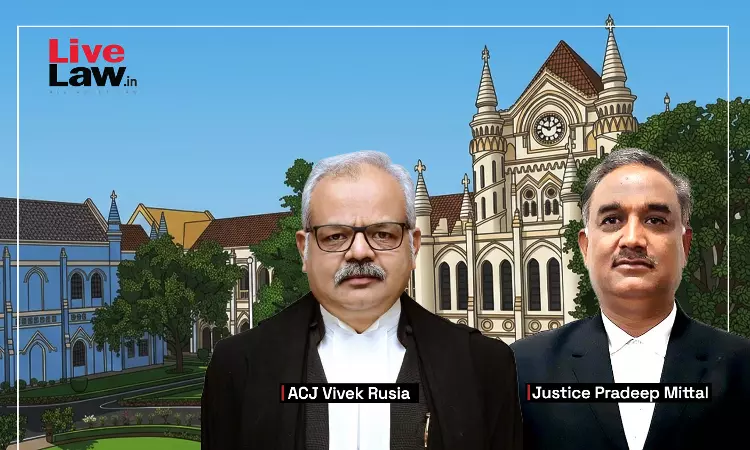
The Madhya Pradesh High Court has held that non-disclosure of pending criminal cases in a nomination form filed for Panchayat Elections is a valid ground for annulment of elections. [2026 LiveLaw (MP) 347]The division bench of Acting Chief Justice Vivek Rusia and Justice Pradeep Mittal observed:"In the present case, the omission on the part of the appellant cannot be treated as a mere...
This is a premium content
Available exclusively to
Our subscribers
Subscribe Premium 
INR 1099+GST
Your support helps us to bring you more content at
an affordable subscription scheme !!!
All payment options available
The Madhya Pradesh High Court has held that non-disclosure of pending criminal cases in a nomination form filed for Panchayat Elections is a valid ground for annulment of elections. [2026 LiveLaw (MP) 347]
The division bench of Acting Chief Justice Vivek Rusia and Justice Pradeep Mittal observed:
"In the present case, the omission on the part of the appellant cannot be treated as a mere minor discrepancy or technical defect. The appellant suppressed material information regarding the pendency of a criminal case and his liability towards payment of dues to the Government. Such suppression of material facts goes to the root of the matter and cannot be treated as a minor irregularity in the nomination form or affidavit. Therefore, the number of votes secured by the appellant is of no consequence when the election is challenged on the ground of suppression of material facts".
A writ appeal was filed by Raj Mani Patel Mishri Lal against the order of March 18, 2026, wherein the Single Judge had dismissed his writ petition.
Per the appellant, his nomination papers were duly examined and accepted by the Returning Officer following the applicable election rules, and no objection was raised by the independent candidate, Suresh Tripathi (respondent no 3), or any other candidate.
The appellant thereafter secured 2,174 votes as against 1672 votes secured by respondent no 3. However, after the elections, respondent no 3 challenged the appellant's election on the grounds of material suppression of facts. The alleged suppression was related to criminal cases and default of cooperative bank dues and liability arising out of proceedings concerning Jal Upbhogta Sansthan, and non-disclosure of certain financial and property-related information.
The appellant denied such allegations and submitted that he was acquitted of the said criminal cases, had cleared the bank dues, and had already taken appropriate proceedings against the actions of the Mining Department.
Per the appellant, the respondent no 3 failed to establish any alleged defect or omission in the nomination papers that could materially affect the result.
The appellant further contended that the District Collector, acting as the Election Tribunal, was required to conduct an enquiry under Section 122 of the Madhya Pradesh Panchayat Raj Avam Gram Swaraj Adhiniyam, 1993. However, the District Collector directed the Sub Divisional Officer of Revenue to conduct the enquiry and submit a report, which was impermissible and therefore vitiated the proceedings therein.
The appellant also contended that the Sub Divisional Officer conducted the enquiry ex parte and that no notice or copy of the enquiry was supplied to him. Per the appellant, the report substantially reproduced the allegations levelled by respondent no 3 without independent findings. Thus, the actions of the Election Tribunal in voiding the appellant's election solely based on said enquiry report were impermissible.
The appellant further submitted that the Election Tribunal passed a cryptic, non-speaking order without recording specific findings. He further submitted that since he was acquitted in criminal cases much prior to the elections, the Election Tribunal erred in treating him as a person with criminal antecedents.
The respondents claimed that the appellant's failure to disclose complete and material information required under Rule 31A (2) of the Madhya Pradesh Panchayat Nirvachan Niyam, 1995. Respondent no 3, supporting the Election Tribunal's decision, submitted that the appellant had suppressed material information and therefore was not eligible to contest elections.
Respondent no 3 also produced a notice dated June 4, 2022, and the reply of June 22, 2022, relating to the externment proceedings initiated against the appellant. The State also supported the order of the Election Tribunal, arguing that the appellant failed to disclose material information that was mandatorily required.
The Single Judge, after considering the submission, held,
"the absence of an objection at the stage of scrutiny does not bar a subsequent challenge to the improper acceptance of a nomination under Rule 21 of the Election Petition Rules, 1995. It was further held that Rule 31-A of the Nirvachan Rules, 1995 is mandatory and that noncompliance therewith, including failure to disclose relevant criminal antecedents, may render a nomination liable to rejection".
Aggrieved, the appellant approached the High Court, arguing that the alleged omissions in his nomination papers could not justify invalidating the elections, particularly since he won by a substantial margin.
The bench noted that Rule 31A of the 1995 Rules mandates disclosure of prescribed particulars, including pending criminal cases. In the present case, the crime was pending on June 4, 2022, when the appellant filed his nomination, and he was finally acquitted on October 13, 2022. The court held,
"The failure to disclose the pendency of the said case amounted to non-compliance of the mandatory requirement of Rule 31-A. Consequently, the nomination paper was liable to be rejected at the threshold, and its acceptance by the Returning Officer was improper. The subsequent acquittal does not cure the omission, as the relevant date for disclosure was the date of filing of the nomination".
Rejecting the argument that disclosure is only required in case of convictions and the number of pending criminal cases, the court noted that the appellant mentioned "NIL" in both columns and that there were pending criminal cases against the appellant on the date of filing the nomination form.
The bench emphasized, "Therefore, the contention of the appellant that Column No. 12 was correctly filled in as “Nil” is not acceptable. The failure to disclose the pending criminal case amounts to suppression of material facts".
Additionally, the court observed that the appellant was granted a reasonable opportunity of hearing before the Collector and thus, it cannot be said that the Collector's order was passed in violation of principles of natural justice.
The court also took note of other alleged non-disclosures, noting that the appellant had failed to disclose a recovery order of ₹13 lakhs issued by the Executive Engineer and a penalty of ₹2 lakhs imposed under the Mines and Minerals Development and Regulation Act of 1956, including whether the penalty had been deposited.
Regarding the appellant's objection that the Collector had called a report from the SDO, which was not permissible, the bench noted that the Collector had applied its independent mind and taken a decision and did not merely act upon the report submitted by the SDO.
The bench rejected the appellant's argument that the said non-disclosure did not involve serious offences and therefore was not required. The court clarified that the criminal cases against the appellant were for obscenity, criminal intimidation, causing hurt to extort property, and voluntarily causing hurt, which are substantive offences.
The court also did not accept the appellant's contention that he won by a substantial margin. The court clarified that the appellant's omission cannot be treated as a minor discrepancy, and such non-disclosure goes to the root of the matter; therefore, the number of votes secured is of no consequence.
Accordingly, the bench held that the order of the Single Judge did not suffer from any illegality or error. Thus, the appeal was dismissed.
Case Title: Raj Mani Patel Mishri Lal v State of Madhya Pradesh, WA-2757-2026
Citation: 2026 LiveLaw (MP) 347
For Appellant: Advocate Praveen Dubey
For State: Government Advocate Anubhav Jain
For Respondent no 3: Advocate Bhagwan Singh Thakur
Tags

Jayanti Pahwa
Jayanti Pahwa is a Correspondent with LiveLaw, covering the Madhya Pradesh High Court

