



- Home
- /
- High Courts
- /
- Madras High Court
- /
- Can Persons Who Convert To...
Can Persons Who Convert To Christianity Claim “Most Backward Class” Reservation? Madras High Court To Examine
Upasana Sajeev
12 Nov 2026 9:16 PM IST
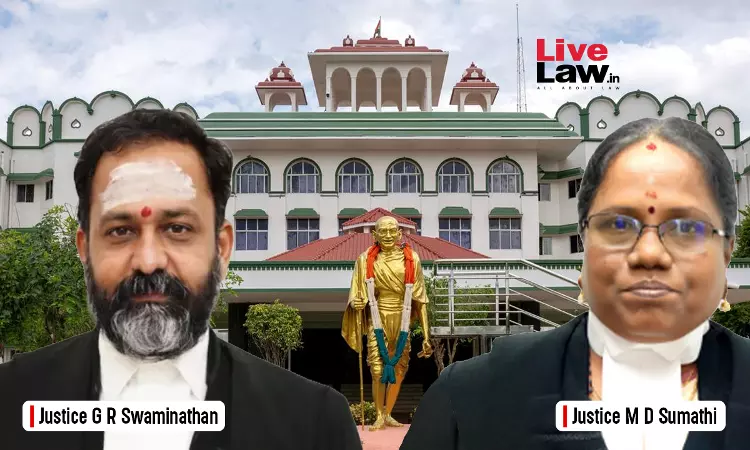
The Madras High Court is set to examine whether a person who converts to Christianity can continue to claim reservation as “Most Backward Class”. “There is nothing axiomatic or eternal about one's OBC status. A clear case has to be made out for inclusion or retention in the OBC list. Merely because some entities have enjoyed the privilege of reservation for a few decades, would...
This is a premium content
Available exclusively to
Our subscribers
Subscribe Premium 
INR 1099+GST
Your support helps us to bring you more content at
an affordable subscription scheme !!!
All payment options available
The Madras High Court is set to examine whether a person who converts to Christianity can continue to claim reservation as “Most Backward Class”.
“There is nothing axiomatic or eternal about one's OBC status. A clear case has to be made out for inclusion or retention in the OBC list. Merely because some entities have enjoyed the privilege of reservation for a few decades, would that necessarily mean that the original inclusion was constitutionally justified? We answer in the negative. As and when a challenge is mounted, the Government is obliged to demonstrate to the Court's satisfaction that inclusion or retention of the concerned entity in the OBC list is constitutionally warranted or justified,” the court observed.
The bench of Justice GR Swaminathan and Justice MD Sumathi has issued notice to the Backward Classes, Most Backward Classes and, Minorities Welfare Department, the Human Resources Management Department, the Tamil Nadu Backward Classes Commission, and the Secretary of Tamil Nadu Public Service Commission.
“Therefore, the petitioner argues that placing the backward classes on the same pedestal as those who have not been empirically shown to be backward amounts to treating unequals equally…In view of the aforesaid submissions of the Petitioner, we are satisfied that the petitioner has established a prima facie case that warrants deep constitutional scrutiny,” the court said.
The notice has been issued on a plea challenging specific entries in Schedule I to the Tamil Nadu Government Servants (Conditions of Service) Act, 2016, which collectively confer Backward Class or Most Backward Class status on various Christian communities and converts to Christianity.
The petitioner argued that through the entries, the reservation pool that is meant for genuinely backward classes is being unconstitutionally diluted by the inclusion of various Christian denominations and converts, who have never been subjected to any empirical test of social and educational backwardness as mandated by Article 16(4) of the Constitution of India.
Placing the historical facts, the petitioner submitted that the First Backward Classes Commission, headed by Thiru A.N. Sattanathan, in 1970, had explicitly declined to examine the claims of Christian communities for inclusion. The court was informed that the Second Backward Classes Commission, headed by Thiru J.A. Ambashankar, in 1985, had also rejected the inclusion of Christian converts from the Backward Classes.
The petitioner argued that in blatant disregard of these expert body findings, the state had issued the Government Order including all converts to Christianity in the Backward Community list. The petitioner argued that there is no objective, quantifiable data to demonstrate the social and educational backwardness of these groups in the State of Tamil Nadu.
The petitioner also pointed out that one of the entries confers Backward Class status on members of the Church of South India (CSI). He submitted that as per this, any individual, including a member belonging to a forward class, can instantly claim Backward Class status merely by acquiring membership in the CSI through baptism.
The court noted that if such an assertion was true, it needed a serious rethink of the government order.
“The Petitioner's counsel startled us by asserting that if a Brahmin gets converted and joins CSI denomination, he can enjoy OBC status as per the present statutory framework. If this assertion is true, then a serious re-think is certainly called for,” the court noted.
The petitioner also placed reliance on the recent orders of the Supreme Court, where the court had held that change of religion cannot, by itself, establish a new birth-based community identity.
Noting that a prima facie case has been made out, the court issued notice, returnable by 8 weeks and adjourned the case.
Counsel for Petitioner: Mr. K. Suresh
Counsel for Respondents: Mr. M. Kannan, Special Government Pleader, Mr. V. Panneerselvam
Tags

Upasana Sajeev
Upasana Sajeev is a Principal Correspondent with LiveLaw, covering Madras High Court

