



- Home
- /
- High Courts
- /
- Madras High Court
- /
- Kolathur Election Dispute: Madras...
Kolathur Election Dispute: Madras High Court To Decide Maintainability Of MK Stalin's Plea Alleging EVM Failure, VVPAT Verification Lapses
Upasana Sajeev
31 Aug 2026 12:02 PM IST
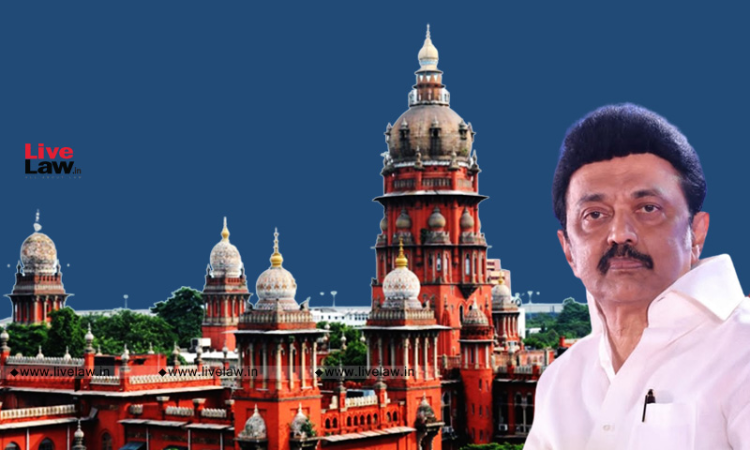
The Madras High Court, on Monday (August 31), said that it will consider the maintainability of a plea filed by former Chief Minister and leader of the Dravida Munnetra Kazhagam (DMK) party head MK Stalin, challenging the victory of Tamilaga Vettri Kazhagam's (TVK) VS Babu from the Kolathur constituency in the 2026 Legislative Assembly Elections.The bench of Chief Justice SA Dharmadhikari...
This is a premium content
Available exclusively to
Our subscribers
Subscribe Premium 
INR 1099+GST
Your support helps us to bring you more content at
an affordable subscription scheme !!!
All payment options available
The Madras High Court, on Monday (August 31), said that it will consider the maintainability of a plea filed by former Chief Minister and leader of the Dravida Munnetra Kazhagam (DMK) party head MK Stalin, challenging the victory of Tamilaga Vettri Kazhagam's (TVK) VS Babu from the Kolathur constituency in the 2026 Legislative Assembly Elections.
The bench of Chief Justice SA Dharmadhikari and Justice G Arul Murugan said it will pass orders after hearing Senior Advocate Kapil Sibal for Stalin and Senior Advocate Dama Sheshadri Naidu for the Election Commission of India (ECI).
Stalin had approached the court seeking directions to the ECI to conduct 100% counting of Voter Verifiable Paper Audit Trail (VVPAT) slips for the Constituency and to check and verify all 286 machines deployed in the constituency for the assembly elections.
Stalin submitted that immediately after the declaration of results, on May 7th, he had filed an application, along with the necessary fee, to check and verify burnt memory/microcontroller of 14 EVMs for any tampering or modification. He submitted that though the application was made at the beginning of May, the checking and verification was done only on July 29, after an inordinate delay. He submitted that out of the 14 EVMs, 2 EVMs stopped working immediately after they were taken up for checking. He submitted that the failure unequivocally calls for a technical diagnosis.
Stalin also submitted that with respect to another EVM, proper chain of custody was not followed as the address tags on the carrying cases of Ballot Units and Control Units were blank and unfilled, seals were affixed on the reverse side, among other issues. Stalin submitted that despite the lapses, the District Election Officer declared that the checking and verification process had been carried out successfully and as per prescribed procedures.
Stalin argued that the order casts a shadow upon the rule of law and the substantive fairness of the electoral process. It was submitted that the violations of statutory provisions governing the custody and identification of the units were left unaddressed and the verification process was termed as successful.
Stalin thus argued that the order was against law, arbitrary and was passed mechanically without any application of mind. It was submitted that the order was passed without any inquiry, investigation or even acknowledgement of the technical failure.
Stalin pointed out that one of the Control Units had failed to detect a Ballot Unit that bore his name, which raises a question on how many more such control units existed and how many such ballot units were uncounted. Arguing that such failure strikes at the foundation of a free and fair election and the purpose for which the VVPAT machines were introduced, Stalin sought to set aside the District Election Officer's order. Stalin also sought a recount in the constituency and to declare VS Babu's victory as void.
When the matter was taken up today, the bench asked why the petitioner could not have filed an Election Petition for challenging the victory of the returning candidate. To this, Sibal argued that the ECI conducted the verification of the EVMs only after an expiry of 45 days after the declaration of election results and thus, Stalin could not have filed an Election Petition. He added that merely because the time period had lapsed, the petitioner could not have been left remediless.
Taking the court through the process of registering votes, Sibal submitted that when the ballot was pressed, a signal was sent to the Control Unit, which then sends a signal to the VVPAT. He added that in the present case, the VVPAT was placed in between, and a signal was sent to the software, which could be easily manipulated.
On the other hand, Naidu, appearing for the ECI, opposed the plea and argued that the petitioner was seeking a remedy that lies in an election petition, by way of clever drafting. It was argued that if Stalin had doubts regarding the machines, he should have challenged it in the beginning and now, after sleeping over his rights, he could not come to the court challenging the same.
Naidu submitted that the Supreme Court has already ruled against 100% recount, and if the same was allowed by the court now, it would open a Pandora's box, with every person coming and filing such petitions.
When the court asked Sibal why he did not approach ECI earlier, Sibal submitted that a letter was sent to the ECI within 7 days of the declaration of results, as was directed by the Supreme Court in its earlier decisions. He submitted that after receiving the letter, it was upon the ECI to verify the machines, but the same was done only after 45 days, preventing Stalin from filing an Election Petition. Pointing to the technical glitches that came to light, Sibal argued that the matter needed to be investigated.
"Can the ECI not do its duty as directed by the Supreme Court and then come here and say this? It is shocking...one ballot paper did not even have my name. Whether the court gives me a remedy or not is another matter. But this needs to be investigated," Sibal argued.
After hearing the matter for some time, the court said that it will consider the maintainability of the issue and pass orders.
Counsel for Petitioner: Mr.Kapil Sibal Senior Counsel and Mr.J.Ravindran Senior Counsel for Ms.Aruna Elango and Mr.Agilesh Kumar
Counsel for Respondents: Mr.Dama Seshadri Naidu Senior Counsel and Mr.G.Rajagopalan Senior Counsel for Mr.Niranjan Rajagopalan Stdg. Counsel, Mr.V.Raghavachari Senior Counsel for M/s.Dixita Gohil, Pranjal Agarwal, and Yash S.Vijay Mr.G.Murugendran
Case Title: MK Stalin v Election Commission of India and Others
Case No: WP 34892 of 2026
Tags
Upasana Sajeev
Upasana Sajeev is a Principal Correspondent with LiveLaw, covering Madras High Court

