



- Home
- /
- High Courts
- /
- Madras High Court
- /
- 'Where Is Fraud To Order CBI...
'Where Is Fraud To Order CBI Probe?': Madras HC Says CBI Not Necessary Party In Plea Challenging AG Perarivalan's Enrolment As Advocate
Upasana Sajeev
9 Jun 2026 3:54 PM IST
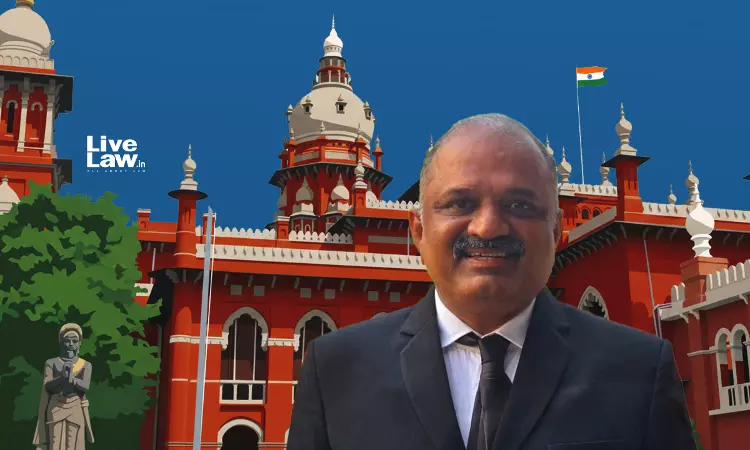
The court dismissed the plea in so far as respondent 5 CBI was concerned, and directed other respondents to file their replies
The Madras High Court on Tuesday (June 9), said that the Central Bureau of Investigation was not a necessary party in the plea filed by Congress MP R Sudha challenging the enrolment of AG Perarivalan, one of the convicts in the Rajiv Gandhi Assassination case, as an Advocate with the Bar Council of Tamil Nadu and Puducherry. The bench of Chief Justice SA Dharmadhikari and Justice G...
This is a premium content
Available exclusively to
Our subscribers
Subscribe Premium 
INR 1099+GST
Your support helps us to bring you more content at
an affordable subscription scheme !!!
All payment options available
The Madras High Court on Tuesday (June 9), said that the Central Bureau of Investigation was not a necessary party in the plea filed by Congress MP R Sudha challenging the enrolment of AG Perarivalan, one of the convicts in the Rajiv Gandhi Assassination case, as an Advocate with the Bar Council of Tamil Nadu and Puducherry.
The bench of Chief Justice SA Dharmadhikari and Justice G Arul Murugan thus dismissed the plea against CBI after noting that the petitioner was not pressing for the interim relief of CBI probe into the enrolment process.
“Where is the fraud to order CBI probe? Do you know in what cases CBI can be asked to conduct investigation? Supreme Court says that such orders can be made only in rare cases. Whatever enrolment has been done is as per provisions..Nothing has been mentioned in the plea about CBI. Nothing on why it is required. I think it (CBI) is not required,” the bench orally observed.
Thereafter, the court directed the dismissal of the plea against CBI.
“Counsel for the petitioner does not press for the interim direction. As a consequence, 5th respondent (CBI) is not a necessary party. No relief has been prayed against 5th respondent in the main petition. Writ petition against 5th respondent stands dismissed. In the meantime, other respondents may file their counter affidavits,” the court ordered.
The court was hearing the plea filed by Sudha against Perarivalan's enrolment. Sudha had sought to declare Section 24A of the Advocates Act as unconstitutional so far as it permits persons convicted and sentenced with the death penalty and imprisonment for life to enroll as Advocates after a period of 2 years from their remission. She also sought to declare the enrolment of AG Perarivalan as illegal and void.
In her plea, Sudha submitted that there was no iota of doubt about Perarivalan's involvement in Rajiv Gandhi's assassination and he was released merely on the ground of inordinate and unexplained delay in deciding his pending mercy petition. Sudha submitted that merely because Perarivalan was released from jail would not wipe off his guilt.
Sudha pointed out that when a person guilty of contempt is not permitted to act as an Advocate unless and until he is purged from Contempt, someone like Perarivalan, who was convicted for acts of terrorism, should not have been permitted to be enrolled as an advocate.
Sudha questioned the interpretation of the word “Release” under the Advocates Act and argued that the same should not include persons who are convicted and sentenced for the death penalty and imprisonment for life.
When the case came up for hearing on Tuesday, the bench wondered how a “writ of declaration” could be sought, as prayed for by the petitioner. The court orally remarked that such a writ was not provided for in the Constitution.
The court also noted that though the plea sought to declare Section 24A of the Advocates Act as illegal, no grounds had been produced. The court pointed out that in many cases, the petitions were drafted with defects, which often tied the courts' hands, preventing relief even when the case was good.
The court also noted that as per the provision, a person could not be enrolled as an Advocate if he was convicted for an offence involving moral turpitude. The court wondered if Perarivalan's conviction under Section 302 of the Constitution could be seen as one involving moral turpitude.
“Which section has he been convicted in which involves moral turpitude? He has not been convicted for an offence of moral turpitude. Will Section 302 fall under moral turpitude? All this will have to be looked into,” the court orally remarked.
Nevertheless, the court noted that the Section contained a proviso as per which the bar on enrolment ceases to exist 2 years after the release. In the present case, the court noted that Perarivalan was released from prison in 2022 and thus, as per the proviso, there would be no impediment for his enrolment.
The court then directed the respondents (except CBI), i.e., the Union Home Department, Legal Affairs Department, Bar Council of India, Bar Council of Tamil Nadu and Puducherry, and AG Perarivalan to file their counters to the plea.
Case Title: R Sudha v Union of India and Others
Case No: WP 19498 of 2026
Tags

Upasana Sajeev
Upasana Sajeev is a Principal Correspondent with LiveLaw, covering Madras High Court

