



- Home
- /
- High Courts
- /
- Madras High Court
- /
- Madras High Court Seeks State's...
Madras High Court Seeks State's Response On Plea Challenging Notification Mandating Sanction Before Prosecuting Police Officials
Upasana Sajeev
19 Feb 2026 10:10 AM IST
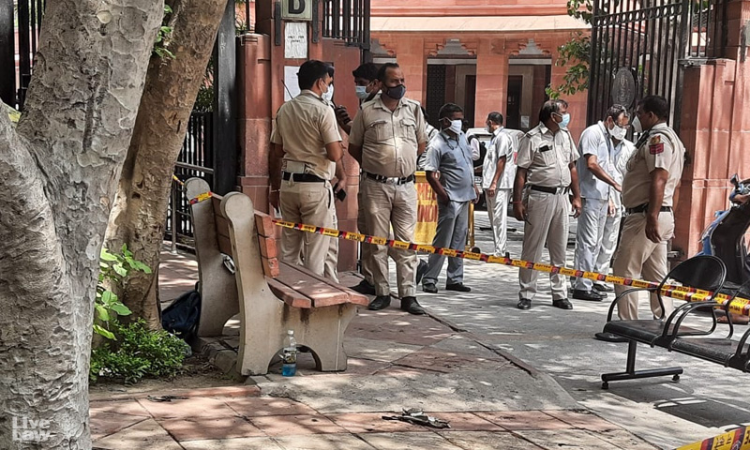
The Madras High Court has sought the response of the State Government on a plea challenging a notification issued by the Home Department, which mandated getting prior sanction before prosecuting police officials in the State of Tamil Nadu. The bench of Justice G Jayachandran and Justice KK Ramakrishnan has directed the Home (Police) Department and the Director General of Police to respond to...
This is a premium content
Available exclusively to
Our subscribers
Subscribe Premium 
INR 1099+GST
Your support helps us to bring you more content at
an affordable subscription scheme !!!
All payment options available
The Madras High Court has sought the response of the State Government on a plea challenging a notification issued by the Home Department, which mandated getting prior sanction before prosecuting police officials in the State of Tamil Nadu.
The bench of Justice G Jayachandran and Justice KK Ramakrishnan has directed the Home (Police) Department and the Director General of Police to respond to the plea.
The petition, filed by advocate Vivekanandan states that the notification is ultra vires it misuses a directory power to equate civil servants under Entry 2 of List II of the Seventh Schedule (State Police) with the 'Armed Forces of the Union' under Entry 2 of List I.
It may be noted that as per Section 218(2), no court was to take cognizance of an offence alleged to have been committed by any member of the Armed Forces of the Union while acting or purporting to act in the discharge of his official duty except with the previous sanction of the Central Government. Under sub section (3), the state government was also given power to issue notifications making the prior sanction for such officers charged with maintenance of public order.
Under the notification in question, this benefit of prior sanction was extended to all the classes and categories of police personnel of the Tamil Nadu Police charged with the maintenance of public order, wherever they may be serving.
The petitioner Vivekanandan submitted that this power was given to the States to extend armed forces like protection for extraordinary public order situations and not as a blanket tool. It has been argued that by extending the specialised exception to every departmental appointee across the State, the State is equating the entire police force with the armed forces.
The plea further argues that through the notification, the State has violated the Doctrine of Proportionality and used a directory power to permanently override the mandatory Removability Test established by Parliament in Section 218(1).
The plea further states that there is a distinction between “maintenance of public order” and routine “law and order”. It has been argued that the notification gives blanket protection to all officers, irrespective of the nature of their duty, treating a routine station constable as an equal to an elite operative without any Intelligible Differentia. It has been argued that the notification is manifestly arbitrary and creates an irrational parity, violating Article 14 of the Constitution.
The plea further stated that by infringing upon the statutory accountability of the police officers, the State has infringed upon the fundamental rights of the citizens under Article 21 of the Constitution.
Thus, the plea seeks to declare the notification as unconstitutional, null, void, and ultra vires Section 218 of the BNSS, manifestly arbitrary under Article 14, and violative of the Procedure Established by Law under Article 21.
Case Title: Vivekanandan A v. State of Tamil Nadu and Another
Case No:WP(MD) No. 4549 of 2026
Tags

Upasana Sajeev
Upasana Sajeev is a Principal Correspondent with LiveLaw, covering Madras High Court

