



- Home
- /
- High Courts
- /
- Madras High Court
- /
- Madras High Court Acquits Death Row...
Madras High Court Acquits Death Row Prisoner Accused Of Sexually Abusing 5 Minors, Says 'Draconian' POCSO Provisions Weaponised
Upasana Sajeev
9 Sept 2026 4:00 PM IST
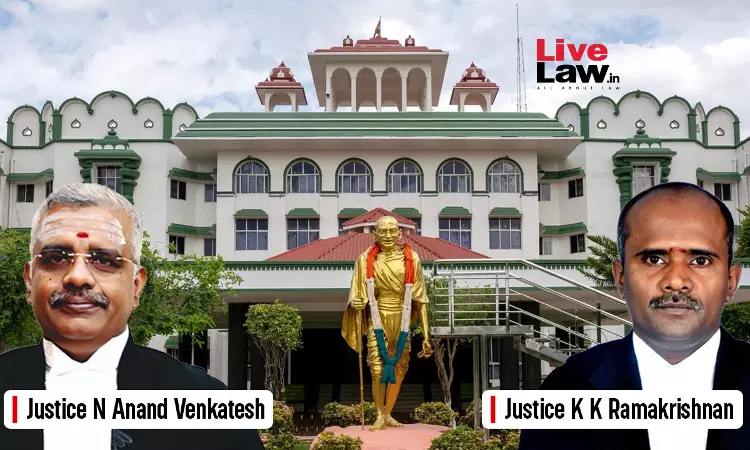
The Madras High Court recently set aside the death sentence imposed on a man accused of sexually abusing 5 minor children. [2026 LiveLaw (Mad) 434] The bench of Justice Anand Venkatesh and Justice KK Ramakrishnan observed that the prosecution case suffered from material inconsistencies, omissions and deficiencies which create a reasonable doubt. The court added that when such...
This is a premium content
Available exclusively to
Our subscribers
Subscribe Premium 
INR 1099+GST
Your support helps us to bring you more content at
an affordable subscription scheme !!!
All payment options available
The Madras High Court recently set aside the death sentence imposed on a man accused of sexually abusing 5 minor children. [2026 LiveLaw (Mad) 434]
The bench of Justice Anand Venkatesh and Justice KK Ramakrishnan observed that the prosecution case suffered from material inconsistencies, omissions and deficiencies which create a reasonable doubt. The court added that when such doubt arises, the rule of law requires acquittal.
“When reasonable doubt survives a conscientious judicial scrutiny, acquittal is not an act of indulgence; it is the command of the rule of law. Where, after a comprehensive appreciation of the evidence, a reasonable doubt remains regarding the very occurrence alleged and the involvement of the accused, the benefit of such doubt necessarily belongs to the accused. An acquittal in such circumstances is not a failure of justice; rather, it is a consequence of the fundamental principle that no person can be convicted unless the prosecution proves his guilt beyond reasonable doubt,” the court said.
The court also agreed with the contention of the accused that the testimonies of the victims and their parents were in the nature of a rehearsed or regurgitated version, which suggested tutoring or coaching.
“The evidence of the victims in this case indicates that the victims were tutored before making their statements to the police as well as before deposing before the court. In view of the above discussion upon the evidence of victims, this Court is of the view that the possibility of suggestive tutoring cannot be ruled out,” the court said.
The court also noted that the accused was not given a fair trial, which caused prejudice to him and affected his fundamental guarantee of a fair trial under Article 21 of the Constitution.
“On an overall consideration of the record, this Court is unable to hold that the accused received a fair and meaningful trial. The cumulative effect of the denial of an effective opportunity to consult and instruct counsel, the absence of counsel on material occasions, the inadequacy of the record regarding effective cross-examination, the procedural irregularities concerning the victims, the deficiencies in identification, and the failure to adhere to the safeguards governing capital sentencing has resulted in a fundamental failure of the trial process,” the court said.
The court was hearing a referred trial by the State to confirm the death sentence imposed on the accused. The accused had also filed an appeal challenging the conviction and death sentence by the Special POCSO Court.
The allegation against the accused was that on February 4, 2024, he had lured the victim children, all under 10 years of age, under the pretext of giving them a phone to play games and buying them snacks, and repeatedly subjected them to sexual assault.
The accused argued that the conviction was legally unsustainable as the prosecution had failed to establish the foundational facts. The accused argued that there were material contradictions and inconsistencies in the testimony of the witnesses and there was no independent corroboration to their versions. The accused also pointed out that there was inordinate delay in lodging the complaint.
The accused also argued that the prosecution version was inherently improbable. It was argued that the incident was alleged to have occurred in the accused's house, which did not have a door or window, during daytime. It was pointed out that even according to the victim's testimony, they had screamed during the occurrence. It was thus argued that if such an incident had actually taken place, the screams would have been heard by persons in the neighbourhood and the neighbours would have rushed to the spot, and the absence of any such evidence in the present case renders the prosecution version doubtful.
The State, however, argued that the oral evidence of victims, testimony of other witnesses and documentary evidence established the guilt of the accused beyond reasonable doubt and the case involved most heinous offence involving children, warranting imposition of extreme death penalty.
After analysing the evidence of the victims and their parents, the court found it that the prosecution had failed to establish the foundational facts. The court noted discrepancies in the very manner in which all the victims had assembled at the accused's house. The court also noted that since the accused's house did not have a door or window and the alleged incident occurred in morning time in a densely inhabited residential area, any loud cry would have been heard by the occupants. The court noted that no independent witness had been examined to establish that the cries were heard or any attempt was made by neighbours to rescue the children.
The court also took note of the evidence of some children and their parents stating that there was prior argument with the accused. The court also noted that the medical evidence was based on the history narrated by the victim and their parents and there was no internal or external injury noted by the doctor.
Thus, considering all the materials, the court noted that the case was a textbook illustration of how a draconian statutory provision was weaponised.
“This case stands as a classic textbook illustration of how draconian statutory provisions can be weaponized, holding an innocent person beneath the suspended sword of a death sentence. In an era where trial by media often pronounces guilt long before the judicial process concludes, high-profile cases generate intense public expectation. Courts cannot and must not be guided by popular clamor or media narratives. Yet, intense public scrutiny places an extra duty of care upon the bench to ensure every shred of evidence is exhaustively analyzed, leaving no stone unturned,” the court remarked.
Thus, the court was inclined to set aside the death penalty and acquitted the accused of all charges.
Counsel for Appellant: Mr. R. John Sathyan State Public Prosecutor Assisted by Mr. G. Karupasamy Pandian State Public Prosecutor
Counsel for Respondents: Mr. A. Prasanna Rajadurai, Mr. A. K. Hemaraj, Mr. J. Prabu
Case Title: State of Tamil Nadu v Chandran
Citation: 2026 LiveLaw (Mad) 434
Case No: RT (MD) No 05 of 2026
Tags

Upasana Sajeev
Upasana Sajeev is a Principal Correspondent with LiveLaw, covering Madras High Court

