



'Collective Duty Of Bench & Bar To Make Legal Profession Achieve Greatest Height': Orissa High Court CJ Harish Tandon Retires
LIVELAW NEWS NETWORK
14 Nov 2026 11:00 AM IST
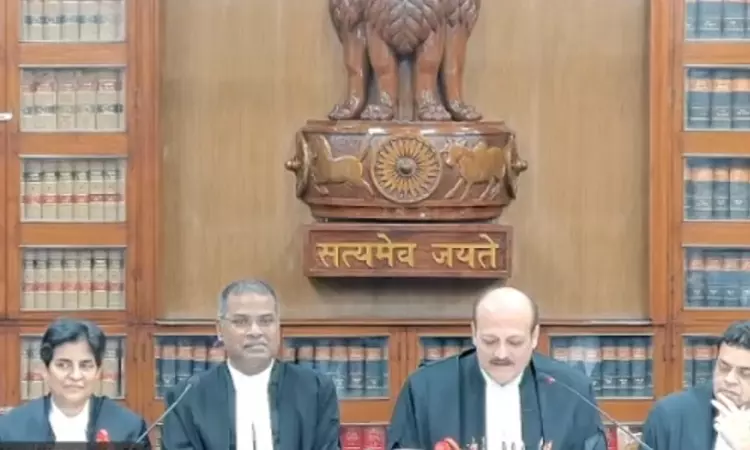
Justice Harish Tandon, the 35th Chief Justice of the Orissa High Court, bid adieu to the Court on Friday (November 13) after serving at helm of the Odisha Judiciary for nearly 20 months. He is due to retire from office on November 15, 2026.
A Full Court Reference was held in the honour of the outgoing jurist at the Chief Justice's Heritage Court Hall in the old building. The event was presided over by the senior-most Judge and Acting Chief Justice-designate Justice Bibhu Prasad Routray. It was attended by all the Judges, Advocate General, Deputy Solicitor General (DSGI) and President of the Orissa High Court Bar Association (OHCBA) amongst others.
Speaking on the occasion, Advocate General Pitambar Acharya borrowed a stanza from the Bhagavad Gita to describe the leadership qualities of the outgoing Chief Justice. The stanza reads,
“यद्यदाचरति श्रेष्ठस्तत्तदेवेतरो जन: ।
स यत्प्रमाणं कुरुते लोकस्तदनुवर्तते ॥”
It means whatever a great person does, common people follow. Whatever standard they set by exemplary acts, all the world pursues. He paid tributes to the contributions made by Justice Tandon to the judicial and legal fraternities of Odisha. Similar thoughts were echoed by the DSGI and President of the OHCBA.


Addressing the gathering, the Chief Justice reminisced his youthful days at the Calcutta Bar. He paid rich homage to his senior Late Shri Sudhish Dasgupta, Senior Advocate, under whose tutelage he started his legal practice. He said even though he belonged to a family of lawyers, his senior inculcated in him the values that every lawyer must endearingly embrace.
“The first principle that he taught was that a lawyer must be very humble. He must have compassion; he must be empathetic. Yet his wisdom should be above-board…The second principle, he says, is that you should also be courteous to your learned brothers, [who] may be appearing for the litigants against whom your client has initiated a proceeding, and should not put any quarrel but concentrate solely on your point and your case, undeterred by what is whispered and what comes as a passing remark. The third principle which he taught was to never give up your inquisitiveness throughout your journey as a legal professional.”
He said when he was offered judgeship in the Calcutta High Court, he was initially sceptical. However, a sense of duty towards the society to dispense justice convinced his transition from the Bar to the Bench.
“The equality principle was deeply embedded in my heart and in my mind, and I could not resist myself, more particularly, when I find a discrimination on the basis of gender. The equal opportunity, equal participation are the hallmarks of dispensation of justice originating from our constitutional ethos. As a Judge, I always stood by the side of a person who has been subjected to any injustice and also at times, when I feel the injustice is faced by the juniors [Advocates] while presenting cases. I always encourage them and give them the full opportunity to argue and put their points.”
He further said, “it is often said that the Judges are made at the Bar, which I cannot deny nor have inkling of doubt in such perception.” He emphatically said that it is the collective duty of the Bench and the Bar to make the profession achieve the greatest of heights. He hoped to have taken a few small steps in that direction.
While countering, on a lighter note, to the frequent whispers at the Bar regarding his use of “flowery vocabulary” in judgments, the outgoing Judge said he is no literature maestro, and he merely uses the ideas and knowledge which he has gathered over the years. He quoted Lord Denning who famously observed, “the clarity of thoughts inexorably leads to clarity of language”.
He expressed gratitude to his colleagues on the Bench as well senior and junior members of the Bar for accepting him “with open hearts” even though he hailed from a different State and predominantly served in a different High Court.
“I will definitely leave the place with some kind of a sorrow that I will be missing you daily, more particularly when the mentioning time comes. But definitely I will remember you and keep you in my heart till I breath the last.”
Justice Tandon was born on November 16, 1964. After obtaining his LL.B. degree from the Calcutta University, he got enrolled as an Advocate on September 26, 1989 and started practicing before the Calcutta High Court. He conducted civil, constitutional matters, and practised mainly in the Appellate Side of the High Court and also appeared before the City Civil Court, the Debt Recovery Tribunal and the Supreme Court.
He was elevated as a permanent Judge of the Calcutta High Court on April 13, 2010. He took oath as the Chief Justice of the Orissa High Court on March 26, 2025. Notably, he stands at Serial No. 1 of the All-India High Court Judges' Seniority List.
Upon the superannuation of Justice Tandon, the current strength of the Orissa High Court has reached a historic low of 13 Judges, against a sanctioned strength of 33 Judges. Though the names of four Advocates were recommended by the Supreme Court Collegium in August this year, they are yet to be cleared by the Centre.


