



- Home
- /
- High Courts
- /
- Orissa High Court
- /
- Requisition & Proposal Must Be...
Requisition & Proposal Must Be Served Upon Sarpanch Along With Notice While Convening His Removal: Orissa High Court
LIVELAW NEWS NETWORK
15 Aug 2026 10:00 AM IST
The Orissa High Court has recently held that it is mandatory for Sub-Divisional Magistrate (SDM) to serve the copies of requisition signed by at least one-third of the total membership of the Grama Panchayat along with the removal resolution, while serving the notice of meeting on the Sarpanch against whom a 'no-confidence motion' is proposed. [2026 LiveLaw (Ori) 95]Elucidating the...
This is a premium content
Available exclusively to
Our subscribers
Subscribe Premium 
INR 1099+GST
Your support helps us to bring you more content at
an affordable subscription scheme !!!
All payment options available
The Orissa High Court has recently held that it is mandatory for Sub-Divisional Magistrate (SDM) to serve the copies of requisition signed by at least one-third of the total membership of the Grama Panchayat along with the removal resolution, while serving the notice of meeting on the Sarpanch against whom a 'no-confidence motion' is proposed. [2026 LiveLaw (Ori) 95]
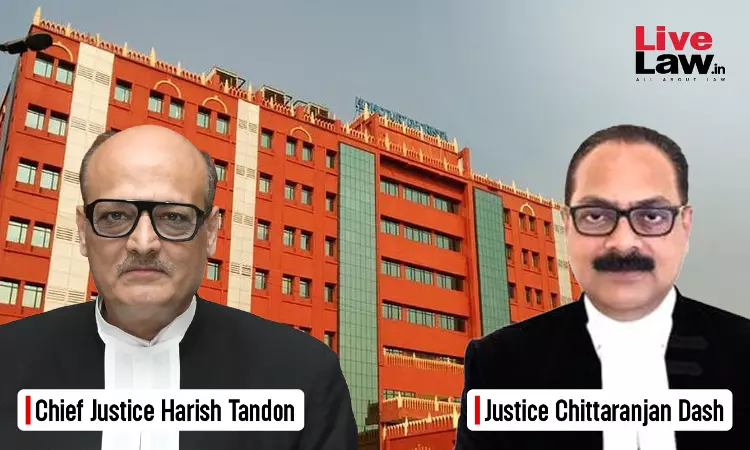
Elucidating the statutory mandate under Section 24(2)(c) of the Orissa Grama Panchayats Act, 1964 ('the 1964 Act'), the Division Bench of Chief Justice Harish Tandon and Justice Chittaranjan Dash observed–
“A plain reading of the aforesaid provision makes it abundantly clear that the statutory requirement is not satisfied by mere service of a notice convening the special meeting. The notice must necessarily be accompanied by copies of the requisition and the proposed resolution. The legislative intent is to ensure that the elected office bearer is informed not merely of the meeting, but also of the foundation and subject matter of the proposed motion. To hold otherwise would render a substantial part of Section 24(2)(c) redundant.”
A notice of 'no-confidence motion' under Section 24(2)(c) of the 1964 Act, issued by the SDM, Athagarh, was allegedly served upon one Gyana Ranjan Dash (the appellant), the Sarpanch of Kandarai Gram Panchayat, on 12.01.2026. However, the appellant alleged that the said notice was not accompanied by the removal proposal and requisition, which is a statutory pre-requisite under Section 24(2)(c) of the 1964 Act.
Upon receiving the notice, he purportedly made an endorsement in vernacular by stating that the postal service bereft of the aforesaid mandatory documents and returned the same. Later, he unsuccessfully made a representation before the SDM on 20.01.2026 to redress his grievances. Therefore, the appellant filed a writ petition challenging the notice.
The Single Bench, however, did not grant him any relief and declared the notice to be sufficient. While holding thus, the Bench took into consideration the inability of the appellant in explaining as to how he annexed a photocopy of the notice, even though he claimed to have returned the same. Additionally, the Court took eight-day delay in approaching the SDM as an unusual behaviour on the part of the appellant and thus, dismissed his petition as an 'after-thought' to defeat the no-confidence motion.
The State Counsel tried to defend the Single Judge's order by arguing that the notice was duly sent with proposal and requisition, but the same returned unserved. Hence, the documents were sent to the appellant via WhatsApp and those were also affixed on his residence walls.
The Division Bench, speaking through Justice Dash, affirmed the view taken by the Single Judge who held that service of notice through electronic mode such as WhatsApp and affixing the same on residential premises are not sufficient compliance of the mandatory statutory provision under Section 24(2)(c), which reads as follows–
“The Sub-Divisional Officer on receipt of requisition shall fix the date, hour and place of such meeting and give notice of the same to all the members holding office on the date of such notice along with a copy of the requisition and of the proposed resolution, at least fifteen clear days before the date so fixed.”
The only question which survived for consideration was whether the notice admittedly served upon the appellant was accompanied by copies of the requisition and the proposed resolution as mandated under Section 24(2)(c) of the Act.
The Court gave due importance to the endorsement made by the appellant whereby he specifically recorded that copies of the requisition and the proposed resolution had not been supplied to him. The Bench was of the considered opinion that had the requisition and the resolution been served together with the notice, there was no occasion for the appellant to record such an objection at the time of receipt.
It was further held that when validity of a statutory proceeding is challenged on the ground of non-compliance with a mandatory procedural requirement, the burden rests upon the authority to establish compliance with the procedure and it cannot take assistance of presumptions or inferred compliances, particularly where the consequence is the removal of a democratically elected representative.
Having regard for the aforesaid, the Court came to a definite conclusion that the respondents failed to comply with the mandatory provision of Section 24(2)(c) and therefore, the very initiation of the meeting was illegal. The impugned order and all the consequential proceedings were accordingly set at naught.
Case Title: Gyana Ranjan Dash v. State of Odisha & Ors.
Case No: Writ Appeal No. 994 of 2026
Counsel for the Appellant: Mr. S.K. Dalai, Advocate
Counsel for the Respondents: Mr. Saswat Dash, Addl. Govt. Advocate; Mr. S.K. Baral, Advocate
Citation: 2026 LiveLaw (Ori) 95
Tags


