



'Presumption Of Innocence Not Effaced Merely Because Trial Court Has Recorded Conviction': Patna High Court Acquits Man In Rape Case
LIVELAW NEWS NETWORK
6 Nov 2026 12:10 PM IST
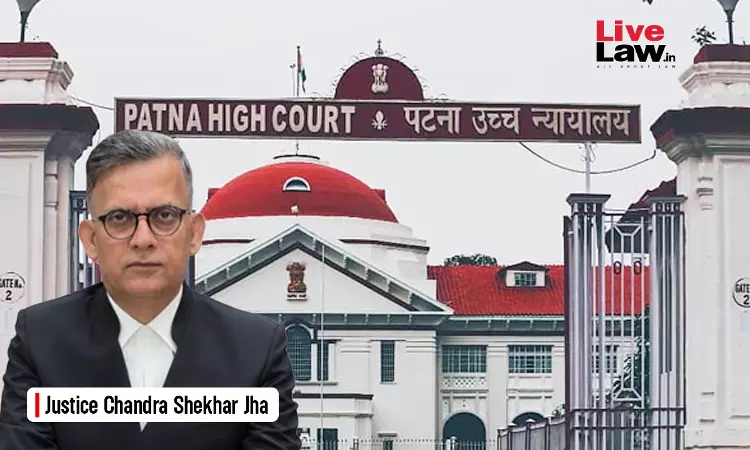
The Patna HC has held that the presumption of innocence does not cease merely because a Trial Court has recorded a conviction, and continues until the prosecution establishes guilt beyond reasonable doubt before the appellate court. The Court acquitted a man convicted of rape and procuration of a minor girl, noting material inconsistencies in the prosecution evidence.
A Single Judge Bench of Justice Chandra Shekhar Jha set aside the conviction of Sambhu Sada under Sections 366A and 376 of the Indian Penal Code (IPC), holding that the prosecution had failed to establish his guilt beyond reasonable doubt.
The appeal challenged the judgment dated June 23, 2015, and sentencing order dated July 9, 2015, passed by the Second Additional Sessions Judge, Madhepura, sentencing the appellant to four years' rigorous imprisonment under Section 366A IPC and five years under Section 376 IPC, with both sentences running concurrently.
The prosecution case arose from a complaint filed by Vidyanand Bhagat, who alleged that his minor daughter had been taken away by the accused persons on September 12, 2010. The girl was recovered on September 17, 2010, and medically examined the following day.


Examining the evidence, the High Court emphasised the duty of an appellate court to independently scrutinise the prosecution case. The Court observed:
“I have given anxious consideration to the rival submissions and have carefully gone through the evidence available on the record. The appellate jurisdiction in a criminal appeal carries with it a duty to independently scrutinize the entire evidence and to arrive at its own conclusion regarding the reliability of the prosecution case. The presumption of innocence is not effaced merely because the Trial Court has recorded a conviction. It continues until the prosecution succeeds in establishing guilt beyond reasonable doubt before the appellate court also.”
The Bench noted that the FIR had been lodged two days after the alleged occurrence. While clarifying that delay in reporting sexual offences is not inherently fatal to the prosecution, the Court observed that such delay assumes significance where an alleged eyewitness fails to provide a convincing explanation for remaining silent despite having an opportunity to report the occurrence.
Significantly, the Court found material inconsistencies in the victim's testimony. During her deposition, she initially attributed the commission of rape to three persons but subsequently corrected herself, stating that Sambhu Sada alone had committed rape while the others were merely present. Her statement under Section 164 CrPC had also attributed the alleged offence to the appellant alone.
The Bench held that the expansion of allegations during trial, followed by their correction, could not be treated as a minor variation when the identity and participation of the alleged offenders were directly in issue. Regarding medical evidence, the Court noted that although the victim's hymen was found torn, the examination disclosed no findings suggestive of recent intercourse. However, it clarified that the absence of injuries or medical findings indicating recent intercourse did not establish that rape had not occurred.
Referring to the Supreme Court's decision in State of Punjab v. Gurmit Singh, (1996) 2 SCC 384, the Court emphasised that a prosecutrix's testimony must be appreciated sensitively and minor discrepancies should not be exaggerated. However, where oral testimony suffers from material infirmities, medical evidence cannot supply the missing credibility.
The Court clarified that it was not treating rape as medically impossible, but considering the absence of corroborative medical findings alongside material inconsistencies in the oral evidence and the absence of other scientific or independent evidence connecting the appellant to the alleged offence. On the standard of proof in rape cases, the Bench observed:
“The matter concerning Section 376 IPC requires a still more cautious approach. The seriousness of an allegation of rape cannot be permitted either to dilute the standard of proof or to substitute moral conviction for legal proof. Equally, the Court cannot approach the testimony of a prosecutrix with a predetermined notion that her evidence must necessarily be accepted irrespective of its intrinsic infirmities. The correct approach is one of sensitivity coupled with judicial scrutiny.”
The Court further held that the prosecution had failed to bridge the gap between suspicion and proof and that a criminal conviction could not rest merely on the possibility that the prosecution version might be true.
Accordingly, finding that the prosecution had failed to establish the appellant's guilt beyond reasonable doubt, the High Court set aside the conviction and sentence and acquitted Sambhu Sada of the offences under Sections 366A and 376 IPC.
Appearance:
For the Appellant: Mr. Paritosh Parimal, Advocate (Amicus Curiae)
For the Respondent: Ms. Anita Kumari Singh, APP


