



- Home
- /
- High Courts
- /
- Patna High Court
- /
- Article 226 Cannot Be Invoked On...
Article 226 Cannot Be Invoked On Mere Apprehension Of Tender Disqualification Without Actual Legal Injury: Patna High Court
Rushil Batra
16 May 2026 12:20 PM IST
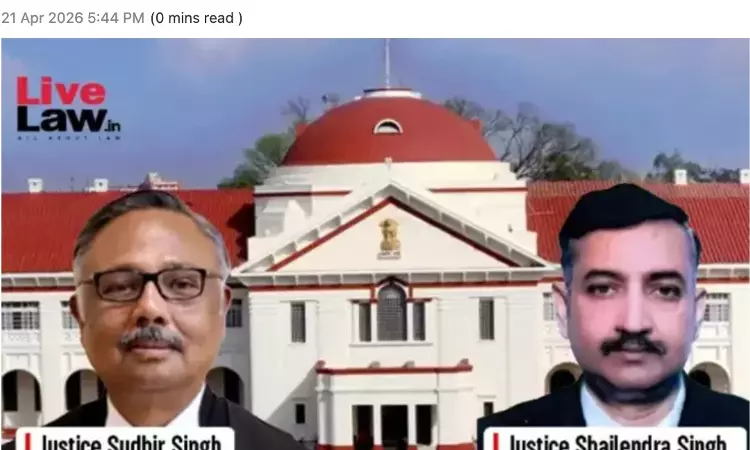
The Patna High Court has held that a writ petition under Article 226 of the Constitution cannot be maintained merely on the basis of an apprehension that a bidder may be disqualified from a tender process, particularly when the bidder has neither participated in the tender nor suffered any actual adverse action.A Division Bench of Justice Sudhir Singh and Justice Shailendra Singh observed...
This is a premium content
Available exclusively to
Our subscribers
Subscribe Premium 
INR 1099+GST
Your support helps us to bring you more content at
an affordable subscription scheme !!!
All payment options available
The Patna High Court has held that a writ petition under Article 226 of the Constitution cannot be maintained merely on the basis of an apprehension that a bidder may be disqualified from a tender process, particularly when the bidder has neither participated in the tender nor suffered any actual adverse action.
A Division Bench of Justice Sudhir Singh and Justice Shailendra Singh observed that writ jurisdiction is extraordinary, discretionary, and remedial in nature, and cannot be invoked in abstract or speculative circumstances. The Court held:
“The writ jurisdiction is not intended to be invoked in abstract, hypothetical or speculative circumstances, but only where there exists a real, live and enforceable cause of action arising from a concluded or imminent administrative action.”
The petitioner, Aarpee Infra Projects (P) Ltd., had approached the Court in relation to two tenders issued by the Public Health Engineering Department, Government of Bihar, for piped water supply schemes in Madhubani and Araria. The petitioner sought a direction that it should not be disqualified on the basis of a prior debarment order passed by the Government of West Bengal.
The debarment order, issued by the Superintending Engineer, National Highway Circle No. II, Birbhum, West Bengal, had debarred the petitioner from participating in tenders issued by the Ministry of Road Transport and Highways and its implementing agencies. The petitioner argued that this order was limited in scope and could not automatically apply to tenders floated by the Bihar Public Health Engineering Department.
It was further argued that Clause 4.8 of the Instructions to Bidders could not be interpreted to give automatic effect to a debarment order passed by another department, in the absence of any independent decision by the Bihar authorities. Reliance was placed on M/s. Erusian Equipment & Chemicals Ltd. v. State of West Bengal & Ors., AIR 1975 SC 266, and M/s. HCL Infosystems Ltd. v. Bihar State Electricity Board, (2013) 2 PLJR 753, to submit that debarment by one authority cannot ipso facto operate as a bar in respect of other departments.
The respondents opposed the petition, submitting that it was in the nature of pre-emptive protection, since no adverse action had been taken against the petitioner. They also pointed out that the petitioner had not participated in the tender process, that the process had already concluded, and that the work had been awarded to the L-1 bidder among responsive bidders.
The Court noted that the petitioner had approached it without participating in the tender process. It further noted that no decision had been taken by the respondents declaring the petitioner disqualified or rejecting its bid. The challenge was therefore based solely on the existence of the prior debarment order and the petitioner's apprehension that it may be considered during tender evaluation.
The Bench also took note of the fact that interim protection had earlier been granted to the petitioner on 04.09.2025. However, despite such protection, the petitioner did not submit its bid. In this context, the Court held:
“Despite such protection, the petitioner chose not to participate in the tender process. In such circumstances, the petitioner, having failed to avail the opportunity extended by this Court, cannot now be permitted to maintain the present writ petition on the basis of a speculative grievance.”
The Court added that the petitioner's conduct indicated a waiver of the opportunity to participate in the tender process. It therefore held that there was no concluded administrative action or live adjudicatory cause of action.
Relying on State of Orissa v. Madan Gopal Rungta, 1951 SCC 1024, the Court observed that Article 226 cannot be invoked for declaratory relief in the absence of a legal injury or enforceable right. It also referred to Tata Cellular v. Union of India, (1994) 6 SCC 651, reiterating that in tender matters, judicial review is limited to examining the decision-making process, and interference is permissible only where there is arbitrariness, irrationality, or mala fides in an actual decision.
The Court further observed that the petitioner had not specifically challenged Clause 4.8 of the ITB. From the nature of the relief sought, the Court found that the petitioner was effectively asking the Court to render the clause inapplicable to it. The Bench held:
“Such a relief would amount to this Court rewriting or modifying the terms of the tender, which is clearly beyond the domain of this Court as the same being impermissible in exercise of writ jurisdiction.”
Accordingly, the Court held that the grievance remained contingent on a future possible event, which may or may not arise depending on the course of tender evaluation. It concluded that the petition was founded on a mere misapprehension and did not disclose a live cause of action warranting interference under Article 226.
Case Title: Aarpee Infra Projects (P) Ltd. v. The State of Bihar Public Health and Engineering Department.
Case Number: Civil Writ Jurisdiction Case No. 13104 of 2025.
Appearance: Mr. Alok Kumar Agrawal for the petitioner; Mr. Raghwanand for the respondents.
Tags


