



- Home
- /
- High Courts
- /
- Patna High Court
- /
- 'Right To Take Out Religious...
'Right To Take Out Religious Processions Is Not Absolute': Patna High Court Refuses To Interfere With Restrictions On Mahabiri Julus
Rushil Batra
24 Aug 2026 10:30 AM IST
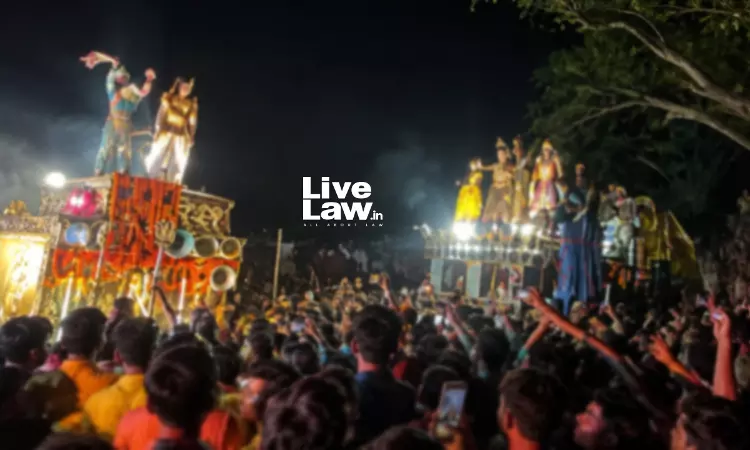
The Patna High Court has held that though the right to take out a religious procession is protected under Articles 19(1)(b) and 25 of the Constitution, the right is not absolute and is subject to reasonable restrictions, including those imposed for maintaining public order.A Single Judge Bench of Justice Alok Kumar refused to interfere with restrictions concerning a 'Mahabiri Julus' in...
This is a premium content
Available exclusively to
Our subscribers
Subscribe Premium 
INR 1099+GST
Your support helps us to bring you more content at
an affordable subscription scheme !!!
All payment options available
The Patna High Court has held that though the right to take out a religious procession is protected under Articles 19(1)(b) and 25 of the Constitution, the right is not absolute and is subject to reasonable restrictions, including those imposed for maintaining public order.
A Single Judge Bench of Justice Alok Kumar refused to interfere with restrictions concerning a 'Mahabiri Julus' in Siwan district, while observing that the number of devotees permitted to participate in future processions would depend upon the prevailing law and order situation when permission is sought.
The petitioner, a devotee of Akhara No.1 in Hathaura village, had sought directions to the authorities to permit the Akhara to conduct its Mahabiri Julus through the traditional route and allow at least 300 devotees to participate. According to the petitioner, a licence to conduct the procession on the 11th day of Bhadrapad Krishna Paksha had been granted every year since 1958. While 200 devotees were permitted to participate in 2012 and 2013, the number was allegedly reduced to 150 in 2014, 100 in 2015 and eventually to five devotees from 2023 onwards. The traditional route was also allegedly altered.
The petitioner argued that the traditional route had never been the subject of any complaint concerning breach of peace. It was further alleged that during a Peace Committee meeting in August 2023, the devotees were compelled to agree to a restriction of five participants and alteration of the route under threat that the licence would otherwise be denied.
The State opposed the plea, submitting that the restrictions were necessitated by law and order considerations. It claimed that despite a sanctioned strength of five devotees, around 1,700 to 2,000 persons had assembled and participated in the procession between 2015 and 2022, resulting in a number of cases.
The State further alleged that in 2024, the petitioner and the accompanying crowd had set fire to a government vehicle belonging to the Block Development Officer, Husainganj, and pelted stones at police personnel. It submitted that the restriction was not discriminatory but was a security-driven measure imposed after verification by the Sub-Divisional Police Officer, Sadar, Siwan.
Considering the rival submissions, the High Court observed that the Supreme Court has consistently held that while the Constitution protects the right to practise one's religion, such rights are subject to public order, morality and health.
The Court referred to the Supreme Court's decision in Dr. M. Ismail Faruqui v. Union of India, where it was held that although offering prayer or worship constitutes a religious practice, offering such prayers at every possible location would not constitute an essential or integral part of the religion unless the particular place itself had religious significance.
The High Court held that the constitutional protection afforded to religious practice did not extend to every mode or manner in which such a right was sought to be exercised. It observed:
“…The right to take out a religious or civic processions is a recognized civil and fundamental right under Article 19(1)(b) and Article 25 of the Constitution. However, they are subject to reasonable restrictions. The reasonable restrictions denotes to legal limits on individual rights and freedom by the state to balance personal liberty with collective public welfare, national security, and social order. Hence, no Constitutional right is absolute; unchecked freedom can cause great harm to society at large.”
The Court also reiterated that secularism forms part of the basic structure of the Constitution. It observed that the State remains neutral towards all religions, treats every faith with equal respect and guarantees the freedom to practise and profess religion.
As regards the petitioner's apprehension that only five devotees may be permitted to participate in future processions, the Court held that the grievance was premature. Any restriction, it said, would have to depend upon the prevailing law and order situation in the locality at the time permission was actually sought.
The issue could therefore not be adjudicated on the basis of a hypothetical future contingency, the Court held.
Finding no merit in the petition, the High Court refused to interfere and dismissed the writ petition.
Case Title: Bhadai Chaudhary v. State of Bihar and Ors.
Case Number: Civil Writ Jurisdiction Case No.14851 of 2024
Appearance:
For the Petitioner: Mr. Harshvardhan Shivsundaram, Advocate
For the Respondents: Mr. Madhukar Mishra, AC to SC-16
Click Here To Read/Download Order
Tags


