



- Home
- /
- High Courts
- /
- Rajasthan High Court
- /
- Conflicting Marriage Claims In...
Conflicting Marriage Claims In Family Pension: Rajasthan High Court Says Civil Services Rules Need Amendments For Clarity
Nupur Agrawal
12 Dec 2025 10:00 AM IST
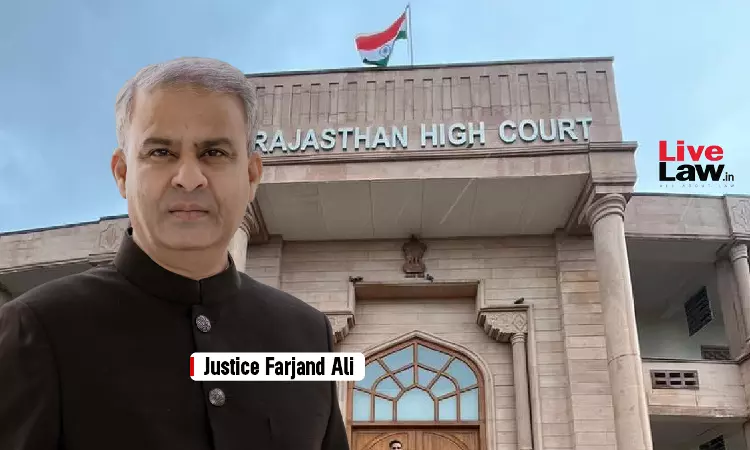
The Rajasthan High Court has observed that the Rajasthan Civil Services (Pension) Rules, 1996 may require appropriate amendments so that provisions relating to nomination, dissolution of marriage, and entitlement are transparent and unambiguous, leaving no room for interpretational confusion, and Justice Farjand Ali directed the Advocate General to put this in the notice of the...
This is a premium content
Available exclusively to
Our subscribers
Subscribe Premium 
INR 1099+GST
Your support helps us to bring you more content at
an affordable subscription scheme !!!
All payment options available
The Rajasthan High Court has observed that the Rajasthan Civil Services (Pension) Rules, 1996 may require appropriate amendments so that provisions relating to nomination, dissolution of marriage, and entitlement are transparent and unambiguous, leaving no room for interpretational confusion, and
Justice Farjand Ali directed the Advocate General to put this in the notice of the State.
The development comes in a dispute between two women, each claiming to be the legally wedded wife of a deceased government employee, and claiming the family pension as his widow.
The petitioner had sought a writ of mandamus seeking the relief, and the Court held that, “writ of mandamus derived from the Latin expression “we command” is confined strictly to ensuring that a public authority performs a statutory or public duty. It does not permit this Court, while exercising its original writ jurisdiction, to embark upon an inquiry into disputed questions of fact, particularly those touching upon marital status, legitimacy, succession, or personal relationships.”
It was highlighted that the records revealed a non-conclusive picture regarding the legally wedded wife of the deceased employee. While the name of one woman was appearing in the employee's 1972 nomination, later on, the petitioner came to be mentioned as his wife, creating uncertainty.
The Court held that who had to be treated as a legally wedded wife was a disputed question which could not be determined in the exercise of writ jurisdiction. It was further held that the plea of customary divorce taken by the deceased could not be accepted since that also required evidence and adjudication in a civil suit.
However, in this background, the Court clarified, “As regards to both sets of children irrespective of the marital disputes inter se their mothers are children of the deceased employee. Their entitlement to the family pension of their father cannot be extinguished whereas the share of the wife shall remain subject to the outcome of the civil proceedings.”
It was further opined that nomination did not confer proprietary rights, and a nominee could not step into the shoes of a legal heir and s/he was merely a trustee for limited purpose of receiving the amount.
The beneficial interests in a deceased's estate had to devolve strictly in accordance with the law of natural succession, irrespective of in whose favour nomination was. And the adjudication of who qualified as legal successor was a seriously disputed fact that could be adjudicated by the competent civil court.
In this background, the Court held that such delicate questions involving validity of marriage, subsistence of prior matrimonial ties, or the legal character of a nominee could only be adjudicated after a full-fledged trial, and there was no reason for the Court to exercise its writ jurisdiction.
Hence, the Court asked the parties to approach the civil court, and directed the trial court that in case of such a trial, the matter be listed every week considering the age of parties.
Accordingly, the petition was dismissed.
Title: Smt. Anand Kanwar v State of Rajasthan & Ors.
Citation: 2025 LiveLaw (Raj) 414


