



- Home
- /
- High Courts
- /
- Tripura High Court
- /
- High Court Slams Tripura University...
High Court Slams Tripura University For Exploiting Contractual Lecturer For Years, Orders Regularisation
Bhavya Singh
24 Oct 2026 1:00 PM IST
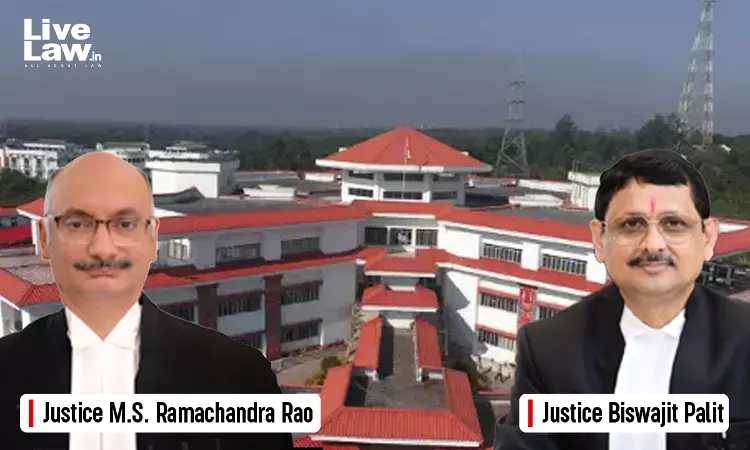
The Tripura High Court has directed Tripura University to reinstate and regularise a contractual employee as Assistant Placement Officer with effect from February 2, 2016, holding that her nearly 15 years of service could not be disregarded merely because her initial appointment was contractual.A Division Bench of Chief Justice M.S. Ramachandra Rao and Justice Biswajit Palit observed,...
This is a premium content
Available exclusively to
Our subscribers
Subscribe Premium 
INR 1099+GST
Your support helps us to bring you more content at
an affordable subscription scheme !!!
All payment options available
The Tripura High Court has directed Tripura University to reinstate and regularise a contractual employee as Assistant Placement Officer with effect from February 2, 2016, holding that her nearly 15 years of service could not be disregarded merely because her initial appointment was contractual.
A Division Bench of Chief Justice M.S. Ramachandra Rao and Justice Biswajit Palit observed, “The Court must look beyond the surface labels and consider the realities of employment.” The Court held that denying regularisation followed by her disengagement after dismissal of her writ petition amounted to manifest injustice.
The appellant, Jayanti Bhattacharjee, joined the University as a contractual Lecturer in its BBA programme on February 4, 2009, after selection through an advertised interview process. On February 2, 2016, she was re-designated as Assistant Placement Officer. In September 2022, the University issued an order fixing her wages at ₹1,200 per working day with effect from January 2022.She challenged the September 2022 order before the High Court and also sought regularisation of her services. The Single Judge, however, dismissed her writ petition on January 9, 2024.
The Court rejected the University's contention that her initial appointment was not against a sanctioned post. It found that the University could not take advantage of its own failure to create regular posts while running the BBA programme through contractual lecturers. It also held that the University had failed to establish that she lacked the qualifications prescribed at the time of her selection in 2008. Later UGC requirements could not be retrospectively applied to invalidate that appointment.
"This is a long period of service of 15 years where she was treated unfairly and arbitrarily by the University in every which way...the pervasive misuse of temporary employment contracts reflects a broader systemic issue that adversely affects workers‟ rights and job security," it remarked.
The Court further held that her re-designation in 2016 was arbitrary and illegal. The Court set aside the September 30, 2022 order, observing that the University had neither given her prior notice nor afforded her an opportunity of hearing before changing her status to that of a daily-wage employee. It was held by the Court that the decision was arbitrary, illegal and violative of Article 14 of the Constitution.
The Court further found that the ruling in Secretary, State of Karnataka v. Umadevi did not apply to the present case, particularly since the appellant had been selected through an interview following a public advertisement. It noted that the appellant had been appointed pursuant to a public advertisement and an interview conducted by a selection committee. Her appointment, therefore, could not be termed a backdoor entry. Her duties were essential and comparable to those of regular employees.
However, the Court declined to regularise her as Lecturer because she had not performed teaching duties for more than ten years. Instead, it directed the University to reinstate her forthwith as Assistant Placement Officer in the Business Management Department and regularise her in that post within one month of the judgment, with effect from February 2, 2016.
The University was directed to pay the regular scale of pay and allowances applicable to the post and count her service from February 4, 2009 as qualifying service for pension and other retirement benefits. It was also directed to pay ₹25,000 in costs within four weeks.

Bhavya Singh
Reporter

