




Law Firm Articles
Personality Rights: Celebrity Rights Or Case For Identity Theft?
Personality rights in India have erupted from judicial whispers into mainstream headlines. What was once restricted to celebrities is now alarming for the masses in light of increasing proliferation of deepfakes. The intermediaries run to dodge accountability, while the ordinary person finds their face weaponised without consent. This highlights India's need to move beyond piecemeal judicial solutions and finally breakthrough with a cautiously calibrated hybrid mechanism that leverages existing...
Beyond Rights: How Indian Courts Place Welfare Of Children Above All In Custody Disputes
The question of child custody is rarely just about legal entitlement. In India, courts have consistently recognised that a child is not merely the property of parents or guardians but a human being with emotional, psychological, and social needs that demand protection. Recent judgments from the Supreme Court and High Courts underscore a progressive legal philosophy: the welfare of the child must be the paramount consideration in any custody dispute.Custody disputes often arise in emotionally...

Behind Closed Doors: Domestic Violence And The Law's Ongoing Battle In India
Domestic violence is often described as a private matter. That is exactly what makes it so dangerous. When violence happens within the home, it hides behind walls, silence, and social pressure. In India, despite strong legislation, domestic abuse continues to affect thousands of women every year across cities, villages, educated families, and economically weaker sections alike.The law is not silent on this issue. The Protection of Women from Domestic Violence Act, 2005 (PWDVA) was enacted to...
The Conundrum Of “Commercial Disputes”
A judgment by the Karnataka High Court[1] ruling that disputes arising out of or in connection with a share purchase agreement do not constitute a “commercial dispute”[2], has once again shined a spotlight on the concept of commercial disputes. In this article, we explore the judicial interpretations expounded by various courts as to what constitutes a “commercial dispute” and analyze the importance of categorizing disputes as commercial and non-commercial disputes, to help organizations...
The Digital Gavel: Navigating Adjudication Under DPDP Act, 2023
The enactment of the Digital Personal Data Protection (DPDP) Act, 2023, brings a paradigm shift in India's regulatory framework. For the first time, corporate faces a "strict-liability" mandate where data is not just a business asset, but a fiduciary relationship. Central to this new wave, is the Data Protection Board of India (DPB) which is a specialized adjudicatory body that functions as the primary enforcer of the Act.However, a critical tension has emerged: how will the DPB balance its...

Third Party Motor Insurance Claims: Why Courts Are Tightening Insurer Defences
Motor accident compensation law in India is undergoing a quiet but decisive shift. Across Motor Accident Claims Tribunals and constitutional courts, there is a growing judicial reluctance to accept routine defences raised by insurance companies to deny or dilute compensation to accident victims. The trend reflects a broader recalibration of priorities, where social welfare objectives embedded in motor insurance law are being placed above technical objections rooted in policy fine print.Recent...

Pre-Nuptial Agreements In India: An Idea Ahead Of Its Time Or A Practical Necessity?
The concept of pre-nuptial agreements has long made Indian society uncomfortable. Marriage, in the Indian legal and social imagination, is not merely a contract between two individuals but an institution shaped by custom, religion, and social expectations. Any attempt to regulate the financial consequences of a possible marital breakdown before the marriage even begins has often been viewed with suspicion, if not outright disapproval.Yet, despite this discomfort, pre-nuptial agreements are no...
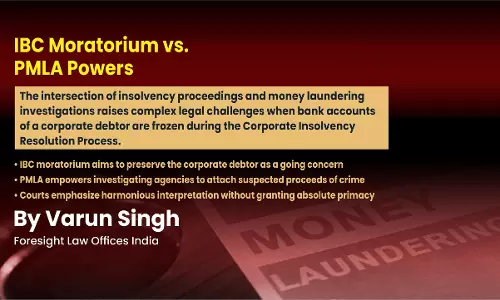
IBC Moratorium Vs PMLA Attachment Powers: Freezing Of Bank Accounts During Insolvency
Imagine a corporate debtor undergoing the Corporate Insolvency Resolution Process. Every rupee lying in its bank accounts becomes critical to sustain operations, pay employees and preserve value for creditors. Yet, at the same time, the Enforcement Directorate or other investigating agencies may step in on allegations of money laundering and freeze those very accounts. What follows is not merely a procedural hurdle, but a collision between two powerful legal regimes with competing objectives.The...

India–EU FTA To Reshape Market Access Across Sectors
The European Union and India have announced the conclusion of negotiations on a historic Free Trade Agreement (FTA) between the second and fourth largest economies. This deal has been called the “Mother of all deals” unlocking opportunities and empowering India. Agreement to come into force in 2027.Several formal steps remain before the FTA comes into force. On the EU side, the draft texts are published, legal revisions and translations made and then submitted to the EU Council for...

Modernising India's Document Registration; An Overview Of The Registration Bill, 2025
The Department of Land Resources, Ministry of Rural Development, Government of India, has prepared a draft bill namely 'The Registration Bill 2025' (“Draft Bill”) with the aim of updating India's document registration framework to align it with a modern, online, paperless and citizen centric registration system. Once enacted, the Bill shall replace the Registration Act, 1908, a pre-Constitution law that has governed the registration of documents relating to immovable property and other...
Delay Is Cruelty: Why Indian Divorce Law Must Prioritise Exit Over Endurance
Indian matrimonial law continues to operate on an uneasy assumption: that the preservation of marriage, even when it has collapsed in substance, serves a greater social good. This assumption manifests most visibly in the procedural delays that characterise divorce litigation. Long waiting periods, repeated adjournments, compulsory “cooling-off” phases, and judicial reluctance to dissolve marriages together create a system where parties are often compelled to endure emotional suffering in the...
Supreme Court On Arbitration: 25 Key Judgments From 2025
The Supreme Court of India pronounced numerous judgments in the matters related to the Arbitration and Conciliation Act, 1996 (“Arbitration Act”) in the year 2025. In this write-up, 25 important pronouncements are briefly discussed.1. Can a High Court under Articles 226/227 of the Constitution interfere with an order passed by an arbitrator if the same is completely perverse?Serosoft Solutions Pvt. Ltd. v. Dexter Capital Advisors Pvt. Ltd., 2025 INSC 26 (Judgment dated 03.01.2025)The Supreme...