




Law Firm Articles

Cybersecurity In Shipping Contracts –Maritime India Vision 2030
The Maritime India Vision 2030 (MIV 2030), formulated by the Ministry of Ports, Shipping, and Waterways, is an attempt to propel India as a global maritime leader by 2030 with ambitions to develop world-class port infrastructure, enhance logistics efficiency through technology and innovation, and lead in safe, sustainable, and green maritime practices including establishing a centralized Digital Centre of Excellence (DCoE) under the Indian Ports Association to drive cyber security and compliance...
10 Important White-Collar Judgments Of 2025
The year 2025 saw some of the most talked about rulings in white collar crime, where the Supreme Court shaped how our criminal justice system looks at economic offences, money laundering, bail rules and the rights of accused persons caught up in complex investigations. These top 10 judgments show how Courts are trying to strike a balance between strong enforcement on one side and fair trial rights on the other. From expanding access to documents in PMLA cases to checking illegal arrests, the...
10 Important Insolvency Judgments Of 2025
In recent years, several noteworthy judgments have been rendered by the Indian Courts and Tribunals in matters pertaining to the Insolvency and Bankruptcy Code, 2016 (IBC). This article covers ten such significant decisions rendered in the year 2025.1. Independent Sugar Corpn. Ltd. vs. Hindustan National Gas & Industries Ltd. (Resolution Professional) [(2025) 5 SCC 209]The Supreme Court, in its judgment in Independent Sugar Corporation Ltd., has held that prior approval of the...
Ten Landmark Arbitration Judgments Of 2025
2025 has been a landmark year for arbitration law jurisprudence in India, with the Supreme Court of India and various High Courts delivering several important decisions. From recognising a limited power to modify arbitral awards to crystallising the tests for a valid arbitration clause, these judgments collectively chart the course towards making India a global arbitration hub.Below is a curated list of the ten most important Indian arbitration rulings in 2025, each with significant implications...
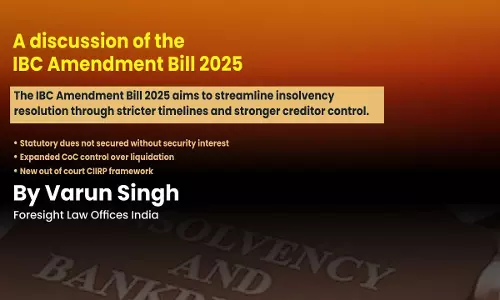
A Discussion Of The IBC Amendment Bill 2025
The Insolvency and Bankruptcy Code Amendment Bill (“IBC Amendment Bill, 2025”) was tabled in the Lok Sabha on August 12, 2025. It essentially had an objective to address various loopholes and shortcomings which the law faces during its practical implementation.The Insolvency and Bankruptcy Code, 2016 (“IBC”) has been facing a lot of operational issues such as non-adherence to timelines which is the very essence of this legislation. There have been various judicial conflicts on the issues...
Joinder Of Parties And Privity Of Contract: Legal Fiction Versus Entity Reality In MSME Arbitration
Privity of contract is a starting point for almost every discussion in contract and arbitration law. Only those who are party to an agreement can sue on it or be bound by it. Arbitration, being based on consent, usually mirrors this rule: if you did not sign the arbitration agreement, you are normally outside its reach.In MSME disputes, a micro or small enterprise usually sues the entity it has contracted with. It is like a contract between a lion and a lamb that both of them will drink water...
Family Courts In India: Reforming A System That Is Failing The Families It Was Built To Protect
“When a judge has 2,000 cases, it becomes oppressive… a judge starts thinking of cases as statistics rather than as human problems requiring solutions and remedies.” — Justice R. V. Raveendran.Family Courts in India were established to insulate vulnerable families from the harshness of conventional litigation. They were envisioned as specialized forums of compassion, speed, and settlement-driven dispute resolution. But four decades later, the truth is unavoidable: family courts have evolved into...
How Digital Piracy Is Evolving And What Courts Are Doing About It
Digital consumption has transformed creative industries. Film, music, sport and publishing now reach audiences across geographical borders through a combination of streaming portals, social platforms and direct creator to consumer models. This shift has created new spaces for entertainment and information but has also given rise to a sophisticated ecosystem of unlawful copying, broadcast reproduction and content theft. Digital piracy has moved far ahead of the traditional world of torrent sites...
Limits Of Executing Courts In Arbitral Award Challenges: Re-Examining Section 47 CPC In Light Of Arbitration Jurisprudence
Arbitration promises finality with speed and without the technicalities of civil procedural laws. That promise unravels when an award, unchallenged within the statutory window, gets re-litigated in execution under the guise of Section 47 of the Code of Civil Procedure, 1908 (CPC). Section 47 of the CPC essentially provides that all questions regarding the execution, discharge or satisfaction of a decree must be decided by the court executing the said decree. Traditionally, this provision applies...
Cross Border Insolvency Under IBC
In India, the insolvency law is governed by the Insolvency and Bankruptcy Code, 2016. Insolvency of a company comprises of parties wherein one is the debtor and the other is the creditor. When the debtor fails to cater its obligation to pay off the creditor, then the creditor initiates the insolvency procedure under the Insolvency and Bankruptcy Code, 2016. When one of the parties in such an insolvency proceeding belong to a nation other than India, then it is categorized under the term...
The Stringency Of Interest Provisions Under MSMED Act: Implementation And Judicial Interpretation
Timely payments are the bedrock of healthy commercial relationships and the lifeline of Micro, Small, and Medium Enterprises (MSMEs) in India. To correct chronic delays, the Parliament embedded a stringent, statutory interest regime in Chapter V of the Micro, Small and Medium Enterprises Development Act, 2006 (“MSMED Act” or “the Act”). Sections 15 - 17 of the Act impose compound interest with monthly rests at three times the RBI bank rate, reinforced by an override clause and a mandatory...
Delhi High Court Stays Outsourcing Move for Long-serving University Staff
The Delhi High Court has granted interim protection to a group of non-teaching staff employed on daily wages at Delhi Pharmaceutical Sciences and Research University (DPSRU), who challenged the University's decision to replace them with outsourced personnel through a manpower agency. The petition, W.P. (C) 14828/2025, was heard by Hon'ble Mr. Justice Prateek Jalan on October 10, 2025.Contentions of the PartiesThe petitioners, represented by Mr. Himanshu Yadav, argued that they have been working...