




Law Firm Articles

The Insolvency And Bankruptcy Code – Respite To MSME
The Insolvency and Bankruptcy Code 2016 (Code) has now been maturing over the period of time with various precedents and clarifications being issued from time to time by the adjudicating authority. The Code, since its implementation, changed the entire symmetry of the debtor creditor relationship. The Code has recently brought relief to the Micro Small and Medium Enterprises (MSME) by relaxing the applicability of the provisions of Section 29A with respect to submission of a resolution...
Open Court, Access To Justice & Virtual Court
"Not only must justice be done; it must also be seen to be done." -Lord Hewart The true import of need for justice be seen to be done, is both physical and...
WAGES (As per the new wage code)
The Code on Wages, 2019 ("Code") received assent of the president on September 28, 2020. The Code focuses on simplifying the existing labour laws dealing with payment of wages, overtime, bonus, minimum wages etc. by bringing uniformity in the definition of terms and reducing the burden of filing returns and maintaining the registers under different acts. The Code will subsume four Central labour legislations namely the Payment of Wages Act, 1936, the Minimum Wages Act, 1948, the Payment of...
Will The Changes Proposed To India's Telecom Sector Have The Desired Effect?
Through a press release issued on September 15, 2021, India's Union Cabinet has announced structural and process reforms to India's telecommunication sector. These reforms are expected to infuse liquidity, encourage investment and reduce the regulatory burden on Telecommunication Service Providers ("TSP"), who have been bruised by declining tariffs, dues payable to the government and a rising debt burden. 100% foreign investment permitted The Union Cabinet has approved 100% foreign...

India's Supreme Court Affirms The Legality Of Dream11's Online Fantasy Sports
Online fantasy sports ("OFS") have seen a major surge in India in the last few years. This has resulted in questions being raised on the legality of OFS platforms (i.e., OFS platforms encourage pure gambling and are not "games of skill") before different High Courts in India. On July 30, 2021, India's Supreme Court (the "SC") dismissed a special leave petition challenging the legality of Dream11's OFS gaming platform. Dream11, a flagship brand of Sporta Technologies Private Limited,...

Liability Of Personal Guarantors Under IBC: A Legal Quandary
Talking of the stature of a personal guarantor, the build might vary in the n number of cases, yet what would resonate to each of the descriptions and would make them stand in unison, with no second thoughts would be their 'plight'. Don't let those lines of worry rest on your forehead after reading this since we won't let you stay puzzled for too long. We promise! Wondering what made our beliefs so firm regarding this concern? You'll get to know all of it within six to seven minutes of...
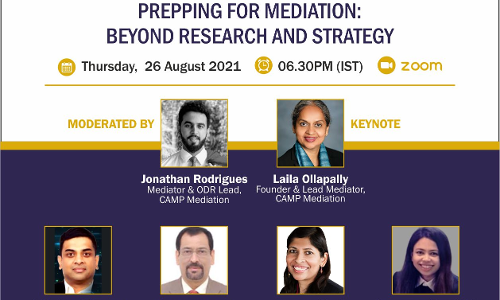
'No Compromise on Preparation before Mediation'
It was an absolute pleasure engaging in an intriguing fireside chat on 'Prepping Your Client for Mediation', organised by CAMP Arbitration and Mediation Practice and IDEX Legal. This was the second episode of #WinThisTogether – a series on the various aspects of Advocacy in Mediation. More information on the Fireside Chat series and the subsequent episodes is available HERE Laila Ollapally, founder and lead mediator, CAMP, set the mood with an inspiring keynote, addressing the role of a...

Damages vs Limitation of Liability
This article examines the conflict between damages as entitled under law versus limiting the damages contractually, more specifically, the issue of whether clauses in a contract such as limitation of liability or such others can disentitle a person from claiming the full amount of damages which a person is otherwise entitled to under law. In this connection, reference may be made to Sections 55, 73 and 74 of the Indian Contract Act, 1872 ("Act") deal with compensation for loss or...
Supreme Court Closes Doors For Withdrawal Or Modification Of Resolution Plans After Acceptance By Committee Of Creditors
The Supreme Court of India, on 13.09.2021, delivered a landmark judgment which has settled the issue of whether withdrawal or modification of the Resolution Plan by the Resolution Applicant, after acceptance by the Committee of Creditors ("CoC") but before approval of the Adjudicating Authority/NCLT, is permissible or not. The bench of Justices D.Y. Chandrachud and M.R. Shah while deciding three Appeals filed by Ebix Singapore PTE Limited, Kundan Care Products Limited and Seroco...
IBC Moratorium Vs Cheque Dishonour Proceedings
The Hon'ble Supreme Court of India has, in the matter of P. Mohanraj & Ors. Vs M/s. Shah Brothers Ispat Pvt. Ltd. has clarified the difference between section 14 of the IBC Code, 2016 and section 138/141 of the Negotiable Instrument Act. Besides determining the difference between the two, Hon'ble Court has also emphasised whether Moratorium under Section 14 of IBC Covers Section 138 of NI Act Proceedings against Corporate Debtor for Cheque Dishonour. First, Hon'ble Court has made...

Medima LLC V. Balasore Alloys Limited
Recently in Medima LLC v. Balasore Alloys Ltd[1], the Hon'ble Calcutta High Court vide its order dated 3rd August 2021 has reiterated that the interim measures available to a party under Section 9 of the Arbitration & Conciliation Act, 1996 ("Act") are applicable to foreign awards unless clearly excluded by the parties in the arbitration agreement.In the present case, Medima LLC ("Medima") and Balasore Alloys Ltd. ("Balasore") had entered into an Agreement dated 31st March 2018...
GST As A Force Majeure Event – In Arbitration Contracts
The High Court of Delhi has recently ruled that the implementation of Goods and Service Tax Act, 2017 (hereinafter referred to as the "GST"), came within the definition of a force majeure event. This ruling came when the petitioner, the National Highways Authority of India (hereinafter referred to as "NHAI") approached the High Court in an application under Section 34 of the Arbitration and Conciliation Act, 1996 (hereinafter referred to as the "A&C Act"), challenging an award of a...