



India's Doping Distress: How Effective Are Anti-Doping Laws?
Vanshika Kataria
13 Nov 2026 10:00 AM IST
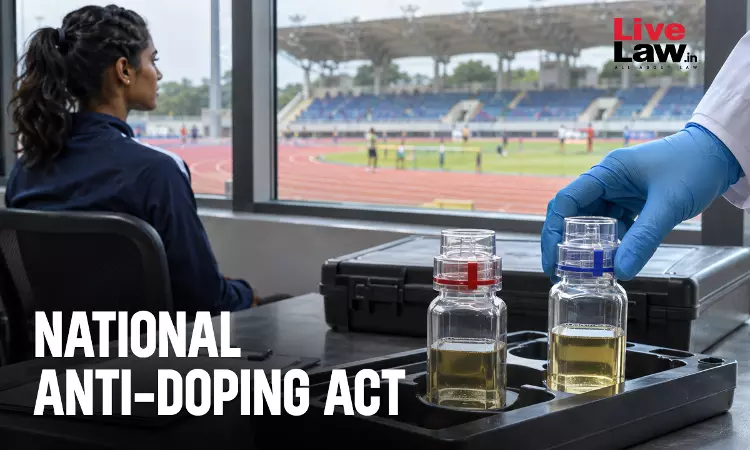
The National Anti-Doping Act, 2022 (Act) was enacted on 12th August 2022 and has been amended once by virtue of the National Anti-Doping (Amendment) Act, 2025 which received presidential assent on 18th August 2025. The legislations have been drafted in conformity with the Convention, Code and international standards prescribed by WADA (World Anti-Doping Agency). Both the legislations have recently come into force on 15th and 16th July 2026, respectively and NADA (National Anti-Doping Agency) has become statutory body under the Act.
Doping refers to practice of consuming an artificial substance to enhance performance in a sports competition. Substances employed to dope are also referred to as 'performance enhancing drugs' (PEDs). Although, doping is the act of ingesting PEDs, legally it is defined as the occurrence of one or more of the anti-doping rule violations (ADRVs) set forth in Article 2 of World Anti-Doping Code, 2021 (Code).


Doping, as an unethical practice includes vast category of individuals ranging from enablers to consumers, among which only the athletes are positioned as prime culprit, reason being, they tested positive for ingestion of banned substances. Various deep-rooted issues contribute to leading performance of India in doping in sports worldwide.
The Principle of Strict Liability
As a general rule, presence of any substance manifesting doping is a conclusive proof to rule out the liability of an athlete for ADRVs, intention being immaterial. However, relaxations on sanction periods have been provided under law in cases of consumption, use, possession and tampering if the accused successfully establishes that the conduct in question was unintentional. For instance, the period of ineligibility in the case of failing to submit the sample is four years but if the athlete can establish that the violation was not intentional, the period of ineligibility shall be two years only. The probability of establishing absence of intention in these cases is generally quite low because of presumption of knowledge against the athletes. Trafficking, administering, complicity and acts to discourage or retaliate against authorities are deemed to be grave and serious violations attracting the ban for lifetime to participate in any event and as such no leniency in sanctioning periods has been provided for them. Principle of strict liability entailed in determining liability of athletes and the near impossibility of them in proving lack of mens rea raises concern as to risk of awarding disproportionate punishment.
The Proposed Amendment to the Act
The government has proposed to amend the National Anti-Doping Act, 2022 by inserting a new Chapter- VIA (Offences & Penalties) consisting of Sections 25A-25I. The Ministry of Youth Affairs and Sports on 19 May 2025, published a draft note containing the proposed amendments asking for comments/suggestions from various stakeholders till 18 June 2026. The amendment intends to criminalize certain category of conducts relating to ADRVs which include trafficking, trading, administering prohibited substance to an athlete, and advertising or promoting the use of prohibited substances. Many sports individuals get influenced by fake advertisements and promotion of products containing prohibited substances and are lured into consuming them. The said issue is closely dealt with by penalizing the companies or individuals engaging in advertisement or paid promotion under the proposed amendment.
The policy rationale behind the proposed amendment is to make those persons criminally liable who provide access to banned substances for the consumption of the athletes whether directly or indirectly. As a matter of fact, criminal prosecution creates more fear among the wrongdoers than disciplinary sanctions such as suspension, disqualification or public disclosure. But the target persons (natural and artificial) of the proposed chapter are narrowed down to the ones who facilitates the commission of doping among athletes which could be anyone including the athletes themselves. Majority of the times when banned substances are caught in athletes' body, the culpability of athlete support personnels is never examined until a prima facie case is there. If these provisions are put into effect, it might help in combating the issue of doping at ground level as the sources of prohibited substances could become traceable.
Moreover, as per Section 25I(4) of the proposed amendment, “The provisions of this Chapter are in addition to and without prejudice to any other liability which a person may incur under this Act or any other law for the time being in force”. The cumulative liability of the offenders as proposed by the amendment raises concerns about the punishment being disproportionate in nature. The penalties are appropriate for persons who engage in organized crime, marketing, advertising and frequent illicit acts of trafficking and administration, not being sports professionals but might be disproportionate for athletes or athlete support personnels who are dependent on sports for their financial survival.
Lack of Legislation on Non-Analytical Findings
No codified law exists in cases of anti-doping violations involving no sample testing and analysis (non-analytical ADRVs) in terms of procedure, rights of the potential violator and procedural safeguards between the stages of potential accusations and transmitting notice of hearing to athletes which is a significant procedural void. Athletes have time and again criticized the absence of procedural fairness in their hearing and investigations when accused of non-analytical findings.
The Procedural Ambiguities
The conducts of trafficking of prohibited substance or method and administering prohibited substance or method are concurrently an offence and ADRV under the Act which raises concern in context to overlapping functions and power to be discharged by distinct authorities under the Act. NADA has the mandatory obligation of 'carrying out investigation of any Anti-Doping Rule Violations' under the Act as per Bharatiya Nagarik Suraksha Sanhita, 2023 and subsequently, the proposed amendment empowers the Central Government to authorise any officer to investigate into the offences laid down in the chapter. The functions and powers of NADA and Central Government intersect in the case of trafficking and administration of banned substances and the following questions come to light-
1. Whether NADA and the government authorised officer will investigate the same conduct separately?
2. Would the criminal prosecution still continue if the disciplinary panel or CAS (Court of Arbitration of Sport) declare the person not guilty?
3. What would be the course of action if the Court acquits the accused but the panel or CAS had already sanctioned them?
4. Whether the evidence collected by one investigating authority will be considered relevant and admissible in the concurrent proceeding?
5. Whether multiple investigations on the same person amount to abuse of power under Article 14 of the Constitution?
Furthermore, as per Article 3.2.3 of the Code, 'Departures from any other International Standard or other anti-doping rule or policy set forth in the Code or these Anti-Doping Rules shall not invalidate analytical results or other evidence of an anti-doping rule violation and shall not constitute a defence to an anti-doping rule violation.' That explains that although appropriate safeguards and procedures are in force, their breach would not call forth any repercussions for the authorities. Under the Act, neither procedural safeguards are guaranteed to any person to whom the Act applies nor their lack is considered a mitigating factor to lower the intensity of the penalty.
Until the enactment of India's National Anti-Doping Act, 2022, the anti-doping legislation was intended to be preventive in nature, but India's surging doping data has shifted the government's focus towards creating deterrence among the violators, thereby proposing to introduce Chapter VIA (Offences & Penalties) under the Act tending to introduce the elements of deterrence in a controlled manner. Moreover, procedural lacunae, concurrent jurisdictions and provisions, and lack of legislations on certain subject-matters raises the question of credibility in the effectiveness of India's legislative framework in counteracting the prevailing issue of doping in India. Therefore, while the statutory framework is seeking to meet the standard requirements of combating doping throughout India, there is a long way to go in curbing the issue of doping downright.
Author is a 7th Semester Law student at Chandigarh University, Mohali, Punjab. Views are personal.


