



Misogyny Masked As Comedy: Sexist Humour, Digital Amplification And Limits Of Free Speech In India
Neeraj
27 Oct 2026 3:00 PM IST
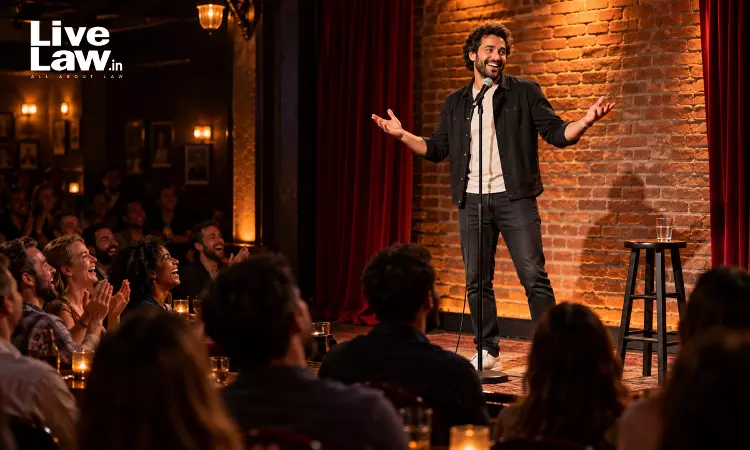
A joke will hang around for 10 seconds on a stage. On the internet, it can remain accessible indefinitely.
This change is highlighted by the recent controversy with stand-up comedian Pranit More. Audience member Himanshu Jangra, during a comedy show in Gurugram, shared that he spent ₹370 on biryani during a date with a girl and suggested that the expenditure entitled him to physical intimacy. The exchange was met with laughter from the audience, recorded and subsequently circulated widely online. The controversy then escalated to police action, including FIRs in Maharashtra and Gurugram. The Supreme Court has since issued notice on More's plea seeking to club the FIRs while the underlying proceedings remain pending.
The most important legal and social question posed by incidents like this one is not merely whether the joke was offensive. It is whether humour changes the way potentially objectionable ideas are received, repeated and eventually normalized, particularly when humour gives those ideas a more socially acceptable form.
Humour has long been used to question social conventions. Satire can be a tool for exposing prejudice, challenging authority and making an uncomfortable subject discussable. However, it can work the other way around as well. When a joke is presented before the audience, laughter may come before reflection on what is being said. A stereotype can become a familiar way of thinking and through repetition, begin to appear ordinary.


Not every sexist joke necessarily produces the same social or legal consequences and offensive humour does not automatically justify criminal punishment. The research on sexist humour reveal a more complex picture, with its effects depending on the content, context and audience. The concern therefore is not humour as such, but what humour can make it easier to say, circulate and tolerate.
“It's Just a Joke”: Article 19(1)(a)
Comedy falls within the broader protection of freedom of speech and expression under Article 19(1)(a) of the Constitution. Protected expression does not have to be agreeable or pleasing. Exaggeration, provocation and discomfort are often the key ingredients of comedy.
While freedom of expression is not absolute. Under Article 19(2) there are constitutional restrictions on the grounds of 'decency or morality'. The problem is that it isn't that comedy needs protecting; it's that it's hard to determine when specific types of expression are crossing a legally defined line.
The Supreme Court's interpretation of Article 19(1)(a) in Shreya Singhal v. Union of India was important, as it made a distinction between discussion, advocacy and incitement. The decision also highlighted the constitutional danger of laws that restrict speech in vague or overbroad terms.
The principle is important for comedy because offensive expression does not automatically become unlawful. A joke can be crude, unpalatable or even be an extremely misogynistic statement, but that does not necessarily make it a crime. Equating social disapproval with legal prohibition would create a problematic precedent for free expression.
But Sexual Content Is Not Legally Neutral Either
The opposite argument here would be equally problematic: that placing an expression within a comedy routine automatically shields it from legal scrutiny.
In the case of Aveek Sarkar v. State of West Bengal, the Supreme Court rejected the earlier Hicklin test on obscenity and replaced it with a contemporary standards approach. The Court emphasized that the context and the totality of the material are to be taken into account in determining whether material is "obscene," rather than the individual words or images.
This is especially so for modern comedy. A sexually explicit reference, vulgar expression or provocative joke cannot be treated as obscene merely because someone finds it shocking. Context matters. Context also means, however, that the word “comedy” doesn't end the legal investigation.
The difference is particularly relevant when humour invokes sexual entitlement, harassment or coercion. The question is not simply whether a joke contains sexual language, but whether the content, considered in context, falls within an existing legal prohibition.
When Humour Reinforces Stereotypes
This becomes especially significant when humour targets historically marginalised groups. In Nipun Malhotra v. Sony Pictures Films India Pvt. Ltd., regarding the depiction of a person with disability in the film 'Aankh Micholi', the Supreme Court clearly differentiated between 'disabling humour', which denigrates and ridicules persons with disabilities and 'disability humour', which questions conventional notions of disability. The Court drew this correlation to dignity and reinforcement of stereotypes.
The case was not about sexist humour; it concerned the portrayal of disability in cinema. It therefore cannot be taken as an outright decision by the court that misogynistic comedy is illegal. Its reasoning, however, raises a broader question about gender: who is the joke actually on?
The use of humour as a way of revealing a sexist stereotype and the use of humour that relies on the acceptance of the stereotype as the punchline are very different.
A joke about the ridiculousness of women's supposed irrationality challenges the stereotype in a different way from a joke whose humour relies on portraying women as being "dumb". In the first, the stereotype is the object of criticism; in the second, the stereotype becomes the means of the joke.
This is especially critical because comedy can mask the assumption on which the joke is based.
Digital Amplification and Loss of Context
A comedian performing in front of a live crowd operates within a particular context. The entire exchange is heard, their persona is known to the audience and they hear the reactions in the room. After a short clip is cut out and uploaded, all that context can be lost.
The Pranit More controversy illustrates how quickly this can happen. Clips from the Gurugram programme have been shared on platforms like YouTube and Instagram and Maharashtra Cyber Police logged an FIR against the allegedly obscene and objectionable online content.
This does not create a new constitutional test for viral jokes. It alters the speed and scale at which speech operates socially. The words of a comment originally heard by a few hundred people can now be shared with millions without the context in which they were uttered.
This is where the phrase " 'it was only a joke' " becomes misleading. A joke can be legally protected and still participate in a broader culture of normalisation. Conversely, social harm alone does not justify criminalisation unless the speech meets the requirements of an existing legal prohibition.
The difficulty lies in having to fight both extremes; having the misogynistic humour considered automatically illegal and having the word “comedy” considered as an automatic shield against review.
The Joke Is Not Always the Problem; Sometimes It Is What the Joke Makes Ordinary
Often, misogyny is not stated as hatred but simply presented as ordinary. It can manifest itself in repetition, in stereotypes and in seemingly innocuous expectations for women to tolerate.
Those assumptions can be easier to accept when presented through humour because people laugh and create distance between themselves and the proposition contained in the joke. The audience can ignore the literal statement, “it was only a joke”, but get used to the stereotype coming back from the lips of others.
So stripping the debate of its nuances and determining if comedians were “allowed” to say sexist jokes is not the proper way to go about it. What sort of humour do we create, what are we assuming, who is paying the price when those assumptions are being continuously made and entertained?
The role of the law has a more limited one. It should determine if there are specific acts of speech that are legally prohibited, without infringing the constitutional right to comedy, satire and dissent.
But the response of society is not limited to the legal threshold. Something can be legally permissible and it can still be criticised. Being offensive and being criminally punishable are two different things. Attitudes that underlie a joke can be revealed and reinforced when presented as a joke.
If the punchline relies on making women smaller, perhaps the joke is not really on women at all; it's on the person telling it.
Author is a second-year B.A. LL.B. (Hons.) student at the National University of Study and Research in Law, Ranchi. Views are personal.


