



10 Former Chief Justices Of India Inaugurate First-Ever CJI Museum At Jindal Global University
Law School Correspondent
27 Nov 2026 1:02 PM IST
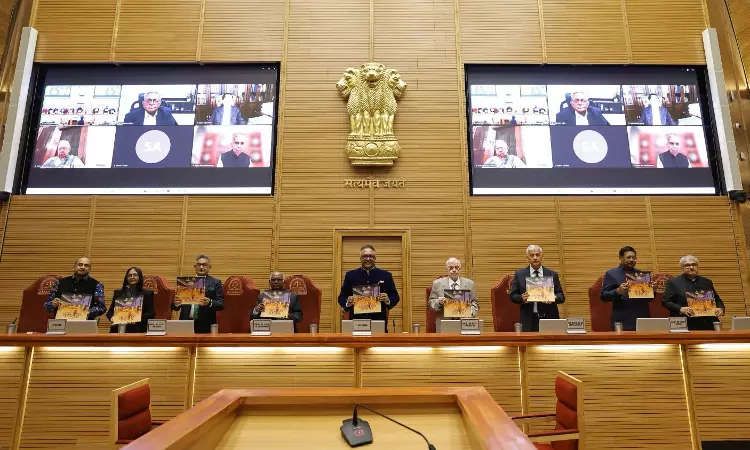
Ten former Chief Justices of India, including M.N. Venkatachaliah, B.N. Kirpal, B.R. Gavai and U.U. Lalit, inaugurated India's first Museum dedicated to the Chief Justices of India at O.P. Jindal Global University (JGU), Sonipat, on November 25, on the eve of Constitution Day.
The former Chief Justices who participated in the inauguration, either in person or virtually, were M.N. Venkatachaliah, B.N. Kirpal, S. Rajendra Babu, K.G. Balakrishnan, P. Sathasivam, R.M. Lodha, Dipak Misra, Sharad A. Bobde, U.U. Lalit and B.R. Gavai.
Titled 'Guardians of the Republic', the Museum seeks to document the lives and contributions of successive Chief Justices of India and trace the evolution of the Supreme Court and India's constitutional framework. Spread across five galleries, it features more than 280 busts of Supreme Court judges, models of 25 High Courts, 22 language tapestries, 20 interactive biographical pillars and exhibits on 20 landmark judgments. It also houses a holographic courtroom, artworks, sculptures and installations.


Naveen Jindal, the Founding Chancellor of JGU, said the Museum extends the vision of the university's Constitution Museum by highlighting the Supreme Court's role in protecting constitutional values.
He said that his own journey to secure every citizen's right to fly the national flag had reinforced his understanding of the Constitution as a living promise, sustained by an independent judiciary. He referred to the Supreme Court's recognition of the right to fly the national flag in 2004 as an example of the role of courts in protecting citizens' freedoms.
Professor C. Raj Kumar, Founding Vice Chancellor of JGU, said the Museum explores justice as an evolving idea and traces how the Supreme Court, through its Chief Justices and judges, has shaped India's constitutional democracy. He said the initiative brings together law, history, memory and public engagement to document the collective legacy of successive Chief Justices.
Observations By Former Chief Justices
Former Chief Justices highlighted the importance of judicial independence, constitutional values, the rule of law and legal education while speaking about the significance of preserving the history of the Supreme Court.
Justice M.N. Venkatachaliah said freedom, democratic ideals and the rule of law had been among the principal factors contributing to India's progress and economic growth. He observed that the Museum would nurture legal education and help future legal practitioners understand the role of institutions in creating an environment conducive to sustained economic development.
Justice B.R. Gavai congratulated JGU on establishing the Museum and said it showcased not only the contributions of successive Chief Justices but also the Supreme Court's role in shaping constitutional law over the past 76 years.
Referring to his own journey from a modest background to the office of the Chief Justice of India, he said his appointment to the apex court demonstrated the Constitution's commitment to inclusiveness and wider representation. He also referred to efforts during his tenure to advance the vision of Dr. B.R. Ambedkar by ensuring representation for Scheduled Castes, Scheduled Tribes, minorities and women.
Justice U.U. Lalit said the Museum traced the development of jurisprudence alongside the growth of the nation. He observed that the evolution of law was closely connected with economic development and the well-being of the population. Referring to India's progress since Independence, he said judicial interventions at various stages had contributed to the country's development.
Justice Sharad A. Bobde spoke about the responsibility of the judiciary in upholding the rule of law and recalled the challenges faced by the Supreme Court during the COVID-19 pandemic, including the introduction and formalisation of online hearings. He said the Constitution remained the bulwark of the nation and recalled that the Supreme Court continued to function on all working days during the pandemic.
Justice Dipak Misra emphasised the role of universities in imparting knowledge and nurturing constitutional values. He said judges must abandon conditioned thinking that was inconsistent with the Constitution. He described the Museum as a reflection of the ideals of liberty, equality and fraternity.
Justice S. Rajendra Babu traced the growth of the Supreme Court from its establishment in 1950 with eight judges to its present strength. He observed that the substantial increase in litigation reflected the complex questions concerning citizens' rights, the powers of the State and the constitutional structure that came before the Court.
He said public confidence in courts depended not only on their judgments but also on public understanding of their functioning. He added that the Museum would benefit law scholars and researchers.
Justice R.M. Lodha described the Supreme Court as an institution symbolising the supremacy of the Constitution and the rule of law. Referring to the landmark judgments displayed in the Museum, he spoke about the development of public interest litigation and the basic structure doctrine.
He observed that the Supreme Court had experienced both periods of great achievement and difficult phases, but its contribution to removing inequalities and protecting constitutional principles had been significant.
Justice P. Sathasivam recalled that the office of the Chief Justice was relatively modest when the Supreme Court first began functioning in January 1950, but had since evolved into one of the most important institutions of India's constitutional democracy.
He said the Supreme Court had withstood external pressures through three essential principles: independence from the executive, integrity that earns public trust, and transparency that converts that trust into confidence.
Justice K.G. Balakrishnan urged law students to study the foundational principles of the Constitution and understand their responsibilities as future legal professionals. He said universities had an important role in preparing future leaders in law and guiding students towards the responsible practice of the profession.
Justice B.N. Kirpal also participated in the commemorative proceedings.
Five Galleries Trace India's Judicial And Constitutional Journey
The Museum is organised into five galleries, each focusing on a different aspect of India's judicial history and constitutional development.
Pathways of Justice explores the historical and social foundations of justice. It features ten marble plaques recalling trials from colonial India and artworks addressing issues such as untouchability, dowry, bonded labour, education, transparency, workplace dignity and climate justice. The gallery also includes a wall of books titled 'Reading Justice' and a model of the Supreme Court beneath an installation called 'Branches of Justice'.
Pillars of Justice presents the lives and contributions of judicial leaders through 20 interactive pillars, each equipped with four screens. It also features 22 regional handloom tapestries representing the word 'justice' in the languages listed in the Eighth Schedule of the Constitution, along with models of 25 High Courts.
Hall of Constitutional Voices features recordings of 11 personalities who contributed to India's constitutional imagination. It also houses an Oral History Project comprising conversations with former Chief Justices and distinguished judges, preserving their reflections for future generations.
Keystones of Justice focuses on 20 landmark judgments and the constitutional principles underlying them. Its exhibits include a holographic courtroom and an installation titled 'From Paper to Precedent', created using ceramics, paper and jute to represent the work involved in delivering judgments.
Ideas of Justice features a sculpture garden and busts of judges, using artistic installations to explore the responsibilities and significance of judicial office. The gallery includes 'The Robe of Justice' and 'The Right to Fly', the latter reflecting Naveen Jindal's legal journey concerning citizens' right to fly the national flag.
The Museum was inaugurated on the eve of Constitution Day, observed on November 26 to commemorate the adoption of the Constitution by the Constituent Assembly on November 26, 1949.


