


Supreme court
Supreme Court Weekly Round-up: June 30, 2025 To July 6, 2025
Reports/Judgements ♦ Supreme Court Declines Plea Seeking Handover Of Mahabodhi Mahavihara At Gaya To Buddhists; Allows To Approach HCCase Title : Sulekhatai Nalinitai Narayanrao Kumbhare v. The Union of India | Diary No. 19102/2025The Supreme Court refused to entertain a writ petition seeking to hand over the management of the Mahabodhi Mahavihara at Bodh Gaya, Bihar to...

Supreme Court Weekly Round-up: June 23, 2025 To June 30, 2025
Reports/ JudgmentsSupreme Court Decries Tactic Of Obtaining Bail By Offering Money Deposit & Later Challenging Condition As OnerousCase Title: KUNDAN SINGH Versus THE SUPERINTENDENT OF CGST AND CENTRAL EXCISE, SLP(Crl) No. 9111/2025Citation : 2025 LiveLaw (SC) 686The Supreme Court strongly deprecated the practice of parties getting anticipatory/regular bail orders from courts...
Prosecutor Working On Contractual Basis Cannot Claim Regularisation : Supreme Court
The Supreme Court recently rejected a plea by a Public Prosecutor, appointed on a contractual basis, seeking regularisation.A bench of Justice Sandeep Mehta and Justice Joymalya Bagchi held that the Calcutta High Court had not committed any error in rejecting the petitioner's writ application seeking directions for regularisation. The Court noted that the petitioner had himself been...

Legal Heirs Of Negligent Driver Not Entitled To Compensation Under Motor Vehicle Act : Supreme Court
The Supreme Court on Wednesday (July 2) reiterated that the legal heirs of the deceased person driving a vehicle negligently cannot seek compensation under the Motor Vehicles Act (“MV Act”). The partial court working days bench of Justices PS Narasimha and R Mahadevan refused to interfere with the Karnataka High Court's decision, which had dismissed the plea filed by the deceased legal...
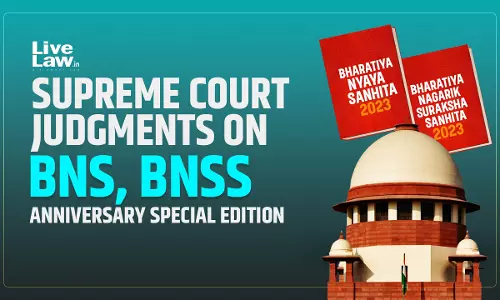
One Year Of New Criminal Laws : Key Supreme Court Judgments On BNS, BNSS
The new criminal laws, Bharatiya Nyaya Sanhita, Bharatiya Nagarik Suraksha Sanhita and the Bharatiya Sakshya Adhiniyam, came into effect exactly a year ago, on July 1, 2024. As we mark their first anniversary, let us look at how the Supreme Court has interpreted and applied these provisions over the past year.SUPREME COURTSupreme Court Allows Benefit Of Section 479 BNSS To Undertrials In...
Supreme Court Weekly Round-up: June 16, 2025 To June 22, 2025
Reports/JudgmentsMere Involvement In Communal Clash Not Enough To Attract UP Gangsters Act Without Proof of Habitual Criminality : Supreme CourtCase Details: Lal Mohd. & Anr. v. State of U.P. & Ors.Citation: 2025 LiveLaw (SC) 685The Supreme Court held that stringent state laws such as the U.P. Gangsters and Anti-Social Activities (Prevention) Act, 1986 (“Gangsters Act”) cannot...
Can Stone Crusher Units Operate In Eco-Sensitive Zones? Supreme Court Allows Issue To Be Raised In Kerala HC
The issue whether a stone crusher unit can operate in the Eco Sensitive Zones (ESZ) notified around protected forests can be raised before the Kerala High Court, the Supreme Court observed recently, while allowing the withdrawal of a petition.A bench comprising Justice KV Viswanathan and Justice NK Singh was hearing a special leave petition filed by M/s Alankar Granites challenging the order...
Mere Recovery Of Weapon With Victim's Blood Group Not Enough For Murder Conviction: Supreme Court
The Supreme Court recently dismissed an appeal filed by the State of Rajasthan challenging the acquittal of a murder accused, observing that mere recovery of a blood-stained weapon matching the victim's blood group is not enough for a murder conviction.A bench of Justice Sandeep Mehta and Justice Prasanna B. Varale upheld the High Court's judgment dated May 15, 2015, which had set aside...
Courts Should Refrain From Staying Conviction Of Public Servants In Corruption Cases : Supreme Court Reiterates
The Supreme Court recently refused to stay conviction of a public servant convicted under the Prevention of Corruption Act, 1988, noting that courts should refrain from staying conviction of public servants who have been convicted on charges of corruption. A bench of Justice Sandeep Mehta and Justice Prasanna B. Varale noted that there was no reason to interfere with the Gujarat High Court...
NEET-PG : Supreme Court Grants Relief To Candidate Denied Admission Despite Paying Rs 27 Lakhs Fee; Allows Him To Attend Class
The Supreme Court on Wednesday (June 25) granted interim relief to a NEET-PG 2024 candidate, who was denied admission due to a delay in reporting to college despite paying the fees. The Court directed the medical college to allow the petitioner to attend the PG class from tomorrow onwards.A bench of Justices KV Viswanathan and N Kotiswar Singh passed the order in the peculiar facts of the...