Supreme court
Supreme Court Decries Tactic Of Obtaining Bail By Offering Money Deposit & Later Challenging Condition As Onerous
The Supreme Court today strongly deprecated the practice of parties getting anticipatory/regular bail orders from courts after voluntarily offering to deposit substantial amounts but later going back on the statements and approaching higher courts claiming that the condition imposed while granting bail was onerous or the concerned counsel did not have authority to make the statement."We...
Stringent Penal Laws Like UP Gangsters Act Can't Be Used As Tool Of Harassment : Supreme Court
The Supreme Court cautioned against the routine invocation of stringent extraordinary legislation like the UP Gangsters Act (“Act”), stating that such laws must be invoked judiciously based on relevant considerations without acting as a tool for harassment. “The constitutional guarantee of personal liberty acquires even greater significance when extraordinary legislation with...
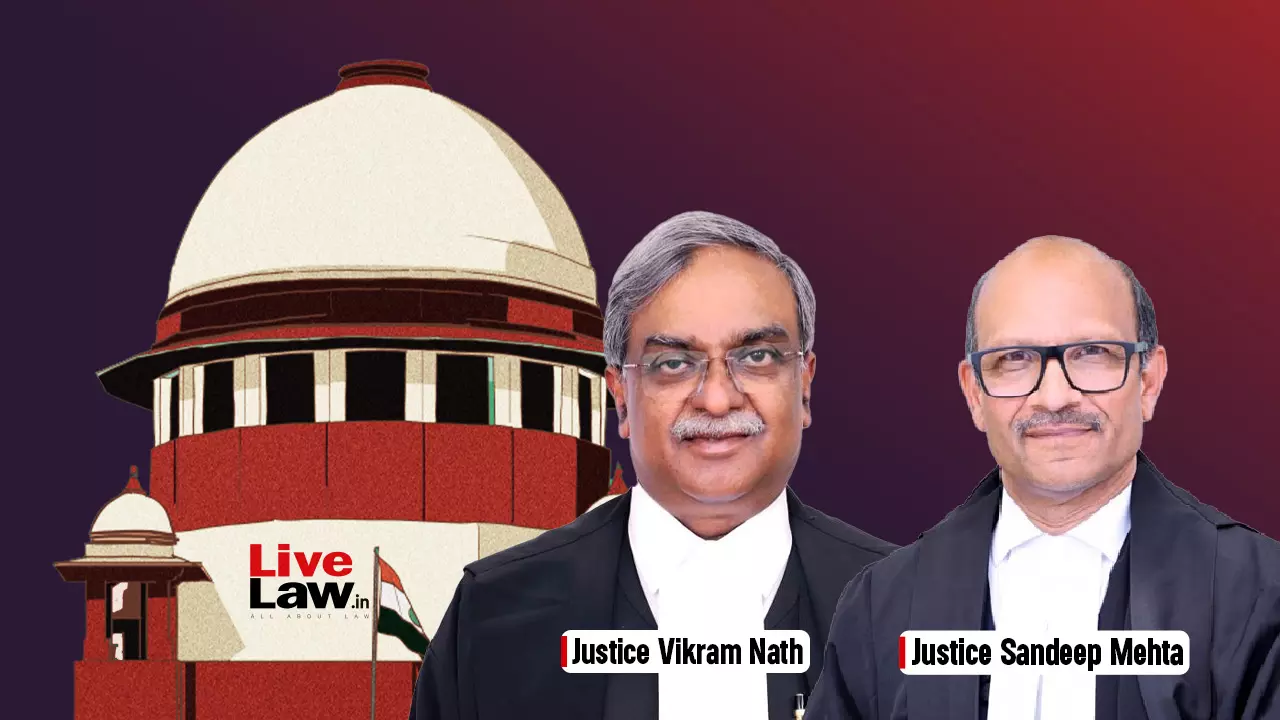
Mere Involvement In Communal Clash Not Enough To Attract UP Gangsters Act Without Proof Of Habitual Criminality : Supreme Court
The Supreme Court recently held that stringent state laws such as the U.P. Gangsters and Anti-Social Activities (Prevention) Act, 1986 (“Gangsters Act”) cannot be applied to individuals solely for their involvement in a single incident of anti-social activity, in the absence of evidence indicating prior or ongoing coordinated criminal conduct. “The mere listing of multiple accused...
Supreme Court Monthly Round-up: May 2025
Reports/JudgmentsMotor Accident Claims | Unemployed Husband Can Be Presumed To Be Partially Dependent On Deceased Wife's Income: Supreme CourtCase Details: Sri Malakappa & Ors. v. Iffco Tokio General Insurance Company Limited & Anr.Citation: 2025 LiveLaw (SC) 511The Supreme Court held that in determining insurance compensation, the deceased's husband cannot be excluded as a...
Agreement To Sell Not Conveyance, Can't Give Any Right In Property Without Suit For Specific Performance : Supreme Court
The Supreme Court recently reiterated that in the absence of a suit for specific performance of a contract, an agreement to sell cannot be relied upon for claiming ownership or title over the property.“In the absence of a suit for specific performance, the agreement to sell cannot be relied upon to claim ownership or to assert any transferable interest in the property.”, the...
Mere Absconding Not Proof Of Guilt, But Relevant Conduct Under S.8 Evidence Act : Supreme Court
The Supreme Court recently observed that while mere absconding after the commission of a crime does not by itself establish guilt, it is a relevant fact under Section 8 of the Evidence Act, as it reflects the conduct of the accused and may indicate a guilty mind. Holding thus, the bench of Justices Surya Kant and N. Kotiswar Singh upheld the appellant's conviction for murder, noting that he...

Supreme Court Weekly Round-up: June 9, 2025 To June 15, 2025
Reports/Judgements♦ Supreme Court Refuses To Urgently List Tamil Nadu's Suit Against Centre For Education FundsCase Title: State of Tamil Nadu v. Union of India | Diary No. 28793/2025 The Supreme Court on June 9 refused to urgently list the suit filed by the Tamil Nadu government against the Centre for the release of over Rs 2291 crores under the Samagra Shiksha Scheme (SSS). A...
Res Judicata Principle Applies To Different Stages Of Same Proceedings As Well : Supreme Court
The Supreme Court recently observed that the principle of res judicata not only applies to different sets of proceedings but also to different stages of the same proceedings. Holding thus, the bench comprising Justices JB Pardiwala and R Mahadevan upheld the Kerala High Court's finding which had dismissed the Appellant's Order I Rule 10 CPC application objecting impleadment of a legal heir...

Legal Heir Impleaded After Order 22 Rule 4 Enquiry Can't Be Deleted Later Invoking Order 1 Rule 10 CPC : Supreme Court
The Supreme Court recently clarified that while the power to add or remove parties under Order I Rule 10 of the Civil Procedure Code (CPC) can be exercised at any stage of the proceedings, this does not entitle a party to raise objections to impleadment of a legal heir at a later stage if the parry had sufficient opportunity to raise objections at the stage of Order XXII Rule 4. The...