


Supreme court
S. 215B MV Act | Supreme Court Directs Centre To Constitute National Road Safety Board Within Six Months
The Supreme Court recently questioned the Central Government for failing to implement Section 215B of the Motor Vehicles Act, 1988 and constitute the National Road Safety Board.A bench of Justice Abhay Oka and Justice Ujjal Bhuyan granted six months to the Government to ensure that the National Road Safety Board is constituted. The Court clarified that no further time would be granted....
Supreme Court Declares Maharashtra's Zudpi Jungles As Protected Forests, Directs Scrutiny Of Post-1996 Allotments
The Supreme Court today (May 22) held that Zudpi jungle lands in Maharashtra are forest lands, bringing them under the purview of the Forest Conservation Act, 1980 (“FC Act”) and stalling their conversion without prior approval from the Central Government. The judgment delivered by a bench of Chief Justice B.R. Gavai and Justice A.G. Masih held that all Zudpi Jungle land allotments...
Duty Of Central Government To Keep Highways Free Of Encroachment: Supreme Court Issues Directions
The Supreme Court has issued various directions to the Union Government and Highway Administration for the removal of encroachments on National Highways, while expressing dissatisfaction over ineffective implementation of statutory provisions under the Control of National Highways (Land and Traffic) Act, 2002.The directions include – The Union of India and Highway Administration must...
NEET PG| Supreme Court Directs Publication Of Raw Score, Answer Keys And Normalization Formula Of NEET-PG Exam
The Supreme Court has directed that the raw scores, answer keys and normalisation formulae of NEET-PG examinations must be published.This was one among the slew of directions issued by a bench comprising Justice JB Pardiwala and J R Mahadevan to ensure transparency in the counselling process and to prevent the malpractice of seat-blocking."Publish raw scores, answer keys and...
Supreme Court Upholds Kerala's Luxury Tax On Cable TV As Constitutionally Valid
The Supreme Court today (May 22) upheld the constitutional validity of the Kerala luxury tax and allowed Kerala's appeal, affirming the state's power to tax cable TV services under Entry 62 of List II (State List) as “luxury.” The Court clarified that the service tax imposed by the Finance Act on broadcasting services under Entry 97 of List I (Union List) does not conflict with state...
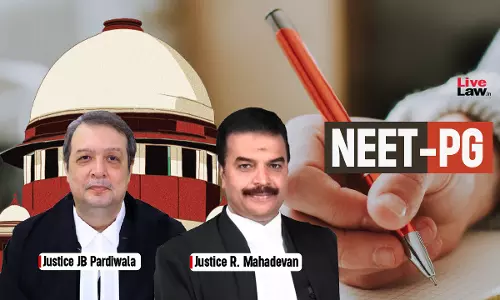
NEET-PG : Supreme Court Issues Directions To Prevent Seat-Blocking; Mandates Pre-Counselling Fee Disclosure By Colleges
The Supreme Court issued a slew of directions regarding the conduct of counselling for NEET-PG (National Eligibility-cum-Entrance Test- Post Graduate) to tackle the malpractices of seat-blocking for admissions to post-graduate medical courses.The bench of Justice JB Pardiwala and Justice R Mahadevan was considering the issue of large-scale blocking of seats during the Medical...
Supreme Court Reinstates Rajasthan Judicial Officer Dismissed Over Alleged Concealment Of Govt Job
In a significant ruling today, the Supreme Court of India allowed the appeal filed by a former judicial magistrate from Rajasthan, who was dismissed from service over allegations of concealment of employment and academic impropriety. The bench comprising Justices BV Nagarathna and SC Sharma set aside the High Court's Full Court decision to terminate the Appellant from the judicial service...
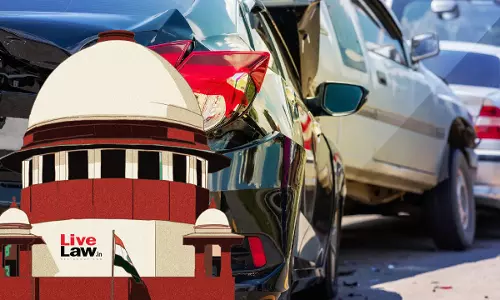
Implement Cashless Treatment Scheme For Accident Victims in True Spirit: Supreme Court To Centre
The Supreme Court recently directed the Central Government to ensure that the Cashless Treatment Scheme for Road Accident Victims Scheme, 2025, which was notified on May 5, 2025, is implemented in its true letter and spirit.The scheme has been framed under Section 162 of the Motor Vehicles Act, 1988, which mandates the government to provide cashless treatment to road accident victims during...
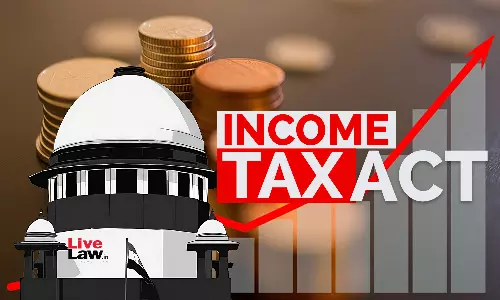
Income Tax Act | Supreme Court Clarifies Restriction Under S.80-IA(9) On Claiming Cumulative Deductions Under S.80IA & 80-HHC
Answering a reference, the Supreme Court held that deductions under Sections 80-IA/80-IB of the Income Tax Act need not reduce the gross total income before computing deductions under other provisions like Section 80-HH for export profits.The bench comprising Justices Abhay S Oka, Ahsanuddin Amanullah and AG Masih delivered the verdict while answering a reference after a matter was referred...
