


Supreme court
Attempts To Spread Communal Hatred & Indulge In Hate Speech Must Be Dealt With Iron Hand : Supreme Court
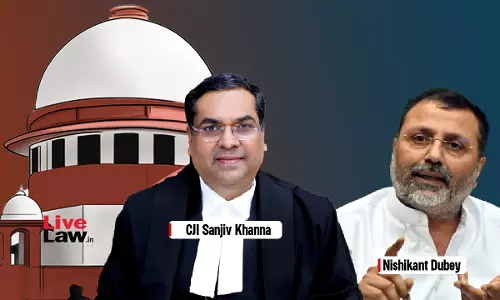
The Supreme Court observed that attempts to spread communal hatred and indulge in hate speech must be dealt with an iron hand. It asserted that hate speech cannot be tolerated."Any attempt to cause alienation or humiliation of the targeted group is a criminal offence and must be dealt with accordingly," the Court said.A bench comprising Chief Justice of India Sanjiv Khanna and Justice...

Supreme Court Delivers Split Verdict On Guilt Of Ex-TN Minister's Wife In Whose Name Disproportionate Assets Were Registered
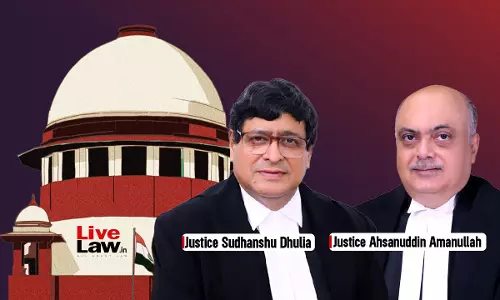
The Supreme Court on Wednesday (May 7) delivered a split verdict on the culpability of P. Nallammal, the wife of former Tamil Nadu Minister, for her alleged role in abetting her husband in a disproportionate assets case under the Prevention of Corruption Act, 1988 (PC Act).The bench of Justices Sudhanshu Dhulia and Ahsanuddin Amanullah delivered a split verdict in a case where A.M. Paramasivam,...
High Court May Grant Article 227 Interim Relief In Arbitration Proceedings In Exceptional Cases : Supreme Court
aThe Supreme Court (May 7) held that while the Arbitration and Conciliation Act, 1996 (“Arbitration Act”) mandates minimal judicial interference, a High Court may, in exceptional cases, exercise its supervisory jurisdiction under Article 227 of the Constitution to grant interim relief, particularly where denial of such protection would result in irreparable harm. “We are aware of...
S.319 CrPC Summoning Order Can't Be Quashed Based On Alibi Evidence Of Additional Accused : Supreme Court
The Supreme Court held that to summon an additional accused under Section 319 of the Cr.P.C., it is not necessary to establish guilt beyond a reasonable doubt; a person may be summoned if there is prima facie evidence indicating their involvement in the offence. “Indeed, it is difficult to conceive of what stronger material could be demanded at the summoning stage short of a confession....
S. 61(2) IBC | Appeal Filed Beyond 45 Days Not Condonable By NCLAT : Supreme Court
The Supreme Court today (May 7) ruled that the National Company Law Appellate Tribunal (NCLAT), acting as the Adjudicating Authority under the Insolvency and Bankruptcy Code, 2016 (Code), has no power to condone delays in filing appeals beyond the prescribed limit of 45 (30+15) days under Section 61(2) of the Code. Accordingly, the bench of Justices JB Pardiwala and R Mahadevan set aside...


Supreme Court Directs NCR States To Issue Directions Under S.5 Environment Protection Act To Enforce Firecrackers' Ban
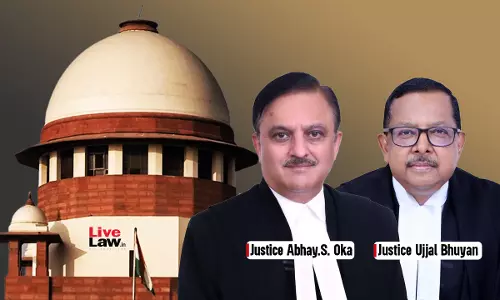
The Supreme Court on Tuesday directed the states of Uttar Pradesh, Rajasthan and Haryana to issue directions under Section 5 of the Environment Protection Act, 1986, enforcing a complete ban on firecrackers in the National Capital Region (NCR). A bench of Justice Abhay S. Oka and Justice Ujjal Bhuyan was hearing the MC Mehta matter concerning air pollution in Delhi NCR from various sources...