


Supreme court
Dispute Over Full & Final Settlement Is Arbitrable Despite Parties Discharging Contract : Supreme Court
The Supreme Court today (May 6) observed that if the insured alleges coercion in arriving at a settlement with the insurer, then the dispute over the validity of the settlement remains arbitrable. “Any dispute pertaining to the full and final settlement itself by necessary implication being a dispute arising out of or in relation to or under the substantive contract would not be precluded...
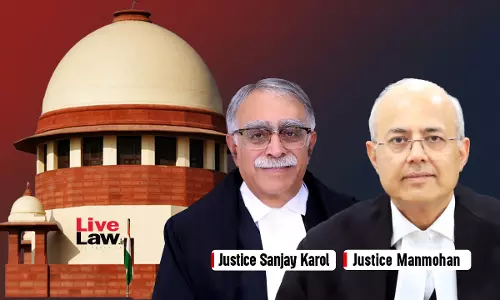
Suits Can Be Dismissed Suo Motu Under Order XII Rule 6 CPC Based On Plaintiff's Admissions : Supreme Court
The Supreme Court today (May 6) ruled that under Order XII Rule 6 of the CPC, a court may not only pass a decree in the plaintiff's favour based on the defendant's admissions but may also dismiss a suit where the plaintiff's admissions undermine the claim. Relying on the recent case of Rajiv Ghosh v. Satya Narayan Jaiswal, the bench comprising Justices Sanjay Karol and Manmohan affirmed that...

Mere Performance Of Another Religious Ritual Doesn't Mean Giving Up Of One's Own Religion : Supreme Court
The Supreme Court today(May 6) set aside the Kerala High Court's judgment which annulled the election of CPI(M) MLA A Raja in the 2021 Legislative Assembly elections.A bench comprising Justice AS Oka and Justice Ahsanuddin Amanullah allowed the appeal filed by Raja against the the March 23, 2023 order of the Kerala High Court which annulled his elections on ground that he was not a member of...
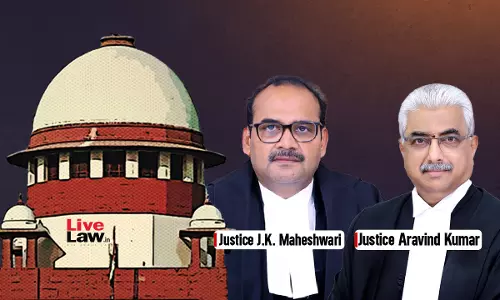
Appeals To Restore Death Penalty Don't Require 3-Judge Bench Hearing : Supreme Court Rejects Godhra Case Convicts' Objections
The Supreme Court today(May 6) began the final hearing of the 2018 appeals pending in the 2002 Godhra train burning case. The criminal appeals, filed by the convicts challenging their conviction and the State of Gujarat seeking death sentence for the convicts, were listed before a bench of Justice J.K. Maheshwari and Justice Aravind Kumar. At the outset, Senior Advocate Sanjay Hegde, for...
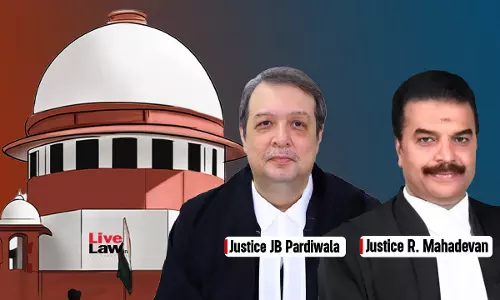
Order XVIII Rule 17 CPC | Power To Recall Witness Vests With Court, Parties Cannot Do Without Court's Leave : Supreme Court
The Supreme Court held that Order XVIII Rule 17 of the CPC empowers the court to recall a witness at any stage solely for the purpose of seeking clarification, but it does not grant any right to the parties to recall witnesses for further examination or cross-examination. The Court further clarified that the power under Order XVIII Rule 17 should be exercised strictly to remove ambiguities...
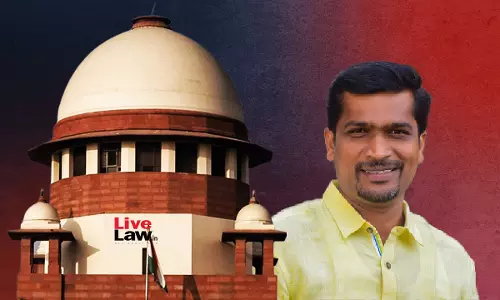
Supreme Court Sets Aside Kerala HC Judgment Which Anulled Election Of CPI(M) MLA A Raja
The Supreme Court today(May 6) set aside the Kerala High Court's judgment, which set aside the election of CPI(M) MLA A Raja in the 2021 Legislative Assembly elections.A bench comprising Justice AS Oka and Justice Ahsanuddin Amanullah allowed the appeal filed by Raja against the the March 23, 2023 order of the Kerala High Court which annulled his elections on ground that he was not a member...
'Replacement Of Damaged Transformers Operational Cost', Supreme Court Dismisses PowerGrid's Plea To Recover ₹24 Crore Through Tariff Hike
In a significant ruling, the Supreme Court on Monday (May 5) dismissed Power Grid Corporation of India's appeal seeking to recover ₹24 crores in replacement costs for damaged transformers through electricity tariffs. The Court held that replacing Inter-Connecting Transformers due to operational failure constitutes an operational expense, not 'additional work', and therefore does not justify...
S. 17 Limitation Act | To Get Over Limitation, Plaintiff Should Show Fraud Prevented Knowledge Of Right To Sue; Not Just Fraud In Sale : Supreme Court
The Supreme Court recently clarified that to seek an exemption from the limitation period under Section 17 of the Limitation Act, 1963, a plaintiff must demonstrate that fraud actively prevented them from knowing their right to sue, instead of merely claiming that the sale deed was fraudulently executed. Section 17 of the Limitation Act says that limitation period in respect of a...

Motor Accident Claim | Tractor's Insurer Liable For Death Of Passenger In Trailer Due To Tractor's Negligence : Supreme Court
The Supreme Court today (May 5) ruled that if an insured tractor causes an accident involving an uninsured trailer, the insurer remains liable.The Court said that if the accident was not due to any independent fault of the trailer but occurred during its movement with the tractor, then the insurer cannot shy away from its liability towards the third-party liability. Holding thus, the bench...

'Reasonable Accommodation Not Charity But Fundamental Right' : Supreme Allows AIIMS Admission For Candidate With Disability
The Supreme Court recently passed an order directing an allotment of a seat in the MBBS UG Course 2025-26 against the 'Scheduled Castes Persons with Benchmark Disability' quota in the All-India Institute of Medical Science, New Delhi, for a candidate suffering from congenital absence of multiple fingers in both hands as well as the involvement of left foot."Manifestly, in view of the...
Electricity Act | Cross-Subsidy Surcharge Based On Prevailing Tariff Rates Valid Even If Decided Separately : Supreme Court
In a major development concerning the discoms, the Supreme Court recently noted that while the determination of the Cross-Subsidy Surcharge (CSS) should be consistent with the applicable tariff rates for the relevant financial year, it is not essential for the CSS to be determined alongside the tariff rates determination. Holding thus, the bench comprising Justices Abhay S. Oka and A.G....
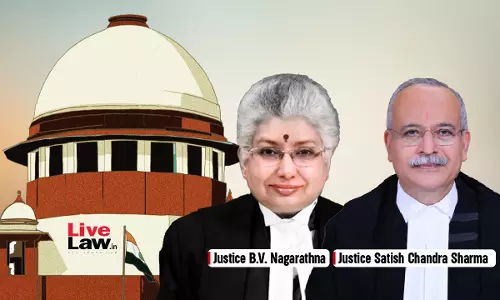
In Direct Recruitment Through Exam, Seniority Must Be Based On Marks & Not Past Service : Supreme Court
The Supreme Court recently invalidated a Tamil Nadu government order that gave in-service candidates seniority over open market recruits, despite the latter scoring higher marks in the selection exams. The Court emphasized that seniority should be based on performance in the exams rather than unrelated factors such as prior in-service experience. The Court reiterated that once an appointment...