Supreme court

Supreme Court Issues Directions To Ensure Direct Bank Transfer Of Compensation To Road Accident Victims & Workmen
The Supreme Court has passed a set of directions to ensure that the compensation paid to claimants under the Motor Vehicles Act, 1988 or the Workmen's Compensation Act, 1923 are directly credited to their bank accounts.The Court passed these directions after noticing that huge amounts of compensation passed under these laws are lying unclaimed before Courts. Based on a letter received from...
Muslim Member Of State Bar Council Can't Continue In Waqf Board After End Of Term In Bar Council : Supreme Court
The Supreme Court held that a person appointed as a member of the State Waqf Board by virtue of being a Muslim member of a State Bar Council can no longer continue to be a member of the State Waqf Board after he ceased to be a member of the Bar Council.As per Section 14 of the Waqf Act(before the 2025 amendment), a Muslim member of the Bar Council of a State/UT can be appointed as a member of...
Supreme Court Upholds Hospital's Vicarious Liability For Doctor's Negligence
The Supreme Court today (April 22) upheld the NCDRC's finding of the hospital being vicariously liable for the medical negligence of the doctor, which caused the death of a patient. The NCDRC imposed a total compensation of ₹20 lakhs (₹15 lakhs on the hospital and ₹5 lakhs on the doctor), leading to an appeal before the Supreme Court by the Hospital. Affirming the NCDRC's findings,...
RFCTLARR Act | Market Value Of Acquired Land Must Be Determined Based On Date Of Section 11 Notification : Supreme Court
The Supreme Court on Monday (April 21) ruled that the market value of the land acquired under the Right to Fair Compensation and Transparency in Land Acquisition, Rehabilitation and Resettlement Act, 2013 (“2013 Act”) should be determined from the date on which the acquisition notification is issued under Section 11. Holding thus, the bench comprising Justices Dipankar Datta and Manmohan...
Maharashtra Ownership Flats Act | Writ Court Shouldn't Interfere With Deemed Conveyance Order Unless Manifestly Illegal : Supreme Court
In a significant judgment related to the Maharashtra Ownership Flats Act, 1963 (“MOFA”), the Supreme Court on Monday (April 21) held that the competent authority under MOFA has the power to grant an order of deemed conveyance. It further emphasized that High Courts should not interfere with such orders unless they are found to be illegal. The bench of Justice Abhay S. Oka and Justice...
Legal Heirs' Suit Against Compromise Decree Not Maintainable When Original Party Didn't File Recall Application : Supreme Court
The Supreme Court yesterday (April 21) reiterated that the only option to assail the correctness of the compromise decree passed under Order 23 Rule 3 CPC is to file a recall application. “The only remedy against a compromise decree is to file a recall application.”, the court said. Holding thus, the Court dismissed an appeal where the Appellants were aggrieved by the impugned...
Absence Of Motive No Ground For Acquittal When There Exists Strong Circumstantial Evidence : Supreme Court
The Supreme Court observed that the absence of motive will not be fatal to the prosecution's case if there exists strong circumstantial evidence proving the guilt of the accused beyond a cavil of doubt. The Court said that “when the circumstances are very convincing and provide an unbroken chain leading only to the conclusion of guilt of the accused and not to any other hypothesis; the...
ESI Act | Person In Supervisory Role Liable For Non-Remittance Of Contributions Regardless Of Designation : Supreme Court
The Supreme Court observed that a person, irrespective of their official designation, may be deemed a 'principal employer' under the Employees' State Insurance Act, 1948 (“ESI Act”), if they act as an agent of the owner or occupier of a factory, or if they supervise and control the establishment in question. Holding thus, the bench comprising Justices Sudhanshu Dhulia and...

Supreme Court Flags Long Submissions In S.34/37 Arbitration Act Proceedings, Says Timelimit Needs To Be Imposed
On April 21, the Supreme Court expressed its displeasure over the prolonged arguments and submissions made by members of the Bar in arbitration proceedings under Sections 34 and 37 of the Arbitration and Conciliation Act, 1996.The Court noted that excessively long oral submissions force judges to invest significant time in reviewing extended arguments, often supported by a large volume of...
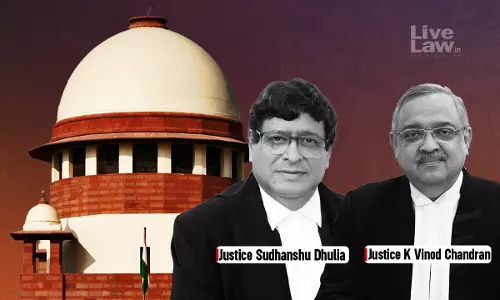
Defective Investigation Does Not Automatically Vitiate Prosecution's Case, If Other Relevant Evidence Exists: Supreme Court
The Supreme Court recently observed that the flaws in the investigation would not automatically be fatal to the prosecution's case when other credible evidence exists. The Court, affirming this position, upheld the conviction of the Appellant, who had sought acquittal on the ground of a faulty investigation. However, upon carefully examining the record and finding other reliable and...