


Supreme court
Principle Of 'Functus Officio' Does Not Apply To Executive Rule-Making Authority : Supreme Court
The Supreme Court on February 12 observed that the principle of functus officio does not apply to a rule making authority and applies to a judicial forum or a quasi-judicial authority. It cannot be disputed that the rule-making power of the legislature cannot be curtailed or nullified by application of the concept of functus officio, the Court said. “The principle of functus...
Supreme Court Upholds Govt's Power To Withdraw Promise Of Rebate In Larger Public Interest
While upholding the Goa Government's order to recover the previously granted electricity tariff rebates from several industrial companies, the Supreme Court today (February 14) reaffirmed the government's power to withdraw or modify economic incentives in the interest of public finances. The Court held that the doctrine of promissory estoppel cannot be rigidly enforced in situations where...

Supreme Court Weekly Round-up: February 03, 2025 To February 09, 2025
Nominal IndexCitationsRimpa Saha v. District Primary School Council Malda 2025 LiveLaw (SC) 143Lok Prahari through its General Secretary v. Union of India 2025 LiveLaw (SC) 144Rajeev Suri v. Archaeological Survey of India & Ors., Special Leave to Appeal (C) No.12213/2019 2025 LiveLaw (SC) 145State of Madhya Pradesh v. Dileep 2025 LiveLaw (SC) 146 Bhupinder Singh v. Unitech Ltd., Civil...
Bombay Stamp Act | Agreement To Sell Attracts Stamp Duty If Possession Is Granted : Supreme Court
The Supreme Court today (February 14) observed that an agreement to sell specifying delivery of the possession of the property would be deemed as 'conveyance' and would be subject to the stamp duty as per the Bombay Stamp Act.Emphasizing that stamp duty is levied on the instrument (agreement) and not the transaction, the Court held that even an agreement to sell could attract stamp duty if...
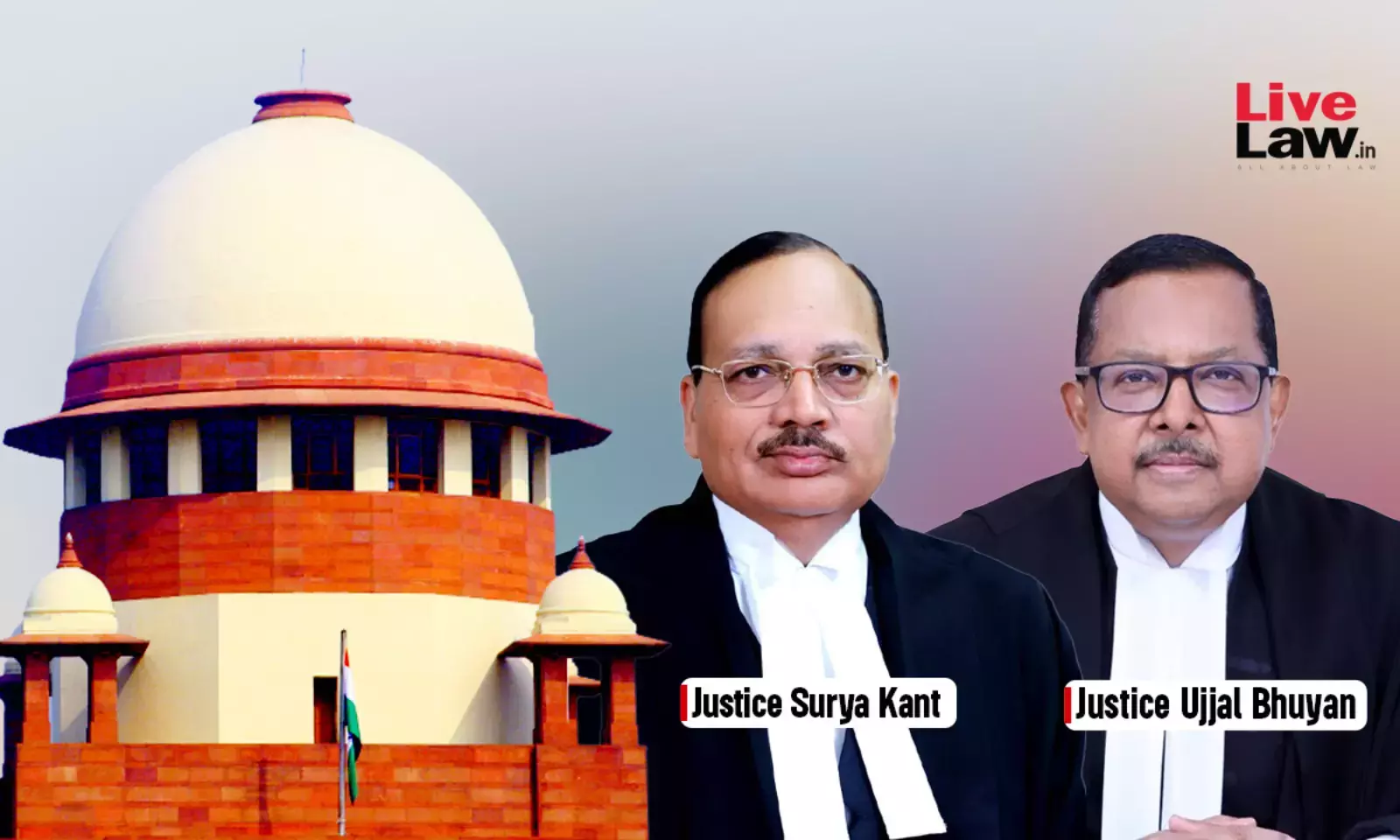
Interest May Be Denied To Party Who Abused Judicial Process : Supreme Court
While interest is usually granted as per Section 34 of the Civil Procedure Code in commercial disputes to account for the time value of money, the Supreme Court clarified that it may be denied in cases where a party's conduct breaches contractual obligations and undermines judicial authority. A bench of Justices Surya Kant and Ujjal Bhuyan denied interest on the refund of the forfeited...
Supreme Court Upholds Meghalaya Govt's Order To Dissolve Private University For Mismanagement
The Supreme Court on Thursday (February 13) upheld the decision taken by the Meghalaya Government in 2014 to dissolve the Chander Mohan Jha (CMJ) University, a private University.The Court also held that the University's decision to self-appoint a Chancellor, without the approval of the Visitor (Governor) was illegal. The State Government ordered the dissolution of the University, by...
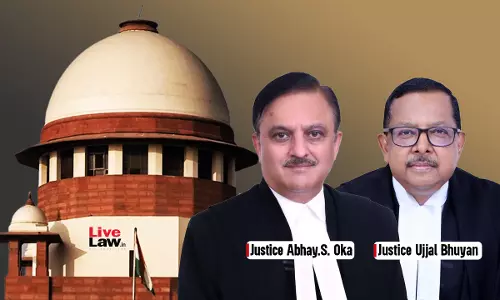
Portion Of S.161 CrPC Statement Used To Contradict Witness Must Be Proved Through Investigating Officer & Marked: Supreme Court
The Supreme Court on Thursday (February 13) set aside the conviction under Section 302 IPC of a man after noting that the trial court failed to follow the proper procedure for contradicting the prosecution witnesses in their cross-examination with their previously recorded Section 161 Cr.P.C. statements. A bench comprising Justices Abhay S. Oka and Ujjal Bhuyan held that the trial court erred...

Income Tax Act | No Penalty Under S.271AAA If Undisclosed Income Is Admitted, Explained & Tax Paid Even With Delay : Supreme Court
The Supreme Court, while determining a tax matter, observed that the undisclosed income, under Section 271AAA(1) of the Income Tax Act, surrendered by the assessee during the search, is not sufficient to levy the penalty. Essentially, the said provision talks about penalty where a search has been initiated. The explanation reads as: “(a) “Undisclosed income” means—...

Uncomfortable Questions Posed During Judicial Proceedings Can't Be Regarded As Humiliation : Supreme Court
The Supreme Court observed that statements made in court, and even uncomfortable questions posed to parties, cannot be considered public humiliation, as these actions are necessary for the court to fulfill its duty of ascertaining the truth. “During court proceedings, many statements are made and questions are posed which may make a person uncomfortable, but all such...
Execution Of Decree Granting Perpetual Injunction Not Subject To Any Period Of Limitation : Supreme Court
In a recent judgment, the Supreme Court stated that the execution of a decree granting a perpetual injunction is not subject to any period of limitation. This is in view of Article 136 of the Limitation Act which states that "an application for the enforcement or execution of a decree granting a perpetual injunction shall not be subject to any period of limitation."The Court made this...