


Supreme court
S.113B Evidence Act | Dowry Death Can't Be Presumed Without Clear Evidence Of Incessant Harassment: Supreme Court
The Supreme Court (on January 09), while acquitting an accused of cruelty and abetment of suicide, observed that to apply Section 113B (Presumption as to dowry death) of the Indian Evidence Act, clear evidence for incessant harassment is essential. The Court stressed that in the absence of such evidence, it cannot straightaway invoke this provision. For context, the concerned portion...
Supreme Court Annual Digest 2024: BSA & Evidence Act
BHARATIYA SAKSHYA ADHINIYAM, 2023, (BSA) and THE INDIAN EVIDENCE ACT, 1872, (IEA) - SUPREME COURT ANNUAL DIGEST 2024CORRESPONDING SECTIONS and COMPARISON SUMMARYAppreciation of EvidenceThe High Court fails to appreciate evidence in a thorough manner and merely relied on a limited set of facts to arrive at a finding. In an appeal, as much as in a trial, appreciation of evidence...
NDPS Act |'Taxi Driver Not Expected To Give Passenger Details' : Supreme Court Acquits Driver Of Taxi From Which Contraband Was Seized
The Supreme Court recently acquitted a taxi driver who was implicated under the Narcotic Drugs and Psychotropic Substances Act, 1985 (NDPS Act), solely for failing to provide details of passengers who had carried contraband in his taxi. The Court held that a taxi driver's inability to provide details of passengers carrying contraband could not justify implicating or convicting him under the...
Supreme Court Says Its Judgments Must Clarify Their Binding Nature So That HCs & Trial Courts Don't Get Confused
The Supreme Court recently highlighted the need to clearly state the intent behind a judgment within the judgment itself. The Court clarified that not every judgment is meant to be a binding precedent under Article 141 of the Constitution. Therefore, the judgment needs to specify whether the decision is intended to resolve a specific dispute between the parties or to establish a precedent...

Supreme Court Weekly Round-up: January 6, 2025 To January 12, 2025
Nominal IndexCitationM/S Naresh Potteries v. M/S Aarti Industries and Anr., SLP(Crl) No. 8659-2023 2025 LiveLaw (SC) 1Bernard Francis Joseph Vaz and Ors v. Government of Karnataka and Ors 2025 LiveLaw (SC) 2Urmila Dixit v. Sunil Sharan Dixit and others 2025 LiveLaw (SC) 3BN John v. State of UP & Anr., SLP (Crl.) No. 2184 of 2024 2025 LiveLaw (SC) 4Municipal Corporation of Delhi v....
No Strict Rule That Money Claim Can't Be Decided Under Writ Jurisdiction; Non-Payment Of Admitted Dues Arbitrary : Supreme Court
The Supreme Court (on January 08) reiterated that it is not a stringent rule that the High Court cannot decide a money claim under its writ jurisdiction. The Court reasoned that non-payment of admitted dues by the State authorities may be considered an arbitrary action and thus a writ petition may lie against the same. The Bench of Justices Manoj Misra and Manmohan, inter-alia,...
PC Act | Whether Sanction Granted By Competent Authority Matter Of Evidence : Supreme Court Sets Aside HC Order Which Invoked S.482 CrPC To Quash Trial
The question whether sanction for prosecution under the Prevention of Corruption Act, 1988 (PC Act) was granted by a competent authority is a matter of evidence, observed the Supreme Court, while setting aside an order of the High Court which quashed the proceedings in exercise of powers under Section 482 CrPC.The Court also reiterated that a sanction order cannot be quashed on the ground...
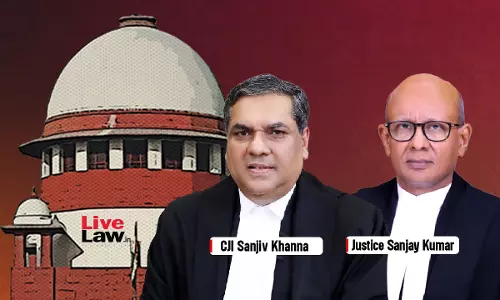
Maintenance Proceedings Under S.125 CrPC Are Civil Proceedings Though Breach May Result In Penal Consequences: Supreme Court
The Supreme Court noted that maintenance proceedings under Section 125 of the Cr.P.C. are essentially civil in nature and should not be equated with criminal proceedings merely because they involve a penal consequence.“even if non-compliance with an order for payment of maintenance entails penal consequences, as may other decrees of a Civil Court, such proceedings would not qualify as or...
Specific Relief Act | Relinquishment Of Claims Under S.12(3) For Part Performance Can Be Made At Any Stage Of Litigation : Supreme Court
The Supreme Court observed that while seeking a part performance of the contract under Section 12(3) of the Specific Relief Act, 1963, the plea regarding the relinquishment of claims regarding the remaining part of the contract and all rights to compensation can be made at any stage of litigation,including the Appellate Stage. “we may only say that the relinquishment of claim to...
Principles To Evaluate Circumstantial Evidence In Criminal Cases : Supreme Court Explains
In a recent judgment, the Supreme Court enunciated the principles that courts must adhere to while appreciating and evaluating evidence in cases based on circumstantial evidence.While dismissing the appeal against the conviction in a rape-murder case, a bench comprising Justice BR Gavai, Justice KV Viswanathan and Justice Sandeep Mehta summarised the principles as follows :(i)The testimony...
'Prosecutrix's Testimony Doesn't Inspire Confidence' : Supreme Court Affirms Acquittal In Rape Case
The Supreme Court (on January 07), observed that in rape cases if a conviction is based on the sole evidence of a single witness, even that of the victim herself, such evidence should inspire confidence in the Court. The Court agreed that while the victim's statement is given a very high value, the Court must carefully examine the same. “Although it is absolutely true that in...