


Supreme court
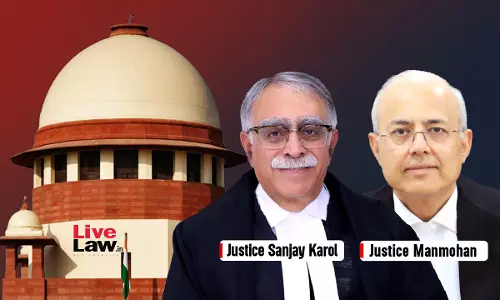
NDPS Act| When Can Owner Of Vehicle Used To Carry Contraband Be Arrayed As Accused? Supreme Court Explains
The Supreme Court today outlined four distinct scenarios that arise in cases involving the seizure of vehicles used to transport narcotic substances, as punishable under the Narcotic Drugs and Psychotropic Substances Act (NDPS Act).The bench comprising Justice Sanjay Karol and Justice Manmohan answered the possible fallouts of those scenarios i.e., whether there would be an interim release of...

Offence Of Grievous Hurt By Dangerous Weapons(S.326 IPC) Can Be Compromised In Exceptional Circumstances: Supreme Court
The Supreme Court (today on January 07) observed that while Section 326 (punishment for grievous hurt by dangerous weapons) of the Indian Penal Code, 1860, is non-compoundable, the Court can, in exceptional circumstances, invoke its inherent power to give effect to compromise. Such circumstance also includes voluntary settlement between the parties. “In light of the amicable settlement and...

NDPS Act Doesn't Bar Interim Release Of Seized Vehicle Pending Disposal Of Criminal Case : Supreme Court
The Supreme Court today (Jan. 7) held that the Narcotic Drugs and Psychotropic Substances Act, 1985 (“NDPS Act”) doesn't prohibit the interim release of vehicles which are seized for allegedly transporting contraband. The Court added that the seized vehicle can be released under Sections 451 and 457 of the CrPC.“This Court is further of the opinion that there is no specific...
Supreme Court Annual Digest 2024 - Advocates & Bar Councils
AdvocateAdvocates-on-Record can mark the appearances of only those advocates who are authorized to appear and argue the case on a particular day of hearing. Bhagwan Singh v. State of U.P., 2024 LiveLaw (SC) 722 : AIR 2024 SC 4785After the change of power from one political party to another, the States/Union Territories are changing their panel of Advocates appearing in the Court. The Court...

High Court Can't Ordinarily Reappreciate Evidence In Article 226 Proceedings : Supreme Court
The Supreme Court (on January 02) reiterated that the High Court cannot reappreciate the evidence unless the appropriate Court has exceeded its jurisdiction or acted perversely.“It is a well-established principle that the High Court, while exercising its jurisdiction under Article 226 of the Constitution of India, cannot reappreciate the evidence and arrive at a finding of facts unless...
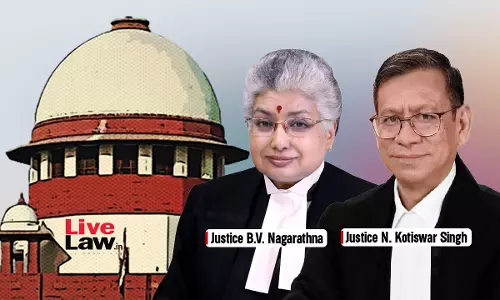
Right To Appeal Against Conviction Is Also A Fundamental Right; Can't Be Dismissed On Delay Without Examining Reasons For Delay : Supreme Court
The Supreme Court observed that the right to appeal against a conviction is a statutory right granted to the accused under Section 374 of the Cr.P.C., and a properly explained delay in filing the appeal cannot be a valid ground for its dismissal."Right of Appeal from a judgment of conviction affecting the liberty of a person keeping in view the expansive definition of Article 21 is also...
S. 21 CPC | Objections To Place Of Suing Can't Be Allowed Unless Taken In Court Of First Instance At Earliest Opportunity: Supreme Court
The Supreme Court held that objections to jurisdiction under Section 21 of the Code of Civil Procedure, 1908 (“CPC”), must be filed at the earliest, and no objection will be entertained at the belated stage unless injustice is caused. “The principle enjoins that objections regarding the place of suing shall not be allowed unless such objection is taken in the Court/tribunal of...

Supreme Court Enhances Compensation For B.Tech Student Who Got Disabled After Motor Accident To Rs. 48 Lakhs
The Supreme Court enhanced compensation granted to a B.Tech student who suffered 60 percent disability after a motor accident from Rs. 35.48 lakhs awarded by the Madhya Pradesh High Court to Rs. 48 lakhs.A bench of Justice Sanjay Karol and Justice Prasanna B. Varale emphasized that while monetary compensation cannot replace a life lost or fully mitigate severe injuries, it should aim to...
Accused Cannot Claim Acquittal On Ground Of Faulty Investigation : Supreme Court
The Supreme Court (today January 06) held that the accused cannot claim acquittal solely on grounds of faulty investigation. It explained that defective investigation does not automatically benefit the accused persons and Courts will have to consider the rest of the evidence relied on by the prosecution.“Hence, the principle of law is crystal clear that on the account of defective...
S. 319 CrPC | Accused Who Was Dropped By Police In Chargesheet Can Be Summoned As Additional Accused By Court : Supreme Court
The Supreme Court observed that the filing of a police closure report would not bar the summoning of an additional accused under Section 319 of Cr.P.C. The Court observed that if the evidence presented during the trial indicates that a person should be summoned to face trial, the trial court has the discretionary power under Section 319 of the Cr.P.C. to summon them as an additional...

'Bank Should Remain Vigilant' : Supreme Court Holds SBI Liable To Refund Amount To Customer Who Reported Fraudulent Transaction
The Supreme Court recently observed that banks cannot shy away from the responsibility to safeguard their customers from unauthorized transactions reported from their accounts. The Court added that it expects the account holders to also remain extremely vigilant and to see that the O.T.Ps. generated are not shared with any third party. The Court upheld the State Bank of India's...