




Supreme court
NCRDC Third Member Deciding Appeal Instead Of Answering Reference Not Necessarily Illegal : Supreme Court
The Supreme Court has clarified the limits of a third or “referee” member's role when members of a National Consumer Disputes Redressal Commission (NCDRC) Bench differ, holding that although the normal course is for the referee member to answer only the questions referred and return the matter to the original Bench, an exceptional case may justify deciding the appeal itself.Where a...
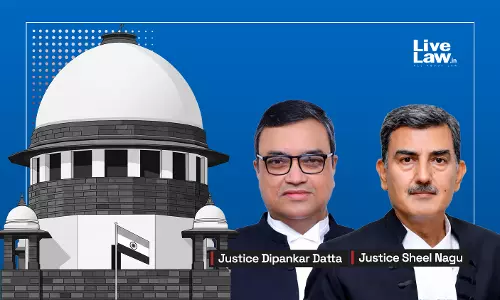
Multiple Cases Per Se Not Ground To Pass Externment Order : Supreme Court
Externment is an extraordinary measure which cannot be ordered routinely, the Court said.
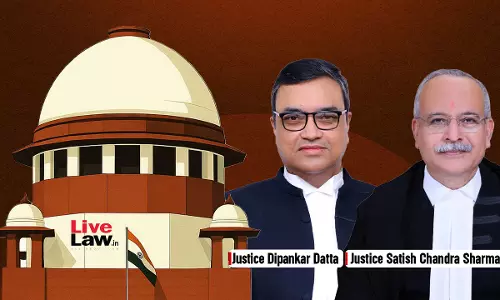
High Courts Shouldn't Routinely Stay Trials : Supreme Court Flags Mechanical Invocation Of Revision Powers
The Supreme Court has disapproved the routine practice of High Courts staying trials while entertaining challenges to interlocutory orders, cautioning that such stays should be granted only where continuation of the trial would seriously and irreparably prejudice the revision proceedings or adversely affect the parties.also flagged the mechanical invocation of revisional jurisdiction...
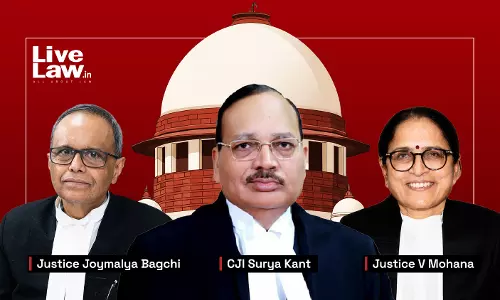
Family Court Judges Not Eligible For High Court Elevation : Supreme Court Refuses To Revisit Precedent
The Court also questioned the need to have separate cadre for Family Court Judges in States like Maharashtra.
Stamp Duty Valuation Based On Nature Of Land's Use & Not Its Classification In Master Plan : Supreme Court
The Supreme Court recently held that the classification of a property under a master plan is not determinative of stamp duty liability, as the actual use of the property is the relevant consideration while determining its valuation. A bench of Justice J.B. Pardiwala and Justice K. Vinod Chandran set aside the Rajasthan High Court's judgment, which had classified the property as commercial...
Statutory Authority Cannot Invoke Article 131; It Confined To Centre-State Disputes : Supreme Court
The Supreme Court has held that a statutory authority or instrumentality of the State cannot invoke its original jurisdiction under Article 131 of the Constitution, reiterating that the provision is confined to disputes involving the Union of India and one or more constituent States.A Bench comprising Justice Dipankar Datta and Justice Sheel Nagu made the observation while setting aside...
LiveLaw Supreme Court Half-Yearly Digest 2026 - Negotiable Instruments Act
Negotiable Instruments Act, 1881 - Supreme Court Half Yearly Digest Jan - Jun, 2026 Negotiable Instruments Act, 1881 - Section 138 - When a company or NGO authorises a specific individual to sign and issue cheques on its behalf, along with the responsibility of making payments under an agreement, such person is treated as the 'drawer' of the cheque and attracts criminal...
Ports Governed By Major Port Trusts Act Liable To Pay Customs Duty On Pilfered Goods Under Customs Act : Supreme Court
The Supreme Court on Tuesday (August 25) upheld the Commissioner of Customs order of classifying the Mumbai Port Trust as a 'custodian' under the Customs Act for the purpose of paying duty on 'pilfered goods' i.e., loss or damage to stock in a warehouse or to cargo in transit. The Court said that regardless of the fact that the Mumbai Port trust is governed by the Major Port Trusts Act,...
LiveLaw Supreme Court Half-Yearly Digest 2026 - Motor Vehicles Act, 1980
Motor Vehicles Act, 1988 - Supreme Court Half Yearly Digest Jan - Jun, 2026 Motor Vehicles Act, 1988 - Conventional Heads – Omission of Filial Consortium – The Tribunal and High Court failed to award any amount under the head of consortium - Held: The Motor Vehicles Act is a beneficial legislation, and courts must ensure 'just compensation' is awarded even if a...
LiveLaw Supreme Court Weekly Digest: August 1 - 12, 2026
Arbitration And Conciliation Act, 1996 - Section 11 & Non-Signatory Parties — "Veritable Party" Doctrine — Non-signatory to the primary agreement can be bound by the arbitration agreement contained therein if their conduct, participation, and performance of obligations under interlinked agreements demonstrate a mutual intent to be bound — Principles laid down in Cox and...
S. 74 CGST Act | General Allegations Of Fraud/Suppression Won't Extend Limitation; SCN Must Specify Foundational Facts : Supreme Court
The Supreme Court on Tuesday (August 25) quashed the GST show-cause notice issued to Tata Steel Ltd. under Section 74 of the Central Goods and Services Tax Act, 2017, for alleged short payment of tax due to suppression of facts. A bench of Justice JB Pardiwala and Justice K Vinod Chandran called the department's invocation of Section 74 of the Act, rather than the ordinary mechanism...