



- Home
- /
- Supreme court
- /
- Right To Access & Use Internet A...
Right To Access & Use Internet A Fundamental Right Of Every Individual Including Children : Supreme Court
LIVELAW NEWS NETWORK
17 Oct 2026 11:05 AM IST
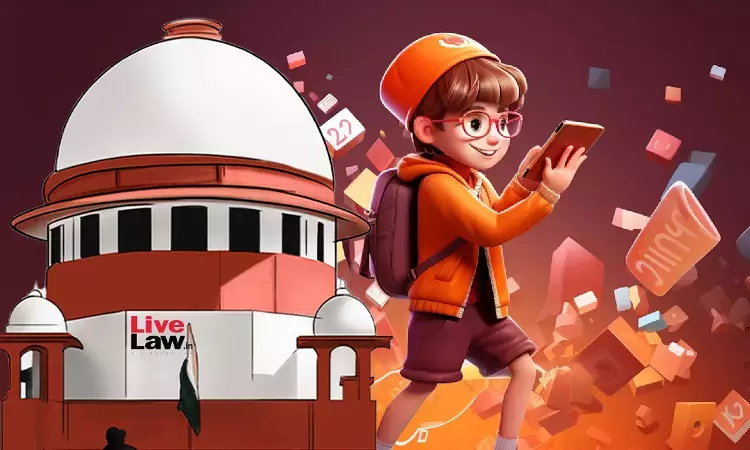
It would be absurd to deny children the right to access internet altogether, the Court held.
In a significant pronouncement, the Supreme Court has declared the right to access and use the internet a fundamental right under Articles 21 and 19(1)(a) of the Constitution. Every individual, including a child, has this right, the Court stated, adding that it would be absurd to deny this right to children altogether.A bench comprising Justice JB Pardiwala and Justice K Vinod Chandran...
This is a premium content
Available exclusively to
Our subscribers
Subscribe Premium 
INR 1099+GST
Your support helps us to bring you more content at
an affordable subscription scheme !!!
All payment options available
In a significant pronouncement, the Supreme Court has declared the right to access and use the internet a fundamental right under Articles 21 and 19(1)(a) of the Constitution. Every individual, including a child, has this right, the Court stated, adding that it would be absurd to deny this right to children altogether.
A bench comprising Justice JB Pardiwala and Justice K Vinod Chandran observed :
"..we have no hesitation in saying that the right to access and use the internet is a fundamental right of every individual under Article 21 read with Article 19(1)(a) of the Constitution. Our children, irrespective of their age enjoy the same rights, and to deny the same altogether would be as absurd as saying children below a certain age do not have a conscience worth protecting or a freedom of speech worth expressing. The safety of our children and their freedom are not at odds with each other. Our children are entitled to both."
The bench made the observation while issuing directions to strengthen the mechanisms for detecting and removing child sexual exploitation and abuse material (CSEAM) from social media platforms and other online services.
In the judgment, the Court discussed the issue whether children should be altogether shielded from the internet and social media for their safety.
It noted that right to freedom of speech and expression under Article 19(1)(a) also includes the right to know and to receive and impart information and ideas. Describing the internet as a marketplace of ideas, creative expression and information, the Court said its value lay not merely in the information it contained but also in the access it afforded to adults and children alike. "For many children, particularly in remote areas, it is often the only source of learning and information," the Court observed.
It added that, for children with special needs, the internet was often the only place where they could find companionship with others like them.
The bench also noted that in the 2020 judgment in Anuradha Bhasin v. Union of India held that "the freedom of speech and expression and the freedom to carry on any trade or business through the medium of the internet is constitutionally protected as a fundamental right under Article 19(1)(a) and 19(1)(g) of the Constitution." It refrained from expressing any view on whether the right to access the internet is, by itself, a fundamental right.
In Pragya Prasun & Ors. v. Union of India(2025), the Court recognized the right to digital access a fundamental right under Article 21. Taking a leap from these precedents, the Court declared the right to use internet a fundamental right, which cannot be denied to children.
Blanket Restrictions On Children's Internet Access Not The Answer, Says Court
The Bench acknowledged that the internet, as it exists today, is far from safe for children. However, it held that keeping children away from the internet because of the failures of intermediaries to detect and remove harmful material would amount to mistaking the victim for the problem.
The Court observed that children do not stop using the internet merely because the law prohibits them from doing so. Instead, they may move to other platforms and websites that are unregulated and potentially more unsafe.
It further noted that restrictions could make children who are being enticed or threatened online reluctant to report such incidents to their parents, guardians or trusted adults for fear of being reprimanded for using the internet.
"Any blanket restriction on the access of internet by children is nothing more than unproven measures of proven disproportionality," the Court observed, adding that no jurisdiction had so far been able to demonstrate that children were safer because of such measures.
The Court also expressed concern that age-based restrictions could require the identification and ascertainment of every user's age, involving the continuous collection and monitoring of sensitive data and creating a disproportionate risk of misuse and surveillance.
Court Leaves Scope For Proportionate Safeguards For Children
While rejecting blanket restrictions, the Court clarified that this did not mean there should be no age-based safeguards for children using the internet.
It observed that some safeguards were necessary to ensure children's online safety and regulate the content accessible to them.
The Court suggested that a system could place greater emphasis on parental consent, guidance and oversight concerning children's access to social media platforms, along with a dedicated "child mode" for their accounts.
Such safeguards could include making children's accounts private by default, restricting contact and messages from unknown adults, and moderating advertisements and content accessible to children.
The Court suggested that these measures could be implemented for pre-teens, with reasonable and proportionate means of verifying parental consent. It left the modalities of such measures to the Union Government.
The Bench also clarified that nothing in its observations would prevent the Union Government from restricting children's access to specific categories of content or services that are inherently harmful to them, such as adult-content websites.
The Court also issued a slew of directions to detect and remove CSEAM, , including the creation of a comprehensive national database to enable the identification and removal of such content across social media platforms.
Also from the judgment -Supreme Court Directs Union To Create National Database On Child Sexual Exploitation & Abuse Materials (CSEAM) For Removal Across Platforms
Headnote
Child Sexual Exploitation and Abuse Material (CSEAM) — Social Media Intermediaries — Perceptual Hash Matching and URL Listing — Creation of National Hash & URL List Database — Sahyog Portal — Distinction Between CSEAM of "Known Origin" and "Unknown Origin" — Mandatory Two-Hour Reporting Timeline — Dedicated Grievance Officers — Disgorgement of Profits from Paywalled Content — Fundamental Right to Access Internet under Article 21 — Rejection of Blanket Age-Based Internet Bans — Age-Appropriate Sex Education and Digital Safety Curriculum - Inadequacy of Fragmented Detection & Rule 4(4) Ambiguity - Existing detection mechanisms operate in isolation on each platform, allowing CSEAM removed on one platform to circulate freely on others and via indirect redirect links - The phrase "on the computer resource of such intermediary" in Rule 4(4) of the IT Rules (as amended in 2026) narrowly confines proactive removal to content previously deleted on that specific platform - The Union of India was directed to frame periodically revisable guidelines mandating industry-wide adoption of Perceptual Hash-Matching and URL Listing. [Paras 19–24, 30–33, 39–50, 316].
Establishment of National Hash & URL List Database & Verification Safeguards - The Union of India shall establish a centralized National Hash & URL List Database (either within I4C's Sahyog Portal or as a standalone repository) storing only encrypted alphanumeric perceptual hashes and URLs, never the actual CSEAM - Inclusions require a three-tier verification process: (1) source intake, (2) preliminary software screening followed by independent assessment by at least three trained human analysts recording digitally signed findings, and (3) encrypted database entry - The database must undergo periodic public independent audits and strictly be used solely for CSEAM removal, never repurposed for unrelated surveillance or censorship. [Paras 51–66, 93–97, 303, 316.2].
Procedural Dichotomy - CSEAM of "Known Origin" vs. "Unknown Origin" - Known Origin (matched against the National Database) - Must be disabled and removed immediately without awaiting further verification, and reported to the database authority via consolidated weekly reports for accuracy cross-verification - Unknown Origin (detected via user complaints, court/government orders, or platform due diligence without a database match) - Must be verified by the intermediary, removed, and reported forthwith and no later than two hours to the Special Juvenile Police Unit (SJPU)/local police/cyber-crime portal under Rule 11 of the POCSO Rules, as well as to the National Database authority. [Paras 69–84, 192 199, 316.2, 316.5, 316.6].
Mandatory Takedown Notices & Dual-Track Grievance Redressal - Whenever content is removed as CSEAM, intermediaries must prominently display a notice (without reproducing the abusive content) specifying whether removal resulted from internal detection or a National Database match - Challenges to internal detections lie before the intermediary's Grievance Officer and the Grievance Appellate Committee (Rules 3(2) & 3A), whereas challenges to National Database matches lie directly before the authority maintaining the National Database. [Paras 85–92, 316.3, 316.4].
Broad Scope of CSEAM under IT Act vs. POCSO Act (Indirect Promotions & AI Manipulation Tools) - Clarifying its 2024 ruling, the Supreme Court held that while visual depiction is required for strict criminal liability under Section 15 of the POCSO Act, Sections 67B(b) and 67B(d) of the IT Act and Rules 3(1)(b) and 4(4) of the IT Rules are much broader - Advertisements or posts that contain no explicit child imagery but promote AI/morphing tools to generate CSEAM, or redirect users via links to external CSEAM sites, constitute CSEAM/harmful content and cannot be cleared under the guise of conforming to "advertising standards". [Paras 132–168, 316.9A–9B].
Overhaul of Reporting & Dedicated Grievance Officers - Intermediaries must provide a distinct, simple, uniform CSEAM reporting category accessible within two steps, preserving complete complainant anonymity - Every intermediary must appoint dedicated, trained Grievance Officers for CSEAM - Automated tools may assist screening, but final disposal of any CSEAM complaint must be made by a human officer recording digitally signed reasons, acknowledged within 24 hours with a tracking number (extending Rule 4(6) obligations to all intermediaries), and published in audited monthly compliance reports. [Paras 113–127, 169–191, 207–220, 316.7–316.9].
Standardized Machine-Readable Reporting Pro-Forma - Union of India must prescribe a mandatory machine-readable reporting format containing nine specific particulars (Hash/URL, timestamp, keywords/captions, file/material type, hosting mode, real vs. synthetic/morphed status, Known vs. Unknown origin, detection mechanism, and human analyst e-signed assessment) for seamless integration with NCRB and NDSO. [Paras 200–206].
Penalties Beyond Section 79 Safe Harbour & Disgorgement of Paywall Profits - Stripping Section 79 safe harbour provides only post facto criminal liability after harm occurs - Surveying global frameworks (US REPORT Act 2024, UK Online Safety Act 2023, EU Digital Services Act, Australia Online Safety Act 2021, South Korea Telecommunications Business Act), the Court directed the Union to frame exemplary monetary fines scaled by gravity, recurrence, and platform turnover - Furthermore, to curb "profiteering until prohibited" behind subscriptions/paywalls, intermediaries must rigorously scrutinize paywalled content, prevent minors from accessing adult/obscene paywalls, and forfeit and disgorge all revenue earned from paywalled CSEAM. [Paras 223–279, 316.10].
Fundamental Right to Access Internet (Article 21) & Rejection of Blanket Age Bans - Reaffirming that the right to access and use the internet is an intrinsic fundamental right under Article 21 read with Article 19(1)(a) enjoyed by children as well, the Supreme Court declined to endorse blanket age-based bans on children using the internet or social media - Blanket bans mistake the victim for the wrongdoer, drive children to unregulated dark corners of the web, deter them from reporting abuse out of fear of reprisal, and necessitate invasive mass age-verification surveillance violating privacy - the Supreme Court recommended proportionate parental consent mechanisms and a default private "child mode “for pre-teens alongside blocking inherently harmful adult sites. [Paras 280–302].
Mandatory Digital Safety & Positive Age-Appropriate Sex Education - Digital safety and sex education are two sides of the same coin - Union and State Governments, NCERT/SCERTs, and NCPCR/SCPCRs must integrate age-appropriate sex education (covering safe/unsafe touch, consent, healthy relationships, and peer image-sharing risks) and digital safety into core school curricula, train teachers, sensitize parents, display helplines (1098 and 1930) in schools, filter institutional networks, and provide free long-term trauma counselling to victims. [Relied on Just Rights for Children Alliance & Anr. v. S. Harish & Ors., 2024 INSC 716; Secretary, Ministry of Information & Broadcasting v. Cricket Association of Bengal, (1995) 2 SCC 161; Anuradha Bhasin v. Union of India, (2020) 3 SCC 637; Shankar Kisanrao Khade v. State of Maharashtra, (2013) 5 SCC 546; Paras 304–315].
Tags


