



- Home
- /
- Supreme court
- /
- Sessions Court Cannot Impose...
Sessions Court Cannot Impose Special Category Sentence Barring Statutory Remission And Commutation : Supreme Court
Yash Mittal
24 Sept 2026 9:13 PM IST
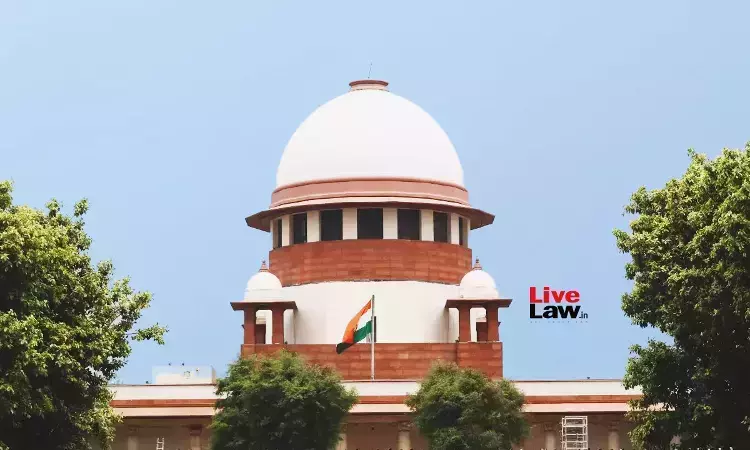
The Supreme Court on Thursday (September 24) reiterated that a Sessions Court cannot impose a special-category sentence directing a convict to remain in prison for the remainder of their natural life by excluding the statutory remission and commutation regime. “…we are of the view that there is no doubt that the Trial Court was competent to impose the punishment of imprisonment for life...
This is a premium content
Available exclusively to
Our subscribers
Subscribe Premium 
INR 1099+GST
Your support helps us to bring you more content at
an affordable subscription scheme !!!
All payment options available
The Supreme Court on Thursday (September 24) reiterated that a Sessions Court cannot impose a special-category sentence directing a convict to remain in prison for the remainder of their natural life by excluding the statutory remission and commutation regime.
“…we are of the view that there is no doubt that the Trial Court was competent to impose the punishment of imprisonment for life upon the appellants for the offence under Section 302 read with Section 34 IPC, however, at the same time, the Trial Court was not competent to impose a special category sentence that the appellants “to remain in prison till rest of their life”, which in substance and effect, excludes the statutory power of remission or commutation.”, observed a bench of Justice Aravind Kumar and Justice Vipul M Pancholi, while upholding the conviction of two for the murder of a woman and her two minor daughters.
The Court modified their sentence from life imprisonment without remission, as ordered by the Sessions Court and later affirmed by the High Court, to 25 years' rigorous imprisonment without statutory remission.
The Sessions Court convicted all three accused under Section 302 read with Section 34 IPC and sentenced them to rigorous imprisonment for life and directed them "to remain in prison till rest of their life". In essence, no scope for statutory remission was granted to the convicts.
The High Court of Punjab and Haryana affirmed the Sessions Court judgment, following which the convicts moved to the Supreme Court.
The judgment authored by Justice Pancholi noted that while the High Court recorded the sentence of rigorous imprisonment for life, it did not specifically refer to the additional direction that the accused should remain in prison for the rest of their lives.
While the Court said that the conviction did not warrant interference, the issue before it was therefore confined to the legality and appropriateness of the sentence, given the law that the Sessions Court is not empowered to order rigorous imprisonment for the remainder of their natural life without remission.
Relying upon a Constitution Bench judgment in Union of India v. V. Sriharan alias Murugan, which had recognised the power of Constitutional Courts to impose a modified sentence providing for a specified period of incarceration or imprisonment for the remainder of natural life as an alternative to the death penalty.
The Court reiterated the principle that this power belongs only to the High Courts and the Supreme Court, and not to inferior criminal courts.
Reference was also made to the recent case of Kiran v. State of Karnataka 2025 LiveLaw (SC) 1231, the Court said that only Constitutional Courts can pass a sentence barring the grant of remission. The Court in Kiran also clarified that this power to order life imprisonment beyond 14 years cannot be applied by the Sessions Court.
“The Trial Court was competent to impose the punishment of imprisonment for life upon the appellants under Section 302 read with Section 34 IPC, however, it was not competent to direct that the appellants shall “remain in prison till rest of their life”, the Court said.
Court awarded fixed-term imprisonment without remission
Further, the Court considered the sentencing framework laid down in Navas alias Mulanavas v. State of Kerala 2024 LiveLaw (SC) 248, including aggravating and mitigating circumstances.
The aggravating circumstances included the fact that three persons had been killed, including two minor children, and that the murders involved sharp-edged weapons.
At the same time, the Court considered the substantial period of incarceration already undergone by the appellants and their conduct in prison. Also, their conduct certificates indicated satisfactory conduct, discipline and compliance with prison rules. Thus, the Court modified their sentence from a rigorous life sentence till the remainder of their natural life to rigorous imprisonment for a period of 25 years, without any statutory remission.
“…having regard to the gravity of the offence, the fact that three persons were killed including two minor children, the respective roles attributed to the appellants, the substantial period of incarceration already undergone by them, their satisfactory conduct during custody and the fact that the present proceedings are confined to the question of sentence, the ordinary imprisonment for life subject to the statutory remission or commutation regime would not adequately meet the ends of justice, whereas, imprisonment for the remainder of the natural life of the appellants would be disproportionate in the circumstances of the present case. In our considered view, the ends of justice would be adequately met by altering the sentence of the appellants awarded by the Trial Court, i.e. rigorous imprisonment for life and “to remain in prison till rest of their life”, to the sentence of rigorous imprisonment for a period of 25 years, without any statutory remission.”, the Court held.
The appeal was allowed in part.
Cause Title: NAVAL KISHORE & ANR. VERSUS STATE OF PUNJAB
Citation : 2026 LiveLaw (SC) 985
Click here to download judgment
Appearance:
For Petitioner(s) :Mr. Ashish Pandey, AOR Ms. Sampa Sengupta Ray, Adv
For Respondent(s) :Mr. Siddhant Sharma, AOR
Tags

Yash Mittal
Yash Mittal is a Correspondent with LiveLaw, covering the Supreme Court of India

