



- Home
- /
- Supreme court
- /
- Solatium & Interest For Land...
Solatium & Interest For Land Acquisition Under National Highways Act To Be Computed As Per 1894 Act For Pre-2015 Awards : Supreme Court
Saima Anjum
8 Sept 2026 9:34 PM IST
The Supreme Court on Tuesday (08.09.2026)held that when the Competent Authority under the National Highways Act, 1956 (NH Act) determines compensation before 01.01.2015, the solatium, interest, and interest on solatium payable to the landowner must be computed under the Land Acquisition Act, 1894, and not under the Right to Fair Compensation and Transparency in Land Acquisition,...
This is a premium content
Available exclusively to
Our subscribers
Subscribe Premium 
INR 1099+GST
Your support helps us to bring you more content at
an affordable subscription scheme !!!
All payment options available
The Supreme Court on Tuesday (08.09.2026)held that when the Competent Authority under the National Highways Act, 1956 (NH Act) determines compensation before 01.01.2015, the solatium, interest, and interest on solatium payable to the landowner must be computed under the Land Acquisition Act, 1894, and not under the Right to Fair Compensation and Transparency in Land Acquisition, Rehabilitation and Resettlement Act, 2013. For context, 01.01.2015 is the date on which the 2013 Act was made applicable for acquisition made under the NH Act.
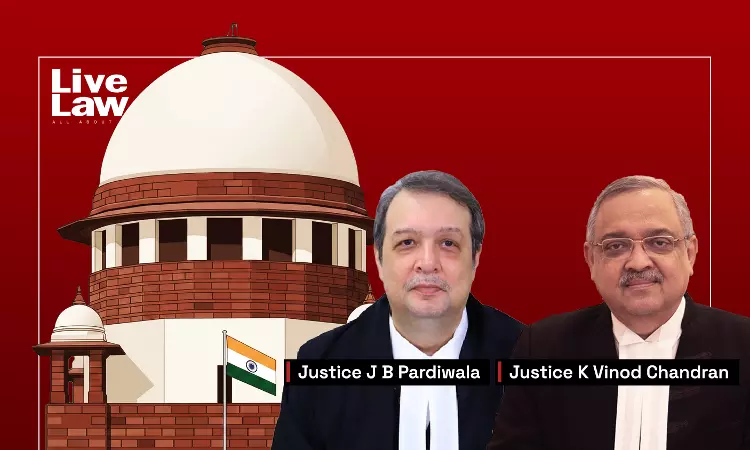
A bench of Justice JB Pardiwala and Justice Vinod K Chandran ruled so while dealing with an appeal arising from a land acquisition matter under the NH Act, where the dispute was “whether the claim of solatium, interest and interest on solatium, insofar as the acquisition made under the National Highways Act, 1956, is to be computed under the Land Acquisition Act, 1894 or the Right to Fair Compensation and Transparency in Land Acquisition, Rehabilitation and Resettlement Act, 2013.”
The appellant's land was acquired under the NH Act in 2011, via a notification published under Section 3A, and a declaration under Section 3D was subsequently published in 2012. The Competent Authority under the NH Act determined the compensation in 2014, as Rs 3,47,38,287, out of which the appellant received Rs 49,17,000, in 2014. The appellant, thereafter, sought a reference to arbitration, wherein the Arbitrator passed an award in 2016. Subsequently, the award was challenged before the Supreme Court under Sections 34 and 37 of the Arbitration and Conciliation Act, 1996.
Before the Supreme Court, the appellant represented by Senior Advocate Harin P Raval, relied on Union of India v Tarsem Singh (Tarsem Singh II), to point out that Court had refused prospective operation of Tarsem Singh I (2019) as there could be no differentiation in the benefit of solatium and interest between a landowner whose land was acquired on 31.12.2014 and one acquired the very next day. On this basis, the appellant contended that he was entitled to full benefits under the 2013 Act. In the alternative, since the Arbitrator's award was passed in 2017, it was also argued that the 2013 Act would apply even on the National Highway Authority of India's (NHAI) own reasoning.
The NHAI, represented by Senior Advocate Ankur Mittal, did not dispute the landowner's entitlement to solatium, interest, and interest on solatium. It, however, contended that since the 2013 Act was made applicable to the acquisitions made by NH Act only from 01.01.2015, and the award was passed in 2014, the benefits had to be computed under the 1984 Act. For this, reliance was placed on National Highways Authority of India v Tarsem Singh (Tarsem Singh III).
Tracing the legislative background, the Supreme Court noted that the 1997 amendment to the NH Act inserted Section 3J, excluding the applicability of the 1894 Act to the acquisitions made under the NH Act. This provision was held unconstitutional in Tarsem Singh I, for being violative of Article 14. The bench referred to the judgment observing as, “both before the 1997 Amendment Act and after the coming into force of the 2013 Act, solatium and interest is payable to landowners whose property is compulsorily acquired for purposes of National Highways. This is one other very important circumstance to be borne in mind when judging the constitutional validity of the 1997 Amendment Act for the interregnum period from 1997 to 2015.”
Examining Section 105 of the 2013 Act, the bench explained that while the Act came into force on 01.01.2014, its compensation related provisions were extended to enactments listed in Fourth Schedule (which includes NH Act), only with effect from 01.01.2015.
The bench also clarified the scope of Tarsem Singh II, holding that it did not lay down that solatium and interest before 01.01.2015 must also be computed under the 2013 Act. “Tarsem Singh-II does not lay down as a proposition that solatium and interest before 01.01.2015 would also have to be computed based on the provisions under the Act of 2013, not even from its effect, i.e.: 01.01.2014; since for the acquisitions under the NH Act, the Act of 2013 came into effect only from 01.01.2015. That benefits of solatium and interest are due to even landowners whose lands are acquired on or before 01.01.2015, is unimpeachable, however, the entitlement would be determined as to whether the 'award' was passed before or after 01.01.2015; if before, the entitlement will be under the Act of 1894 and if after, under the Act of 2013,” it was held.
The Court further held that the determination made by the Competent Authority under Section 3G(1) of the NH Act is “in the nature of the award” analogous to an award under Section 11 of the 1894 Act. The bench relied on Indore Development Authority v Manoharlal, which held that compensation must be determined under the 2013 Act where no award under Section 11 of the 1894 Act had been made on 01.01.2014. On the basis of this, the bench reasoned, “if an award is made prior to 01.01.2014, the date of effect of the Act of 2013, then the compensation has to be determined under the provisions of the Act of 1894 in the reference under Section 18 of that Act and in any further challenge raised, wherein the solatium and interest will be as available under that Act. However, if the award is made after 01.01.2014, obviously, it has to concede to the more beneficial proceedings under the Act of 2013, even if the acquisition proceedings were commenced under the Act of 1894.”
Applying the aforesaid, the Supreme Court held that, “if a determination of compensation has not been made before 01.01.2015, then necessarily the Act of 2013 was to apply. But if a determination of compensation is made by the Competent Authority under the NH Act before 01.01.2015, even if it is after 01.01.2014 solatium interest and interest of solatium would be payable under the Act of 1894.”
The appellant also relied on a notification issued by the Ministry of Road Transport and Highways to contend that where awards had not been announced, or compensation had not been paid to a majority of land holdings as on 31.12.2014, compensation would be payable under the First Schedule of the 2013 Act. The Court, however, rejected this contention, noting, “the word employed in the notification is the majority of the 'land holdings' and not the 'landowners'. NHAI has taken a contention, as available in Annexure R-1 produced along with the counter affidavit that the total land acquired is 3.080 hectares out of which the compensation for 1.700 hectares was paid in the year 2014 itself. The notification does not help the appellant.”
Allowing the appeal, the Court directed that the compensation determined by the Arbitral Award be conferred with solatium, interest, and interest on solatium as provided under the 1894 Act, and remanded the matter back to the Competent Authority.
Headnote
Land Acquisition — National Highways Act, 1956 — Sections 3G(1), 3G(5), and 3J — Right to Fair Compensation and Transparency in Land Acquisition, Rehabilitation and Resettlement Act, 2013 — Section 24(1)(a) and Section 105 read with Fourth Schedule — Land Acquisition Act, 1894 - Applicability of 2013 Act vs. 1894 Act for calculating Solatium, Interest, and Interest on Solatium for NH Act acquisitions — Relevant cut-off date — Held: Although landowners acquired under the NH Act are entitled to solatium, interest, and interest on solatium, the rate and statutory regime governing such benefits depend upon the date on which the initial compensation determination (award) was made by the Competent Authority under Section 3G(1) - Under Section 105(1) & (3) of the 2013 Act, a one-year hiatus was provided for Schedule IV enactments; the 2013 Act compensation provisions were extended to NH Act acquisitions only with effect from 01.01.2015 (via Ordinance 9 of 2014, Ordinance 5 of 2015, and subsequent notification) - if the Competent Authority's determination under Section 3G(1) was passed prior to 01.01.2015, benefits must be computed exclusively under the Land Acquisition Act, 1894, even if the Arbitrator's award under Section 3G(5) was rendered subsequent to 01.01.2015. [Paras 11–13, 17-19, 22- 27]
Land Acquisition — National Highways Act, 1956 — Competent Authority's Determination vs. Arbitrator's Award - Nature of Section 3G(1) determination vis-à vis Section 3G(5) Arbitral Award — Held: The initial determination of compensation by the Competent Authority under Section 3G(1) of the NH Act corresponds to an "award" passed under Section 11 of the 1894 Act (or Section 23 of the 2013 Act) - The determination of a dispute by an Arbitrator under Section 3G(5) of the NH Act is akin to a reference determination by a Civil Court under Section 18 of the 1894 Act - for the purposes of attracting Section 24(1)(a) of the 2013 Act, the relevant cut off event is the date of the Competent Authority's determination under Section 3G(1) and not the date of the Arbitrator's award. [Relied On Indore Development Authority v. Manoharlal and Others, (2020) 8 SCC 129; Paras 19–24]
Land Acquisition — Constitutional Validity & Retrospective Scope — Interpretation of Precedents - Effect of striking down Section 3J of the NH Act — Held: Striking down Section 3J in Tarsem Singh-ensured that solatium and interest could not be denied to acquisitions made under the NH Act between 1997 and 2015 - declining prospective application in Tarsem Singh-II merely established parity that solatium and interest are universally payable across all periods; it did not mandate that pre 01.01.2015 awards must be calculated according to the higher compensation scales of the 2013 Act. [Relied on Union of India & Another v. Tarsem Singh & Others (Tarsem Singh-I), (2019) 9 SCC 304; Union of India & Another v. Tarsem Singh & Others (Tarsem Singh-II), 2025 SCC OnLine SC 235; National Highways Authority of India v. Tarsem Singh & Others (Tarsem Singh-III), 2026 SCC OnLine SC 481; Paras 6–13]
Case: Manav Bhanot v National Highway Authority of India
Citation : 2026 LiveLaw (SC) 915
Appearance:
For Appellant: Mr Harin P Raval, Sr. Adv.; Mr Abhijeet Shrivastava, AOR; Mr Anshuman Shrivastava, Adv.; Ms Ananya Sahu, Adv.; Ms Shruti Verma, Adv.; Mr Shashank Shekhar Dwivedi, Adv.; Ms Shreya Bansal, Adv.; Ms Shrestha Narayan, Adv.
For Respondent: Mr Ankur Mittal, Sr. Adv.; Ms Paromita Majumdar, AOR; Mr Ankur Saboo, Adv.; Ms Ipshita Dutta, Adv.; Ms Simran Goel, Adv.; Mr Aviraj Pandey, Adv.; Ms Meenakshi Vimal, Adv.; Mr Akash Bhatt, Adv.; Ms Rabaica Jaiswal, Adv.; Ms Allaka Malikayil, Adv.
Tags


