



- Home
- /
- Supreme court
- /
- JJ Act - Murder Is 'Heinous...
JJ Act - Murder Is 'Heinous Offence', Not 'Serious Offence'; S 302 IPC Implies Minimum Life Sentence: Supreme Court
Saima Anjum
22 July 2026 10:08 AM IST
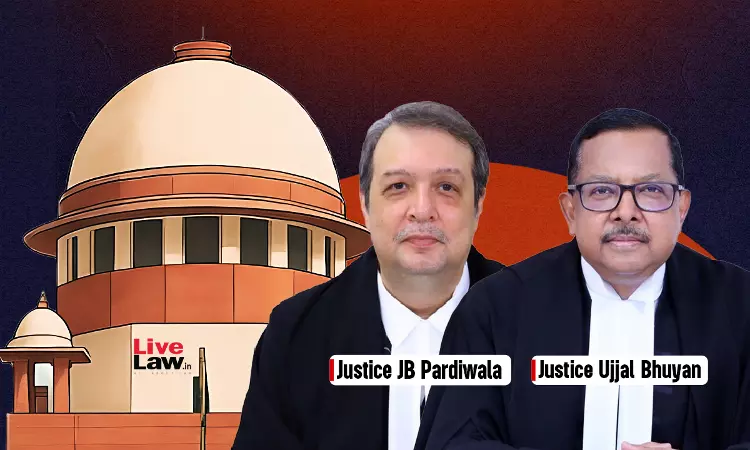
The Supreme Court has held that the offence of murder punishable under Section 302 of the Indian Penal Code (now Section 103(1) of the Bharatiya Nyaya Sanhita) is a "heinous offence" under the Juvenile Justice (Care and Protection of Children) Act, 2015, ruling that imprisonment for life constitutes its implied minimum punishment even though the provision does not expressly prescribe...
This is a premium content
Available exclusively to
Our subscribers
Subscribe Premium 
INR 1099+GST
Your support helps us to bring you more content at
an affordable subscription scheme !!!
All payment options available
The Supreme Court has held that the offence of murder punishable under Section 302 of the Indian Penal Code (now Section 103(1) of the Bharatiya Nyaya Sanhita) is a "heinous offence" under the Juvenile Justice (Care and Protection of Children) Act, 2015, ruling that imprisonment for life constitutes its implied minimum punishment even though the provision does not expressly prescribe a minimum sentence.
A bench of Justice JB Pardiwala and Justice Ujjal Bhuyan dismissed the appeal of a juvenile accused in a Bihar murder case, upholding the Patna High Court's decision affirming that he should be tried as an adult before the Children's Court. The Court also clarified that while an appellate court has the power under Section 101(2) of the Juvenile Justice Act to seek assistance from psychologists or medical experts, such assistance is discretionary and not mandatory in every case.
The case arose from the alleged murder of a boy in Bihar in May 2022. The appellant, who was 16 years and four months old at the time of the incident, was accused of slitting the victim's throat with a knife. While the Juvenile Justice Board (JJB), by majority, initially held that he lacked the mental and physical capacity to commit the offence and decided to retain the matter before itself, the complainant's appeal succeeded before the Sessions Court, which directed that the juvenile be tried as an adult. The Patna High Court upheld that decision.
Before the Supreme Court, the juvenile argued that murder should be treated as a "serious offence" rather than a "heinous offence" because Section 302 IPC prescribes death or life imprisonment without specifying any minimum sentence. He relied on the Supreme Court's earlier decision in Shilpa Mittal v. State (NCT of Delhi) and contended that offences carrying no minimum sentence but a maximum exceeding seven years fall within the category of "serious offences".
Rejecting the contention, the bench held that Section 302 IPC cannot be equated with offences where courts have the discretion to impose a sentence below seven years.
"A court convicting an accused of an offence under Section 302 of the IPC cannot impose any lesser sentence than imprisonment for life. The statute does not provide any discretion to the courts to award any punishment below imprisonment for life. Thus, life imprisonment is, by implication, the minimum punishment prescribed under Section 302," the Court observed.
The Court further clarified that the use of the word "or" between "death" and "imprisonment for life" merely gives the court discretion to choose between the two punishments depending on the gravity of the offence and does not mean that there is no minimum punishment. It held that Section 302 therefore falls squarely within the definition of a "heinous offence" under the JJ Act.
The bench also rejected the argument that because Section 21 of the Juvenile Justice Act prohibits sentencing a child in conflict with law to life imprisonment without the possibility of release, murder should not be classified as a heinous offence. It held that Section 21 affects only the manner in which the sentence is served after conviction and has no bearing on the statutory classification of the offence for determining the forum of trial.
S.101(2) not mandatory
On the scope of Section 101(2) of the JJ Act, the Court held that the Sessions Court's power to obtain assistance from experienced psychologists or medical specialists while deciding an appeal is discretionary. It refused to extend its earlier ruling in Barun Chandra Thakur v. Bholu, which had treated expert assistance under the proviso to Section 15(1) as mandatory in certain circumstances during the JJB's preliminary assessment.
"The Sessions Court may exercise its power under Section 101(2) of the JJ Act where the circumstances occasion the necessity of assistance from an expert," the bench held, adding that the appellate court must decide this based on the facts of each case.
How JJBs Should Conduct Preliminary Assessment Under S.15? Supreme Court Issues Guidelines
The judgment also contains extensive guidance for Juvenile Justice Boards on conducting preliminary assessments under Section 15. The Court emphasised that such assessment is not a trial and that the Board must independently evaluate all relevant material, including the Social Investigation Report, Social Background Report, witness statements and expert reports, while assessing the child's mental capacity, physical capacity, understanding of the consequences of the offence and the circumstances in which it was allegedly committed. The Board cannot mechanically rely solely on the opinion of an expert, it said.
Although the Court found that the Juvenile Justice Board in the present case had erred by relying almost exclusively on the expert opinion without adequately considering the Social Investigation Report and Social Background Report, it held that no error of law had been committed by the High Court in affirming the order directing the juvenile to be tried as an adult.
Dismissing the appeal, the Court summarised its conclusions by holding that:
(i) murder under Section 302 IPC is a "heinous offence" because life imprisonment constitutes its minimum punishment;
(ii) expert assistance under Section 101(2) is discretionary and depends on the facts of the case; and
(iii) Juvenile Justice Boards must independently apply their mind to all relevant material while conducting preliminary assessments under Section 15 of the JJ Act
Headnote
Juvenile Justice (Care and Protection of Children) Act, 2015; Section 2(33) and Section 2(54) — Indian Penal Code, 1860; Section 302 — Classification of Offences — Whether Murder is a "Heinous Offence" or "Serious Offence" for Juveniles - An offence punishable under Section 302 of the IPC (now Section 103(1) of the Bharatiya Nyaya Sanhita, 2023) which prescribes the punishment of "death or imprisonment for life" carries life imprisonment as its minimum statutory punishment - A court convicting an accused under Section 302 IPC has no discretion to impose any lesser sentence than imprisonment for life - The disjunctive word "or" merely confers discretion to choose between death and life imprisonment based on gravity, but does not permit a sentence below life imprisonment - Section 302 IPC qualifies as a "heinous offence" under Section 2(33) of the JJ Act since its minimum punishment is seven years or more. It cannot be classified as a "serious offence" under the fourth category of offences wrapped into Section 2(54)(b) by the 2021 Amendment - The modulation of life imprisonment under Section 21 of the JJ Act (prohibiting life imprisonment without the possibility of release for juveniles) applies only at the stage of sentencing and does not alter the statutory classification of the offence for determining the forum of trial. [Relied on Babasaheb Maruti Kamble v. State of Maharashtra, (2019) 13 SCC 631; Distinguished from Shilpa Mittal v. State (NCT) of Delhi, (2020) 2 SCC 787; Paras 31, 32, 33, 36, 39, 40, 41, and 85(i)]
Juvenile Justice (Care and Protection of Children) Act, 2015; Section 101(2) vs Section 15(1) Proviso — Nature of Appellate Power — Whether the word “May” is Mandatory or Directory - The expression "may" used in Section 101(2) of the JJ Act, which states that the Sessions Court may take the assistance of experienced psychologists and medical specialists while deciding an appeal against a preliminary assessment order, is directory/permissive and not mandatory - The rule laid down in Barun Chandra Thakur—interpreting "may" as mandatory under the proviso to Section 15(1) when the Juvenile Justice Board lacks an expert member cannot be mechanically transplanted to appellate proceedings under Section 101(2) - The Sessions Court as an appellate court stands on a completely different footing; its object is to examine the legality and correctness of the Board's order based on the existing record (including any expert reports already obtained) - While the Sessions Court has the independent power and discretion to seek fresh expert assistance if the facts and circumstances necessitate it, it is not legally mandated to do so in every single appeal. [Relied On State of U.P. v. Babu Ram Upadhya, 1960 SCC OnLine SC 5; Julius v. Lord Bishop of Oxford, (1880) 5 App Cas 214; Official Liquidator v. Dharti Dhan (P) Ltd., (1977) 2 SCC 166; Paras 46-59, and 85(ii)]
Juvenile Justice (Care and Protection of Children) Act, 2015; Section 15 — Juvenile Justice Model Rules, 2016; Rules 8(5), 10(5), 10(9), 11(2) — Preliminary Assessment Protocol — Materials to be Considered by the Board - The sole purpose of a preliminary assessment under Section 15 is to evaluate a child above 16 years across four distinct parameters: (i) mental capacity, (ii) physical capacity, (iii) ability to understand consequences, and (iv) the circumstances of the alleged offence -The process is not an adjudication of guilt or innocence - While carrying out this assessment, the Juvenile Justice Board is not bound by the sole opinion or recommendation of the expert psychologist - The Board must apply its mind independently to the totality of the circumstances - The Social Investigation Report (SIR) and the Social Background Report (SBR) are not merely supplementary inputs; they are mandatory statutory considerations that must be evaluated alongside witness statements and expert reports - The Board cannot abdicate its judicial duty by mechanically rubber-stamping the expert's conclusion. [Relied On Pradeep Kumar v. State (NCT of Delhi), 2019 SCC OnLine Del 8251; Child in Conflict with Law v. State of Gujarat, 2023 SCC OnLine Guj 3119; Paras 64-79, 82, 84, and 85(iii)]
Case Title: X v. State of Bihar & Anr.
Coram: Justice JB Pardiwala and Justice Ujjal Bhuyan
Citation : 2026 LiveLaw (SC) 702
Click Here To Read/Download Order
Appearances :
For appellant : Mr. Kailas Bajirao Autade, Advocate
For State : Mr. Samir Ali Khan, Advocate
For Victim : Mr. Prashant Bhardwaj, Advocate
Tags


