



- Home
- /
- Top Stories
- /
- Adopting Canadian Model On Warning...
Adopting Canadian Model On Warning Labels For Packaged Foods High In Fat, Sugar Or Salt : FSSAI Informs Supreme Court
LIVELAW NEWS NETWORK
26 Sept 2026 4:47 PM IST
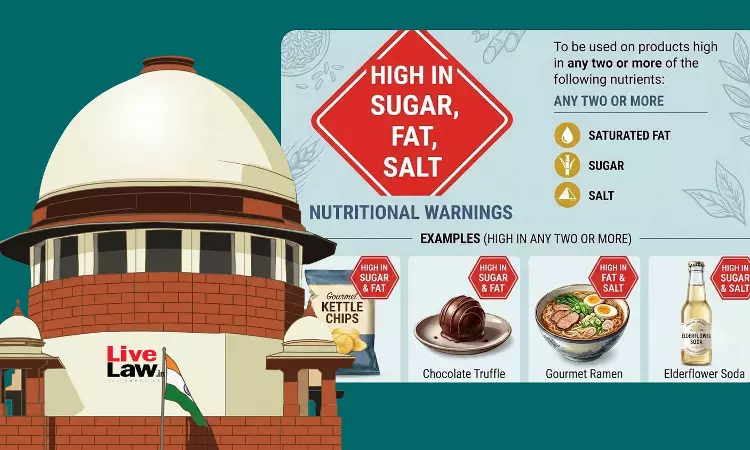
FSSAI also proposed that products, including beverages, containing non-caloric sweeteners may carry the warning "CONTAIN NON CALORIC SWEETENER"
The Food Safety and Standards Authority of India (FSSAI) has proposed adopting a red hexagonal warning label, broadly based on the Canadian model, for packaged food products high in nutrients of concern such as sugar, fat and salt.FSSAI has informed the Supreme Court that it proposes to adopt a single-phase approach for implementing Front-of-Pack Nutrition Labelling (FoPL) and expects to...
This is a premium content
Available exclusively to
Our subscribers
Subscribe Premium 
INR 1099+GST
Your support helps us to bring you more content at
an affordable subscription scheme !!!
All payment options available
The Food Safety and Standards Authority of India (FSSAI) has proposed adopting a red hexagonal warning label, broadly based on the Canadian model, for packaged food products high in nutrients of concern such as sugar, fat and salt.
FSSAI has informed the Supreme Court that it proposes to adopt a single-phase approach for implementing Front-of-Pack Nutrition Labelling (FoPL) and expects to issue and finalise the draft regulations within approximately four months.
The proposal has been submitted before the Supreme Court in response to the Court's order dated September 10, 2026 which sought responses from the Union and FSSAI on 13 specific aspects of the proposed framework, including the implementation timeline, nutrient thresholds, treatment of sweetened beverages, the colour and dimensions of the proposed red hexagon, use of pictorial representations, possible impact on food additives, voluntary compliance and nutritional literacy among schoolchildren.
It may be recalled that the FSSAI came up with the proposal on FoPL only after the Supreme Court came down heavily on the regulator for its inaction. While hearing a petition filed by the NGO '3S and our Health Society', the bench comprising Justice JB Pardiwala and Justice K Vinod Chandran expressed grave concerns over the health of Indians, particularly children, who are lured by packaged food items, and criticised the FSSAI stand that international standards cannot be followed.
The FSSAI's then came up with a proposal, which was to mandate warning labels if the packaged item was high in two or more nutrients of concern (sugar, fat or salt). However, the petitioner, the organisation named '3S and Our Health Society', questioned the 'two or more' trigger as unscientific, and said that the warning labels should apply if the packaged item was high in any of the said components. As the Court also seconded these concerns, the FSSAI agreed to revisit the framework.
Now, it has proposed warning labels even if the item has a high presence of any one of the nutrients of concern.
Red hexagon warning label proposed by the FSSAI
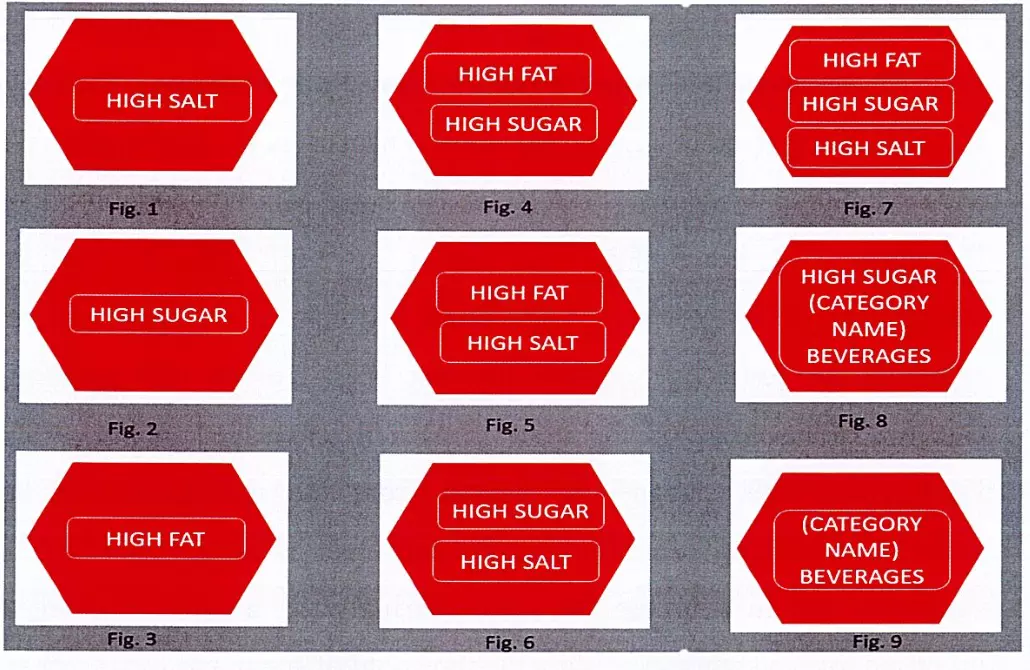
Under the proposed framework, FSSAI would use a red hexagon against a white square-shaped background on the front of food packages.
Where a product exceeds the prescribed threshold for one nutrient of concern, the relevant nutrient would be mentioned inside the hexagon. Where two or three nutrients exceed the applicable thresholds, the same hexagon would contain the names of the relevant nutrients.
The proposed framework would cover products high in any one of the specified nutrients, rather than limiting the warning to products exceeding thresholds for two or more nutrients.
The thresholds are proposed to be based on the Dietary Guidelines for Indians, 2024, issued by the ICMR-National Institute of Nutrition.
FSSAI has also proposed that products, including beverages, containing non-caloric sweeteners may carry the warning "CONTAIN NON CALORIC SWEETENER" on the front of the package.
Warning to be placed on top left of package
The proposed warning would comprise three elements: a white square-shaped background, a red hexagon and the name of the relevant nutrient or nutrients.
FSSAI has proposed that the warning be displayed prominently on the top left of the front of the package. The font size would be at least one point larger than that used in the nutrition information table at the back of the package.
The size of the warning label would broadly correspond to the warning label used in the Canadian model.
FSSAI has stated that it would require approximately four months to issue and finalise the draft regulations under the regulatory process prescribed under the Food Safety and Standards Act and the rules and regulations framed thereunder.
The draft amendment regulations would be published for 60 days to invite comments from stakeholders through domestic consultation and the WTO platform. After examining the comments and obtaining approval of the Food Authority, the final notification would be forwarded to the Ministry for publication in the Official Gazette.
FSSAI has proposed a 365-day voluntary implementation period for food business operators after notification of the regulations.
Nutrient content, not level of processing, to determine warning
FSSAI has stated that the level of processing of a food would not be used as a criterion for determining whether a product carries a front-of-pack warning.
Instead, the nutrient content would remain the regulatory criterion.
The proposed thresholds for added sugar, added fat and salt would apply irrespective of whether a product falls into different categories based on the extent of processing.
FSSAI has cited the thresholds in Table 15.1 of Guideline 15 of the Dietary Guidelines for Indians, 2024.
Added sugar and added fat to be considered
FSSAI has stated that the proposed thresholds for fat and sugar are based on the ICMR-NIN's 2024 Dietary Guidelines.
For solid foods, the sugar threshold has been calculated at approximately 5% of energy from added sugar, while not exceeding 10% of energy from total sugar. For liquid foods and beverages, the corresponding figures are approximately 10% of energy from added sugar and not exceeding 30% of energy from total sugar.
FSSAI has stated that added sugar and added fat are proposed to be considered rather than total sugar and saturated fat for the front-of-pack labelling framework.
It has explained that naturally occurring sugars, such as those present in fruits and milk, are accompanied by other nutrients and therefore need to be distinguished from sugars added during processing and preparation.
Trans-fat
On trans-fat, FSSAI has stated that trans-fat content is already separately reflected on food labels and is subject to a specific regulatory limit and disclosure requirement.
It has therefore proposed not treating trans-fat as an additional component for calculating the total fat threshold under the FoPL framework.
Food additives already regulated
Responding to the Court's concerns about possible increased use of artificial preservatives and emulsifiers, FSSAI has stated that food additives are already regulated under the Food Safety and Standards (Food Products Standards and Food Additives) Regulations, 2011.
It has stated that the implementation of FoPL, which addresses specified nutrients, would not by itself imply or necessitate an increase in the use of artificial preservatives, emulsifiers or other additives.
Nutritional literacy in schools
FSSAI has also detailed measures aimed at improving nutritional literacy among schoolchildren.
It has referred to its Eat Right School programme and awareness campaigns including #StopObesity and #FightObesity.
The affidavit also refers to the Food Safety and Standards (Safe Food and Balanced Diets for Children in School) Regulations, 2020, under which schools are required to promote safe and balanced diets and ensure that certain foods high in saturated fat, trans-fat, added sugar or sodium are not sold on school premises.
FSSAI has further stated that it has proposed collaboration with the Department of School Education and Literacy and the CBSE for inclusion of nutrition literacy and the Eat Right India programme in school curricula.
It has also proposed awareness campaigns, distribution of pamphlets in vernacular languages and programmes by States and Union Territories to educate consumers about FoPL.
The matter is listed for further consideration on September 28. The petitioner society is represented by Adv Rajiv Shankar Dwivedi.
Case : 3S and Our Health Society v. Union of India | W.P.(C) No. 437/2024


