



- Home
- /
- Top Stories
- /
- After Supreme Court Nudge, Centre...
After Supreme Court Nudge, Centre Proposes Skill Training Courses For Cadets Discharged From Military Training Due To Disability
Amisha Shrivastava
23 Sept 2026 8:31 AM IST
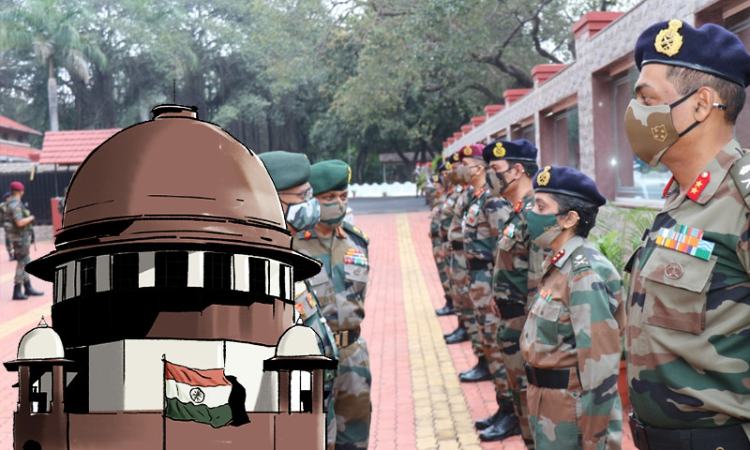
Ministry of Defence has also told the Court that proposals to grant disability pension and Ex-Servicemen status to such cadets were considered but not accepted.
The Centre has proposed a scheme for job-oriented skill training for cadets discharged from military training due to disability, whose disability is below 40% and who therefore do not fall within the scope of the reservation provisions under the Rights of Persons with Disabilities Act, 2016.The Ministry of Defence, in an affidavit filed in response to the Court's direction to prepare a...
This is a premium content
Available exclusively to
Our subscribers
Subscribe Premium 
INR 1099+GST
Your support helps us to bring you more content at
an affordable subscription scheme !!!
All payment options available
The Centre has proposed a scheme for job-oriented skill training for cadets discharged from military training due to disability, whose disability is below 40% and who therefore do not fall within the scope of the reservation provisions under the Rights of Persons with Disabilities Act, 2016.
The Ministry of Defence, in an affidavit filed in response to the Court's direction to prepare a suitable welfare mechanism for such cadets, has proposed 8-10 week structured courses to help such cadets transition from military training to corporate and administrative employment.
The affidavit has been filed in the suo motu case concerning cadets disabled during military training.
The affidavit states that the Directorate General of Resettlement (DGR), functioning under the Department of Ex-Servicemen Welfare, prepared the draft plan of action on August 25, 2026, pursuant to the Supreme Court's direction to prepare a suitable scheme for cadets with less than 40% benchmark disability.
The courses would be divided based on the educational qualification of the cadets, namely graduate and non-graduate, and the discipline, namely technical and non-technical. The Ministry proposes that cadets be nominated for courses based on their qualifications, medical fitness and aptitude.
The draft plan notes that a 4-8 week course would only provide basic orientation and would not allow the mandatory hands-on or on-the-job training prescribed under the National Skills Qualifications Framework. It therefore proposes 8-10 week courses aligned with the existing DGR resettlement courses, with the aim of providing a certifiable, placement-ready skill.
The proposed courses include cyber security and IT support, solar PV system design, installation and maintenance, industrial automation and PLC/SCADA, data analytics and business intelligence, RPAS/drone pilot and operations, logistics and supply chain management, banking, financial services and insurance, retail store and operations management, corporate and private security management, HR and office administration, electrical technician courses, automobile service technician, solar panel installation, CCTV and electronic systems, AC and refrigeration, warehouse and logistics assistance, hospitality and housekeeping, professional driving and fleet operations, and fire and industrial safety.
The indicative cost of the courses ranges from ₹15,000 to ₹55,000 per cadet. The draft states that the costs are based on prevailing National Skill Development Council and Pradhan Mantri Kaushal Vikas Yojana-aligned short-term training norms and would be finalised in consultation with the National Skill Development Council. Travel allowance, daily allowance, boarding and lodging, wherever applicable, would be additional.
The draft scheme proposes that the Directorate General of Resettlement design and conduct the courses, while an authority in the Department of Military Affairs nominates eligible cadets for each training cycle. It also seeks dedicated budgetary support from the Department of Military Affairs/Department of Defence to meet the training costs.
The DGR has also sought decisions on the authority responsible for nominating cadets, the process for verifying their educational qualifications, existing skills, vocational preferences, aptitude and medical or functional limitations, and the authority responsible for verifying eligibility and paying the complete cost of training.
The Ministry has also informed the Court that it has entered into multiple MoUs with universities and colleges to help ex-cadets continue degree courses in which they had enrolled during military training.
According to the affidavit, the arrangements are intended to facilitate lateral entry into appropriate semesters of undergraduate programmes, recognition and transfer of academic credits earned during military training and completion of degree programmes with minimal or no loss of academic time.
The affidavit also sets out the government's position on disability pension and Ex-Servicemen status. It states that a proposal to grant ESM status to medically boarded-out ex-cadets was processed in 2011 but was not accepted by the Department of Ex-Servicemen Welfare (DESW).
In 2022, a separate proposal to grant disability pension at officer rates was not accepted on the ground that existing policies did not permit disability pension to such cadets and that granting it was not feasible.
The Ministry also maintains that ex-cadets cannot be granted ESM status under the existing policy. It has, however, referred to a June 4, 1997 DoPT Office Memorandum which placed medically boarded-out cadets in Priority No. 1 for civil employment. The 2022 meeting proposed reiterating this provision and issuing certificates to such cadets for the limited purpose of obtaining civilian employment.
Case no. – SMW(C) No. 6/2025
Case Title – In Re: Cadets Disabled In Military Training Struggle
Tags

Amisha Shrivastava
Amisha Shrivastava is a Senior Correspondent with LiveLaw, covering the Supreme Court of India. She can be reached at amisha@livelaw.in

