



- Home
- /
- Top Stories
- /
- 'Black Money In Elections Corrupts...
'Black Money In Elections Corrupts Democracy': Supreme Court Issues Directions To Curb Use Of Unaccounted Cash During Polls
Saima Anjum
17 Aug 2026 8:39 PM IST
The Court set a 1-year deadline for investigation in black money cases, which can be exceeded only for recorded reasons sent to the ECI.
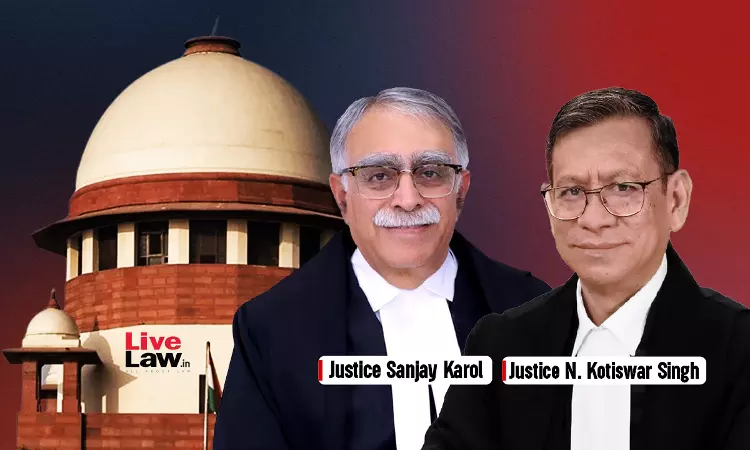
The Supreme Court on Monday (17.08.2026) issued directions to curb the use of black money in elections, holding that unaccounted cash used to influence voters strikes at the root of free and fair elections and compromises the “very essence of democracy.”A bench of Justice Sanjay Karol and Justice Nongmeikapam Kotiswar Singh issued the directions while hearing an appeal arising out of a...
This is a premium content
Available exclusively to
Our subscribers
Subscribe Premium 
INR 1099+GST
Your support helps us to bring you more content at
an affordable subscription scheme !!!
All payment options available
The Supreme Court on Monday (17.08.2026) issued directions to curb the use of black money in elections, holding that unaccounted cash used to influence voters strikes at the root of free and fair elections and compromises the “very essence of democracy.”
A bench of Justice Sanjay Karol and Justice Nongmeikapam Kotiswar Singh issued the directions while hearing an appeal arising out of a 2015 Karnataka High Court order that had quashed an FIR against the respondent. The respondent, Prathik Parasrampuria, was a candidate in the 2014 Lok Sabha bye-election from Bellary, and was alleged to have hoarded a large amount of cash for bribing the voters. The High Court quashed the FIR on the ground that the complaint did not specify whom the accused intended to bribe or the mode he had planned to adopt.
While hearing the appeal, the Supreme Court expanded the scope of the proceedings to examine the larger systematic issue of black money in elections, and issued notice to the Election Commission of India, the Union government, and all States and Union Territories. Senior Advocate Gaurav Aggarwal and Advocate (Dr.) Swapnil Tripathi were appointed as amici curiae.
“If it is that this one chance at expression is itself tainted, it would not be an understatement to say that the very essence of democracy, which is a rule of the people, by the people and for the people, is compromised,” the Court observed. It further stated that a choice “influenced by external factors is no longer a choice of their own. It is somebody else's choice being thrust upon them.”
The bench traced the evolution of democracy from ancient Athens to the present representative form and stated that democracy, the rule of law, and the electoral process are three ideas “inextricably linked to one another,” such that if one is compromised, it impacts the three ideas in entirety.
The judgment authored by Justice Sanjay Karol relied upon the concurring opinion of Justice HR Khanna in Indira Nehru Gandhi v Raj Narain, that democracy “can indeed function only upon the faith that elections are free and fair and not rigged and manipulated.” The Constitution Bench judgment in Anoop Baranwal v Union of India was also referred to, where the Court had observed that “the ballot is more potent than the most powerful gun.”
While discussing the constitutional mandate of the Election Commission of India under Article 324 of the Constitution of India, the bench reiterated the settled principles governing the Commission's powers, and observed that while its jurisdiction is “wide enough to include all powers necessary for smooth conduct of elections.”
The Court traced the developments from Justice PN Bhagwati's observation in 1975 in Kanwar Lal Gupta v Amar Nath Chawla, that unchecked financial disparity between candidates produces “anti-democratic effects,”, to the 1990 Goswami Committee Report, the 1993 Vohra Committee Report on the nexus between crime syndicates and politics, and the 255th Law Commission Report (2015), which had noted that “currency notes come first in containers, then in truckloads, moving to wholesale/small retail forms, and finally to suitcases and in people's pockets.”
The bench also took a note of data placed before it by the Election Commission of India showing that while 3,87,430 FIRs were registered during the 2024 Lok Sabha elections, only about 42.9% (1,66,044) had resulted in convictions, while the rest pending trial or investigation.
Further, the Court flagged the Commission's concern regarding the unilateral withdrawal of election-related prosecutions by the government after the change in the ruling dispensation. For this, reference was made to the Commission's communication to Chief Secretaries stating that such withdrawal “sends a wrong signal that miscreants may indulge in any electoral malpractices and offences at elections with impunity as those cases may be withdrawn later.”
Amicus (Dr.) Swapnil Tripathi submitted a note on 'Global Practices in Election Matter' before the Court, comparing the position across sixteen jurisdictions including Australia, Bangladesh, Canada, and Indonesia. It flagged that in most jurisdictions, the decisions to prosecute or withdraw election-offence cases vest solely with public prosecutors without any role for the election management body.
Directions issued
Considering the suggestions made by the amici and the Election Commission, the Supreme Court issued the following directions:
Any authority effecting a seizure of cash/assets must report it to the jurisdictional District Magistrate or Additional District Magistrate or Court within 24 hours, along with written reasons showing a prima facie nexus with a suspected electoral offence.
Investigating Officers must make every effort to complete the investigation within one year of the registration of FIR. Any delay must be recorded in writing and reported to the Election Commission of India.
Quarterly status reports on investigation must be submitted to the Election Commission through a Nodal Officer, after the approval of the concerned Senior Superintendent or Deputy Commissioner of Police.
When cash exceeding Rs. 10 Lakhs is detected by the Static Surveillance Teams, the same must be reported to the Income Tax authorities.
High Courts to designate special courts for prompt disposal of cases registered against candidates and sitting Members of Parliament or Members of Legislative Assemblies, given the recurring five-year election cycle.
Approval of jurisdictional High Court mandatory for withdrawal of prosecution against candidates in an election cycle, as per State of Kerala v K Ajith and Ashwini Kumar Upadhyay v Union of India.
Noting the large percentage of pendency of cases in connection with 2024 Lok Sabha and 2019-25 Assembly elections, the Court directed concerned courts to make all efforts to bring cases to their logical conclusion with utmost expedition.
The Supreme Court had directed the Election Commission of India and the respective governments to file a compliance report on or before November 18, 2026.
Case Title: State of Karnataka & Anr. v Prathik Parasrampuria
Citation : 2026 LiveLaw (SC) 816
Tags


