



- Home
- /
- Top Stories
- /
- Courts' Hands Aren't Tied To...
Courts' Hands Aren't Tied To Interfere When Free & Fair Elections Are Polluted By Unconstitutional Or Illegal Means: Supreme Court
Gursimran Kaur Bakshi
21 Oct 2026 4:16 PM IST
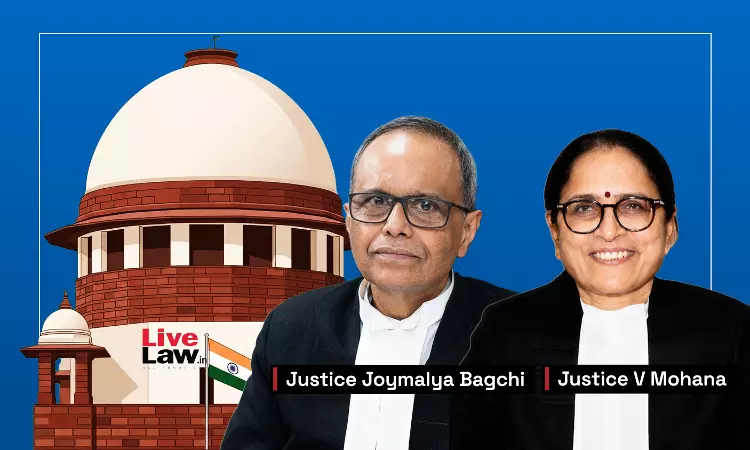
" Instilling confidence in the election process is vital for the maintenance of constitutional democracy," the Court said.
The Supreme Court has observed that while Constitutional Courts would not ordinarily interfere with the election process, their hands are not tied when intervention is necessary to ensure that free and fair elections are not polluted by unconstitutional or illegal means such as the use of muscle power.The Court made the observation while granting interim relief to the Yuvajana Sramika...
This is a premium content
Available exclusively to
Our subscribers
Subscribe Premium 
INR 1099+GST
Your support helps us to bring you more content at
an affordable subscription scheme !!!
All payment options available
The Supreme Court has observed that while Constitutional Courts would not ordinarily interfere with the election process, their hands are not tied when intervention is necessary to ensure that free and fair elections are not polluted by unconstitutional or illegal means such as the use of muscle power.
The Court made the observation while granting interim relief to the Yuvajana Sramika Rythu Congress Party (YSRCP), the principal opposition party in Andhra Pradesh, which alleged that its candidates were prevented from filing nominations for the Urban Local Body elections due to violence and the prevailing law and order situation.
A bench comprising Justice Joymalya Bagchi and Justice V Mohana observed that the party had made out a prima facie case warranting directions to protect the integrity of the nomination process. The bench therefore directed the State Election Commission to consider the YSRCP request to extend the nomination deadline in the light of its complaints regarding widespread violence against its candidates.
The Court clarified that it was not directly intervening in the election process but was allowing the Andhra Pradesh State Election Commission (SEC) to consider the party's grievance and take an appropriate decision. It also directed the SEC not to publish the final list of candidates on October 21 and to defer the publication until October 23.
The YSRCP had approached the Supreme Court alleging that nearly two-thirds of its candidates were prevented from filing nominations for the Urban Local Body elections because of violence and obstruction.
The party had initially approached the Andhra Pradesh High Court seeking anticipatory measures in view of its apprehension of violence. The High Court declined the plea on October 15. The party subsequently sought an extension of the nomination deadline, contending that physical violence had prevented its candidates from reaching nomination centres. The High Court declined this request as well, prompting the party to approach the Supreme Court.
The State of Andhra Pradesh and the State Election Commissioner opposed the plea.
'Constitutional Courts Remain Ultimate Custodians Of Free And Fair Elections'
The bench acknowledged the principle of judicial deference to the State Election Commission, which is constitutionally entrusted with conducting and supervising elections. However, it said that this principle could not completely exclude judicial review when the fairness of the election process was under threat.
"Free and fair election is a basic structure of the Constitution. Right to participate in such elections by filing nominations is a facet of free and fair election process," the bench observed.
The Court noted that the State Election Commission's constitutional responsibility necessarily included taking steps to ensure the free and transparent filing of nomination papers by contesting candidates. At the same time, the power of Constitutional Courts to exercise judicial review in furtherance of the election process could not be rendered wholly nugatory.
The bench explained that judicial restraint in election matters stemmed from the need to entrust the process to an independent constitutional authority and ensure that elections were conducted within a prescribed timeline, without being entangled in judicial interference.
However, it said that Constitutional Courts could not remain silent when there was a prima facie possibility that the election process was being prejudiced by obstruction of nominations.
"The custodian of constitutional values is the constitutional courts," the bench observed, adding that the power of judicial review to ensure free and fair elections could not be completely muted when a principal opposition party approached the Court with material supporting its apprehensions.
The bench noted that the YSRCP had placed on record representations made by the party and its candidates to the State Election Commission, both physically and electronically, even before the commencement of the election process. The material also included video clips purportedly evidencing the alleged obstruction.
"Instilling confidence in the election process is vital for the maintenance of constitutional democracy," the Court said.
The Court concluded that, having regard to the representations and other material placed before it, the YSRCP had made out a prima facie case for issuing directions.
Accordingly, the Court asked the Andhra Pradesh State Election Commission to consider the party's request for extending the nomination deadline and deferred publication of the final list of candidates until October 23.
It said: "Free and fair elections are a basic structure of the Constitution. Right to freely participate in such election by filing nomination papers without hindrance is a facet of the free and fair election process. It is a constitutional duty vested on the State Election Commission under Article 243ZA to conduct and supervise Municipal elections in a free and fair manner. Discharge of such duty would necessarily include all steps to ensure unhindered filing of nomination papers by all contesting candidates. The power of the constitutional Courts to exercise judicial review, though deferential in election matters, cannot be said to be wholly negated when the discharge of such constitutional duty of the State Election Commission is hampered due to widespread violence impairing peace and tranquility and thereby skewing a level playing field in filing nominations."
The bench said that it was conscious of the judicial deference to the powers of the SEC in the matter of holding of elections. At the same time, it added :
"The philosophy of judicial deference to the control and superintendence of elections by the Election Commission has grown from a doctrine of necessity that the election process which is entrusted in the hands of an independent constitutional authority be permitted to be concluded within a prescribed timeline and not be mired in the quagmire of intermediate judicial interference. All grievances to such election process may be agitated in an election petition after the process is over. However, when the principal opposition political party in the State had approached the High Court even prior to the commencement of the election process and had placed on record ample representations and materials expressing serious apprehension and/or instances of use of force and coercion during filing of nomination papers, the power of judicial review cannot be muted on the plea of non-interference in election matters. In such cases, judicial intervention is imperative to ensure a fair and impartial conclusion to the election process and cannot be eschewed as “calling in question an election” prior to its conclusion..."
Referring to precedents such as Union Territory of Ladakh and Others VS. Jammu and Kashmir National Conference (2024), Bharatiya Janata Party, West Bengal v. State of West Bengal and others (2018), the Court observed :
"These authorities above unequivocally state while constitutional courts would ordinarily not interfere with election process, but their hands are not tied when appropriate interventions are necessary to ensure that elections are conducted in a free and fair manner and are not marred by extraconstitutional or illegal means, for eg. muscle power."
Tags
Gursimran Kaur Bakshi
Gursimran is the Principal Correspondent with LiveLaw for the Supreme Court. She can be reached out at: simrankaurbakshi@livelaw.in

