Delhi SIR : Petitioners Flag Before Supreme Court ECI's Statement Asking Deleted Voters To File Form 6
Amisha Shrivastava
4 Nov 2026 11:45 AM IST
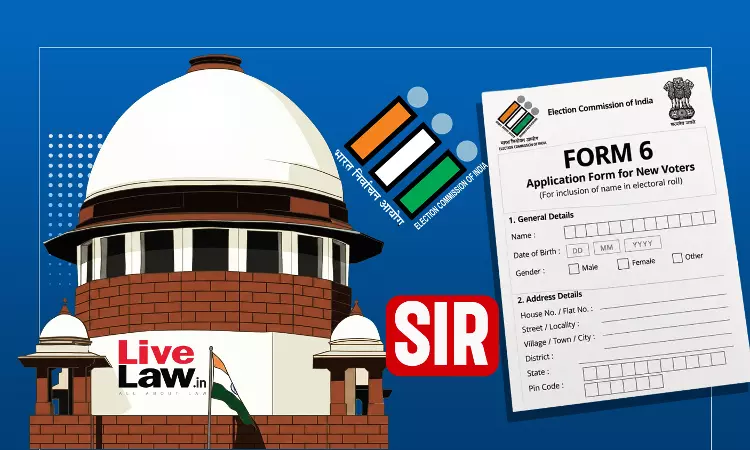
The CJI said that people need not be apprehensive as the Court was hearing the matter.
The petitioners who challenge the Special Intensive Revision (SIR) of the Delhi electoral rolls brought to the attention of the Supreme Court today the recent clarification issued by the Election Commission of India that deleted voters can file Form 6 to register themselves as new voters.
Advocate Prashant Bhushan, making an oral mention for the petitioners before Chief Justice of India Surya Kant, submitted that the ECI's statement issued on November 3 is contrary to the Supreme Court's observations made last week that deleted voters, whose names figured in the 2026 rolls, cannot be compelled to register themselves as new voters using Form 6.
Responding to Bhushan, the CJI stated that the matter is pending before the Court and that people need not be apprehensive.
The CJI asked the petitioners to file an application highlighting the ECI's clarification and said that the issue would be heard on November 19.
The Chief Justice also indicated that, if required, the Court could ask the ECI to extend the deadline further.
The mentioning arose in the backdrop of the ECI's clarification that persons included in the Absent, Shifted, Dead or Duplicate (ASDD) list can submit Form 6 to seek inclusion in the electoral rolls. The petitioners, Anjali Bharadwaj and Amrita Johri, submitted that the ECI's stand was contrary to the Supreme Court's oral directions on October 28 that such persons should be permitted to use Form 8 or the enumeration form.


The Court had on October 28 questioned the ECI's insistence that voters excluded from the draft roll for not submitting enumeration forms should apply through Form 6. The Court had pointed out that Form 6 requires applicants to declare that they are seeking inclusion in the electoral roll for the first time, even when their names figured in the previous electoral roll.
In the statement issued on November 3, the ECI stated that filing of Form 6 by a deleted voter will not amount to a false declaration even though they have voted before.
"It is clarified that an elector whose name does not appear in the draft electoral roll may submit Form 6 to seek inclusion in the final electoral roll, in accordance with the prescribed procedure. Consequently, an elector whose name does not appear in the draft roll is required to seek inclusion afresh in the electoral roll under SIR or afterwards, irrespective of whether the elector had been enrolled previously. The submission of Form 6 in such circumstances is, therefore, for the purpose of inclusion in the electoral roll under SIR or afterwards and is not, by itself, false merely because the elector was previously enrolled," the statement said.
The ECI also relied on the Delhi High Court's observation in Nilotpal Datta v. ECI that persons using Form 6 to enrol in the voters list need not fear prosecution for false declaration. The ECI stated that no prosecution will be taken against those persons merely on the ground that they have voted before.
"Accordingly, no action under Section 31 of the Representation of the People Act, 1950, shall be initiated by an Electoral Registration Officer (ERO) against an elector merely on the ground that the elector had been included in a previous electoral roll and has submitted Form 6 during the SIR process or afterwards, provided that the elector is not already enrolled in any other Parliamentary or Assembly Constituency and the declaration made is otherwise in accordance with law," the ECI stated in its communication addressed to the Chief Electoral Officers of the States.
Background
The issue was raised in the writ petition concerning the Delhi SIR. Advocate Prashant Bhushan for the petitioners had argued that voters who were already enrolled could not be required to make a declaration that they had never been enrolled before, particularly when such a declaration could attract penal consequences under Section 31 of the Representation of the People Act, 1950.
During the October 28 hearing, the Supreme Court suggested that persons who had shifted residence should be allowed to submit Form 8, which is prescribed for shifting of residence and correction of electoral entries, while those people who had been unable to submit enumeration forms should be permitted to do so.
The bench also suggested that the ECI publish the list of deleted voters and facilitate their contact with Booth Level Officers (BLOs) to enable them to submit the appropriate forms. Senior Advocate Dama Seshadri Naidu for the ECI agreed to examine the suggestions and consider remedial measures.
The controversy concerns approximately 47.56 lakh electors excluded from Delhi's draft electoral roll under the category of Absent, Shifted, Dead or Duplicate (ASDD). During the October 28 hearing, the petitioners referred to around 43 lakh voters categorised as permanently shifted or absent, contending that many had not received enumeration forms and were nevertheless being required to apply afresh through Form 6.
In its November 3 clarification addressed to Chief Electoral Officers of all States and Union Territories, the ECI has stated that an elector whose name does not appear in the draft electoral roll may submit Form 6 to seek inclusion in the final roll, irrespective of whether the elector had been enrolled previously. The Commission has clarified that submission of Form 6 in such circumstances would not, by itself, amount to a false declaration merely because the elector had been enrolled earlier.
The ECI has also stated that no action under Section 31 of the Representation of the People Act, 1950, shall be initiated against an elector merely because the elector had been included in a previous electoral roll and submitted Form 6 during or after the SIR, provided the elector was not already enrolled in another Parliamentary or Assembly Constituency and the declaration was otherwise in accordance with law.
The Commission has relied on the Delhi High Court's October 14 judgment, in which the Court disposed of a petition by two voters whose names had been deleted after they could not complete enumeration. The High Court held that their apprehension of being accused of making a false declaration by submitting Form 6 was misplaced and observed that they could submit the form, which would be processed in accordance with law.
The petitioners' communication dated November 3 to the Chief Election Commissioner has urged the ECI and Delhi CEO to establish a simplified mechanism to implement the Supreme Court's directions, including acceptance of Form 8 and enumeration forms from voters on the ASDD list without compelling them to submit Form 6.
The petitioners have also pointed out that approximately 31.59 lakh of the deleted voters were categorised as permanently shifted and 11.73 lakh as absent or untraceable. They have urged that the ASDD list and the relevant forms be made available at booth or block level, with assistance to voters in completing the process and adequate publicity in Hindi and other relevant languages.
The matter arises in the pending writ petition filed by Anjali Bhardwaj and Amrita Johri, which also challenges the ECI's failure to disclose adequate information regarding voters issued notices on grounds of 'Logical Discrepancies' during the Delhi SIR.