



- Home
- /
- Top Stories
- /
- How Allahabad High Court Has Been...
How Allahabad High Court Has Been Exposing UP Police's Encounter Narratives
Sparsh Upadhyay
6 Sept 2026 4:03 PM IST
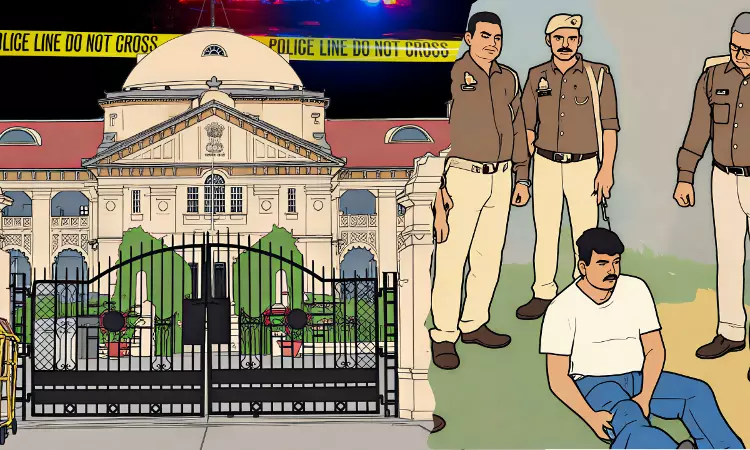
Recently, the versions presented by the UP Police to justify encounters failed to pass judicial scrutiny.
From shooting accused in the legs and failing to separately register and investigate the encounter itself, to questions over rewards and independent investigations, the Allahabad High Court is increasingly questioning Uttar Pradesh's encounter policing. There is a clear-cut striking pattern emerging from the Allahabad High Court's encounter-related orders in 2026. The Court is...
This is a premium content
Available exclusively to
Our subscribers
Subscribe Premium 
INR 1099+GST
Your support helps us to bring you more content at
an affordable subscription scheme !!!
All payment options available
From shooting accused in the legs and failing to separately register and investigate the encounter itself, to questions over rewards and independent investigations, the Allahabad High Court is increasingly questioning Uttar Pradesh's encounter policing.
There is a clear-cut striking pattern emerging from the Allahabad High Court's encounter-related orders in 2026. The Court is not questioning the existence of police encounters as such, nor is it denying the police a right to use force in genuine self-defence.
What it is doing, with increasing firmness, is insisting that an encounter cannot place the police outside the criminal justice system.
In January 2026, in Raju Alias Rajkumar vs. State of U.P 2026 LiveLaw (AB) 48, and in August 2026 in Chotkau Alias Allauddin v. State Of U.P. Thru. Prin. Secy. Home Deptt. Lko And 4 Others 2026 LiveLaw (AB) 619, the Allahabad High Court took note of a repeated pattern of police resorting to firing even in petty matters and subsequently projecting the incidents as encounters.
"The Court is observing day in and day out that whenever the police apprehend a person, it often gives rise to another FIR alleging that when the accused was apprehended, he indulged into indiscriminate firing against the police team. Normally, not even a pellet touches even the uniform of any police person and all of them escape unhurt. The police fires one shot and it hits the accused on his knee or below it", Allahabad HC's stark observation in Chotkau.
There is another reason why this observation needs attention. In cases involving allegations of rape, murder or other heinous offences, an accused can quickly become a villain in the eyes of the public, long before he is arrested or a court tries him as an accused.
Recent instances show us that media scrutiny and public outrage can be intense and an encounter killing may then be celebrated as an act of instant, retributive justice. But if justice has to be served this way, what is the purpose of Courts then?
We must remember that an accusation, however grave, is still an accusation. Public anger cannot become a substitute for proof and a media trial cannot become a criminal trial, no matter what.
It is against this backdrop that the High Court's stern remarks on UP Police's encounter culture - and, increasingly, the practice of what is colloquially called a "half-encounter" or "Operation Langda", where an accused is shot in the leg to incapacitate rather than kill - assume significance.
January 2026 'Raju' case
In Raju, a bench of Justice Arun Kumar Singh Deshwal remarked that the cops, just to get out-of-turn promotion or appreciation from the higher authority or to "get fame in social media", unnecessarily used a firearm and caused a firearm injury to the leg of the accused just below the knee.
"Such act is not permissible in the eyes of law,” the Court said, because "the power of punishment to accused is within the domain of judiciary and not in the domain of police".
"India is a democratic country. It has to be run as per the ethos and directions of the Constitution of India which clearly distinguishes role of legislature, executive and judiciary. In the garb of appreciation or for other extraneous purposes, police officers cannot be allowed to take the function of judiciary to punish a criminal by unnecessary firing and causing injuries even on non-vital part", Justice Deshwal remarked in Raju.
In this case, the Court's message was point-blank, and the choice of phrase could hardly be more apt in a case about police firing: apart from the use of force in appropriate cases, the police can't use measures that are punishment masquerading as lawful policing.
Legal framework on Encounter killings
The legal framework governing such encounters is not new. In People's Union for Civil Liberties v. State of Maharashtra (2014), the Supreme Court laid down detailed safeguards for encounters resulting in death and extended them, as far as possible, to cases involving grievous injury.
The Apex Court had made it clear that in such cases, an FIR has to be registered. The investigation must be independent, conducted by the CID or another police team under an officer at least one rank above the head of the police party. The injured person must receive medical treatment and his statement must be recorded by a Magistrate or Medical Officer. Evidence, weapons and forensic material must be preserved and examined.
The Supreme Court also cautioned against immediate out-of-turn promotions or gallantry rewards before the officer's gallantry is established.
In Raju, the Allahabad High Court stressed that the Apex Court's PUCL directions can not be made subject to the convenience of the police department. It clarified that Article 141 makes the law declared by the Supreme Court binding and thus, there is no exception to following the PUCL safeguards where an encounter results in death or grievous injury.
In Raju, the Bench was concerned with whether those safeguards had actually been followed after Accused-Raju suffered grievous injuries in a police encounter in Mirzapur.
The State produced instructions showing that an FIR concerning the encounter had been registered; however, it also admitted that the injured person's statement had not been recorded either before a Magistrate or a Medical Officer.
In another connected encounter case, the position was even more stark. Inspector Santosh Kumar Singh, who had led the police party, told the Court that no FIR had been registered in connection with the encounter and hence, no investigation had been conducted.
Even the injured accused's statement had again not been recorded before a Magistrate or Medical Officer.
The Court found it "indeed surprising" that such non-compliance continued despite the Supreme Court's directions and the state's own admission that DGP's guidelines had been issued in 2017 and 2024, yet several police officials were not substantially complying with them.
In view of this serious state of affairs, the Court prescribed a specific six-point procedure for such encounters concerning grievous injuries:
- An FIR must be registered;
- Investigation must go to the CBCID or another police station under a senior officer;
- The injured person must receive medical treatment and have his statement recorded by a Magistrate or Medical Officer;
- The investigation into the encounter killing must reach the competent court;
- Immediate out-of-turn rewards must not be given; and
- The victim's family can approach the Sessions Judge where the prescribed procedure has not been followed or impartiality is in doubt.
Raising the stakes for the top cops in cases where these safeguards are not followed, the Court said that liability for failing to follow the directions may extend beyond the officer who led the encounter. The Court clarified that the District Police Chief [SP, SSP or Commissionerate Police] could face contempt proceedings apart from departmental action.
Read more about Raju case here: No Instant Rewards For UP Cops; Mandatory FIR & Medical Aid For Injured: Allahabad High Court Tightens Noose On 'Encounter Culture. Also here: UP Cops Resort To 'Half Encounters' To Get Fame, Appreciation: High Court Warns SP/SSPs Of Contempt If SC's Guidelines Violated
However, the issuance of these strict guidelines was not the end of the matter. The Court would soon have another encounter of its own - with the police version of an encounter.
Just months later, in August 2026, the Lucknow Bench was faced with Chhotkau @ Allauddinv. State of U.P., where the Court did not merely find lapses in encounter procedure. It had to test the encounter story itself, how it unfolded, how the shooting allegedly took place, how the investigation was conducted and why the officers involved had been rewarded.
The concern also surfaced, in broader terms, in Rajendra Tyagi And 2 Others v. State of U.P. and Another, 2026 LiveLaw (AB) 317. While examining allegations of misuse of the Gangsters Act and broader problems of police accountability, Justice Vinod Diwakar noted that “encounter killings, selective crackdowns, and targeted use of the Gangsters Act against inconvenient individuals have periodically attracted judicial notice”.
August 26 order in 'Chhotkau', when the Court pulled apart the Police's encounter story
The Chhotkau's case concerned an alleged encounter in Shravasti. According to the police FIR, 13 police personnel were pursuing Chhotkau after receiving information that he might flee to Nepal. A 10-member SWAT team later joined the operation and the total number of police personnel at the encounter site were 23.
The FIR said that 13 police personnel were travelling in a single government vehicle. It then said that those personnel split into 3 teams and moved along 3 different routes. After the SWAT team joined them, all 23 officers took positions near a bridge, while the FIR mentioned no other vehicle other than the original government vehicle.
A bench of Justice Subhash Vidyarthi found these circumstances difficult to believe and noted that they raised serious doubts about the prosecution's version. Regarding 13 cops travelling in one vehicle, the Bench remarked thus:
"…it was not permissible to carry 13 persons in a jeep, SUV or MUV. This narration of 13 persons sitting in one vehicle prima facie appears to be false and it could only be true if half of them were sitting on the roof top of the vehicle".
The police further claimed that Chhotkau arrived on an e-rickshaw, collided with a tree while trying to escape, got out and ran. Yet 23 police personnel, including 10 SWAT officers, allegedly could not stop him.
Finding this version to be improbable, the bench observed "10 member of SWAT and the 13 members of the three police teams could not stop a person moving on an e-rickshaw, which is also unbelievable, unless all of them are thoroughly incompetent".
The SHO then claimed that Chhotkau fired at the police and subsequently began loading his weapon again. The SHO said he fired two rounds after hearing the sound of the weapon being loaded. Both rounds allegedly struck Chhotkau in his legs.
The SHO told the Court that he had fired from approximately 15 meters on a moonlit night.
Considering these averments, the Court questioned whether the SHO could have accurately aimed and fired from that distance in those circumstances and recorded "serious apprehensions regarding the correctness of the narration made in the FIR". Prima facie, it found that the narration appeared false.
Interestingly, the probe was initially conducted by a Sub-Inspector subordinate to the SHO who had lodged the FIR. Although it was later transferred to another police station, the charge sheet was ultimately submitted by the same SHO who had been the complainant.
Now, the issue is that it was precisely the kind of institutional problem the PUCL safeguards were intended to prevent. An encounter involving grievous injury cannot simply be investigated within the same chain of command that participated in the incident.
The High Court therefore held that, prima facie, the PUCL procedure had not been followed and directed a CBI inquiry into the correctness of the encounter FIR.
Not just that, the Court also directed the CBI to assess the shooting capability of the SHO, including whether he could have aimed and fired from approximately 15 meters at night with a 9 mm service pistol merely after hearing the sound of a weapon being loaded.
Another fact that troubled the Court was that all 23 police officials involved in the encounter had been rewarded for their alleged "good work". The alleged good work included obtaining a confession from Chhotkau regarding an offence for which he had already been acquitted by the Supreme Court.
It was at this point that the police narrative and the circumstances surrounding the encounter became even more intriguing to the Court. Justice Vidyarthi noted that the Supreme Court had earlier made critical observations about the prosecution in that case. He then observed:
"The apparent cause of annoyance of the police against the revisionist may be the observations made by the Hon'ble Supreme Court against the prosecution in the judgment reported in (2023) 6 SCC 742 acquitting the revisionist in the earlier matter".
In this matter too, the Court returned to the pattern it had already flagged in Raju: an apprehended person is shown as having opened indiscriminate fire at the police; the police personnel remain unharmed; and the accused is shot in the knee or below it.
In essence, the High Court had been warning that the constitutional rights of the accused cannot be left to the whims and fancies of police officials. That is precisely why these orders matter.
An encounter, the Court's orders increasingly suggest, is not the point at which the law stops. It is the point at which the law begins asking its hardest questions.
In related news, the issue of encounter killings in the state of Uttar Pradesh also came up before the Supreme Court on September 3, 2026.
When a matter concerning encounter killings in Uttar Pradesh was mentioned for early listing, counsel informed the Court that it had not been listed for more than a year. Chief Justice of India Surya Kant declined to treat the request as urgent, saying, "No urgency".
Tags

Sparsh Upadhyay
Sparsh Upadhyay is an Associate Editor with LiveLaw.

