



- Home
- /
- Top Stories
- /
- 'Industry' Definition Given In...
'Industry' Definition Given In Bangalore Water Supply Case Must Govern Pending Cases Under ID Act 1947 : Supreme Court 9-Judge Bench
Gursimran Kaur Bakshi
20 Aug 2026 11:15 AM IST
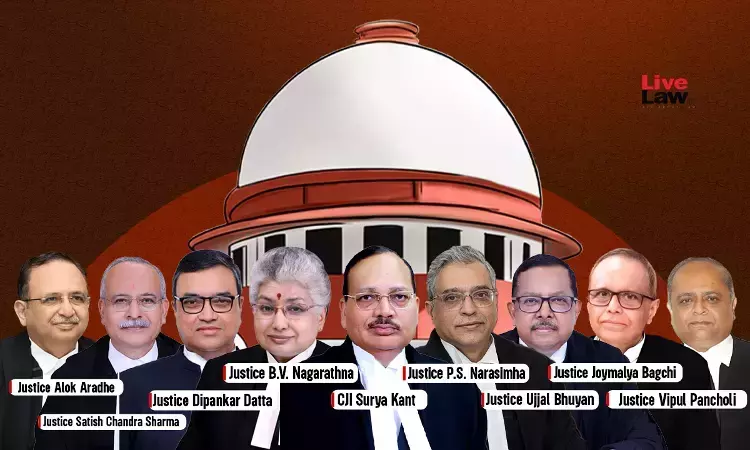
The Court also clarified that the new interpretation (given by 4 Judes) will not affect the new Industrial Relations Code, 2020.
A 9-Judge Bench of the Supreme Court today answered the reference arising out of a 2002 appeal over the correctness of the 'triple tests' laid dow in the 1978 judgment in Bangalore Water Supply and Sewerage Board v. A. Rajappa to determine whether an activity will fall within the definition of "industry" in Section 2(j) of the Industrial Disputes Act, 1947.While four judges of the...
This is a premium content
Available exclusively to
Our subscribers
Subscribe Premium 
INR 1099+GST
Your support helps us to bring you more content at
an affordable subscription scheme !!!
All payment options available
A 9-Judge Bench of the Supreme Court today answered the reference arising out of a 2002 appeal over the correctness of the 'triple tests' laid dow in the 1978 judgment in Bangalore Water Supply and Sewerage Board v. A. Rajappa to determine whether an activity will fall within the definition of "industry" in Section 2(j) of the Industrial Disputes Act, 1947.
While four judges of the bench reformulated the tests to introduce a 'dominant commercial motive' aspect (as per the 1978 judgment, it profit element was unnecessary), five other judges had differing views.
Chief Justice of India Surya Kant, along with Justice Satish Chandra Sharma, Justice Alok Aradhe and Justice Vipul M Pancholi, reformulated the triple test developed by Justice Krishna Iyer. However, they clarified that the new formula will only apply prospectively and will not disturb concluded decisions or affect pending proceedings under the Industrial Disputes Act 1947. They further clarified that the interpretation is confined only to the Industrial Disputes Act, 1947, and will not impact the new Industrial Relations Code, 2020.
Justice Nagarathna, Justice Datta and Justice Bhuyan dissented to hold that the reference was not maintainable.
Justice Narasimha wrote a separate judgment, holding that while the reference was maintainable, it was not necessary to re-open the 'triple tests' since the 1947 Act has been repealed.
Justice Bagchi, while holding that the reference was maintainable, affirmed the Bangalore Water Supply.
View of CJI + 3 Judges
The judgment authored by CJI Surya Kant(for himself and 3 others), held :
The present reference has been validly made and is maintainable.
Certain aspects of the triple test and the accompanying guidelines formulated in Bangalore Water Supply are susceptible to further refinement, while the essential framework laid down therein has stood the test of time.
Some of these constituent elements could have been articulated differently so as to better reflect the scope and contours of Section 2(j). Therefore, we propose to reformulate the triple test.
The triple test articulated in this judgment is to be understood as no more than our considered opinion on the proper interpretation of Section 2(j) of the Industrial Disputes Act, 1947. It is not intended to prejudice the legal position in respect of pending proceedings. Consequently, all matters presently pending before courts, tribunals, labour authorities or other fora under the Industrial Disputes Act, 1947 may be adjudicated in accordance with the triple test as laid down in Bangalore Water Supply.
It is clarified that the judgment is essentially prospective in the sense that it shall not reopen disputes or otherwise affect proceedings that have attained finality. Judgments, settlements and determinations that are no longer subject to challenge shall remain undisturbed, notwithstanding the reformulation of the test set out in this judgment.
Justice Nagarathna's view
Reference was unnecessary.
The definition given in the Bangalore Water Supply case does not call for any interference. The judgment was rendered in the particular economic and industrial context of the country then.
Since the new Industrial Code has come into effect from November 2025, it is not necessary to revisit the earlier interpretation.
In the interest of employers, workmen and industrial activity, as well as the Indian economy itself, the definition of "industry" in Section 2(j), as interpreted in Bangalore Water Supply, must be followed in the pending cases.
Justice Narasimha :
Justice Narasimha held that the reference was maintainable. While an authoritative interpretation of the definition of "industry" was compelling at the time of the reference, such a determination has now become unnecessary with the repeal of the said provision with effect from November 21, 2025. With the advent of the Industrial Relations Code, 2020, with effect from November 21, 2025, the ratio in Bangalore Water Supply is now confined to cases arising under the repealed Act.
It must be ensured that the future interpretation of the definition of "industry" under Section 2(p) of the Industrial Relations Code, 2020 is not burdened by the existing interpretations of the repealed Section 2(j) of the Industrial Disputes Act, 1947. The Industrial Relations Code, 2020 must be interpreted on its own text and in its own context alone.
It is prudent to dispose of the pending cases on the basis of the ratio laid down in Bangalore Water Supply without attempting to create a third set of principles applicable only to the pending cases.
Justice Dipankar Datta (for himself and Justice Bhuyan)
Justice Datta held that the reference was not maintainable. According to him, the 5-judge bench, in 2005, did not properly consider various precedents while making the reference.
On merits, Justice Datta held that the tests laid down in the Bangalore Water Supply Case were correct. "The reference made by the five-judge Bench in Jai Bir Singh was not necessary and serves no practical, jurisprudential or doctrinal purpose," Justice Datta stated.
Background
The Constitution Bench was examining whether the broad interpretation of “industry” adopted in the 1978 judgment authored by Justice VR Krishna Iyer requires reconsideration.
In the Bangalore Water Supply case, a seven-judge bench had laid down a sweeping interpretation of the term “industry” under the Industrial Disputes Act, 1947. The Court held that any systematic activity organised by cooperation between employer and employee for the production or distribution of goods and services could fall within the definition of industry, even if the organisation was not engaged in profit-making.
The triple tests for 'industry', as laid out in the said judgment, are :
(1)There must be an organised and systematic activity,
(2) by cooperation between employer and employee (the direct and substantial element is chimerical), and
(3) for the production and/or distribution of goods and services calculated to satisfy human wants and wishes (not spiritual or religious), but inclusive of material things or services for celestial bliss
In the order passed on February 16 this year, the bench led by CJI observed that the following issues broadly emerge in the reference :
(i) Whether the test laid down in paragraphs 140 to 144 in the opinion rendered by Hon'ble Mr. Justice V.R. Krishna Iyer in Bangalore Water Supply and Sewerage Board's case (supra) to determine if an undertaking or enterprise falls within the definition of “industry” lays down correct law? And whether the Industrial Disputes (Amendment) Act, 1982 (which seemingly did not come into force) and the Industrial Relations Code, 2020 (with effect from 21.11.2025) have any legal impact on the interpretation of the expression “industry” as contained in the principal Act?
(ii) Whether social welfare activities and schemes or other enterprises undertaken by the Government Departments or their instrumentalities can be construed to be “industrial activities” for the purpose of Section 2(j) of the ID Act?
(iii) What State activities will be covered by the expression “sovereign function”, and whether such activities will fall outside the purview of Section 2(j) of the ID Act?
The reference arises out of a 2002 appeal. In 2005, a five-judge bench, headed by Justice N.Santosh Hegde, referred the Bangalore Water supply case to a larger bench, in State of Uttar Pradaesh v. Jai Bir Singh. In 2017, a 7-judge bench referred the matter to a 9-judge bench, since Bangalore Water supply case was rendered by a 7-judge bench.
Case Details : STATE OF U.P. Vs JAI BIR SINGH | C.A. No. 897/2002
Citation : 2026 LiveLaw (SC) 848
Tags

Gursimran Kaur Bakshi
Gursimran is the Principal Correspondent with LiveLaw for the Supreme Court. She can be reached out at: simrankaurbakshi@livelaw.in

