



- Home
- /
- Top Stories
- /
- Law Protects Intrinsic Character Of...
Law Protects Intrinsic Character Of Ancient Monument : Sambhal Mosque Committee Tells Supreme Court
Gursimran Kaur Bakshi
8 Sept 2026 6:45 PM IST
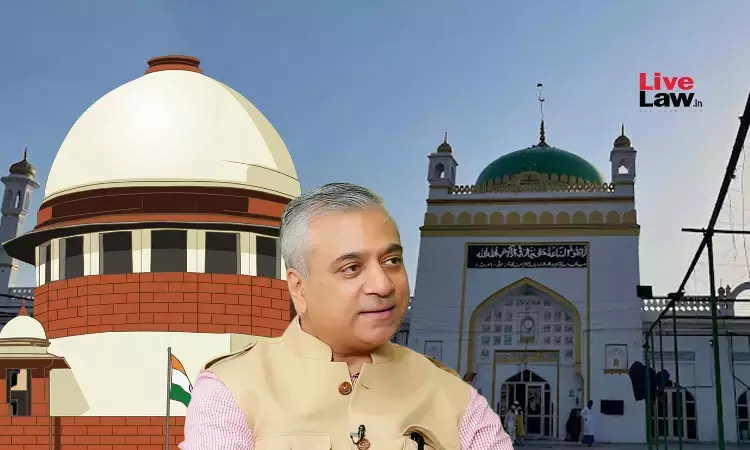
The mosque committee argued that the trial court's survey order was bad in law, and that there was no urgency for an ex-parte action.
The intrinsic religious character of an ancient monument must be preserved under law, the Sambhal Jama Masjid Committee told the Supreme Court today, arguing that the statutory protection afforded to protected places of worship cannot be overridden by a claim seeking access to the monument for performing religious ceremonies and offering prayers.Senior Advocate Huzefa Ahmadi, appearing for...
This is a premium content
Available exclusively to
Our subscribers
Subscribe Premium 
INR 1099+GST
Your support helps us to bring you more content at
an affordable subscription scheme !!!
All payment options available
The intrinsic religious character of an ancient monument must be preserved under law, the Sambhal Jama Masjid Committee told the Supreme Court today, arguing that the statutory protection afforded to protected places of worship cannot be overridden by a claim seeking access to the monument for performing religious ceremonies and offering prayers.
Senior Advocate Huzefa Ahmadi, appearing for the Committee of Management Jami Masjid, Sambhal, submitted before a bench of Justice PS Narasimha and Justice Alok Aradhe that the Hindu plaintiffs' reliance on Section 18 of the Ancient Monuments and Archaeological Sites and Remains Act, 1958, which deals with the right of access to protected monuments, overlooks the more fundamental protection contained in Section 16.
Ahmadi argued that Section 16 protects a protected place of worship from misuse, pollution and desecration and, where an ancient monument has a religious character, requires that character to be maintained.
"The substratum of the case of the respondent is based on Section 18 [right of access to protected monuments]," Ahmadi submitted.
He pointed out that the plaintiffs' case was essentially that they should be granted access to the ancient monument so that they could perform religious ceremonies and offer prayers. According to him, such a claim is inconsistent with the statutory requirement that the existing religious character of the protected monument be preserved.
"Section 16 is a mirror image of Section 3 of Places of Worship Act," he submitted, arguing that where a place of worship is also an ancient monument having a religious character, "the religious character must be maintained."
Ahmadi further argued that if the plaintiffs' claim was for access to conduct religious ceremonies at the monument, the suit itself would be contrary to the protection provided under Section 16.
The bench was hearing the Special Leave Petition filed by the Mosque Committee challenging the Allahabad High Court's May 2025 order upholding the appointment of an Advocate Commissioner to conduct a local investigation of the mosque premises.
The Committee has also challenged the High Court's findings that the suit was not barred by the Places of Worship (Special Provisions) Act, 1991.
Ahmadi argued that the High Court was wrong in holding that the PoW Act did not apply since it exempted monuments protected by the ASI. He contended that this exemption, under Section 4(3), is only applicable to Section 4 and not the entire Act. Section 3 of the Act imposes a blanket ban on the conversion of a place of worship, he argued.
Sambhal Case Should Be Heard Alongside Places Of Worship Act Matters
Ahmadi also submitted that the Sambhal proceedings should be considered alongside the batch of cases before the Supreme Court challenging the Places of Worship (Special Provisions) Act, 1991, as well as the petition seeking implementation of the Act.
He referred to the Supreme Court's December 12, 2024, order passed by a three-judge bench directing that no fresh suits concerning places of worship be registered across the country until further orders.
The order had also restrained courts from passing effective interim or final orders in pending proceedings, including orders relating to surveys.
Against this backdrop, Ahmadi argued that the Allahabad High Court ought not to have proceeded with the Sambhal matter.
Appointment Of Commissioner Was Made In 'Hot Haste'
Ahmadi thereafter turned to the appointment of the Advocate Commissioner, arguing that the Trial Court's order dated November 19, 2024 was legally unsustainable.
He submitted that the commissioner was appointed ex parte, without notice to the Mosque Committee, and without the Trial Court specifying the particulars or points on which the commissioner was required to conduct the local investigation.
Referring to Order XXVI Rule 9 of the Code of Civil Procedure, Ahmadi argued that the court is required to define the matters on which the local commissioner has to report.
He said the Trial Court had appointed the commissioner merely on "ipse dixit" of the plaintiff, without recording the requisite satisfaction or identifying what exactly the commissioner was required to investigate.
"There is no recording of the satisfaction by the Trial Court for the requirement of appointment of a local commissioner, no enumeration of what he has to report, which is in violation of mandatory provisions of the CPC," he submitted.
Ahmadi also questioned the urgency behind the appointment, noting that the suit had been filed over a claim dating back to several years.
"Given the sensitivity of the matter, the trial court shouldn't have appointed a commissioner ex parte and without notice. It's not as if the suit was filed or something immediately going to happen. Suit was filed after almost 70 years. Where was the requirement of appointing a commissioner in such hot haste?" he asked.
He pointed out that the commissioner's visit was followed by violence in Sambhal, in which six people were killed, and that prayers had to be disrupted.
'Commission Is To Assist Court, Not To Get Best Evidence For A Party'
The Mosque Committee also challenged the Allahabad High Court's view that a commission could be used by a party to obtain the "best evidence."
Ahmadi submitted that the purpose of a commission under the CPC is to assist the court and not to assist a litigating party in collecting evidence.
"A commission is to assist the court," he said.
He explained that one form of commission is where the court appoints a local commissioner to ascertain the ground situation. In another situation, after evidence has been completed, the Trial Court may consider a spot inspection necessary to determine an issue that cannot otherwise be resolved.
"But this finding of the learned judge of the High Court that the commission can be used by a party to get the best evidence; it is contrary to the CPC because the court doesn't assist any party in getting evidence," he argued.
After Ahmadi concluded, Advocate Nizam Pasha commenced his submissions. He argued that the Places of Worship Act, 1991 and the Ancient Monuments and Archaeological Sites and Remains Act, 1958 are composite statutory enactments and must be read together. The principle of "non-retrogression", which is inherent in the PoW Act, is part of the AMASR Act, he argued.
The petitioners have completed the arguments. The Court will hear the respondents' arguments on the next date.
Case Details – Committee of Management Jami Masjid, Sambhal v. Hari Shankar Jain | SLP (C) Diary No. 46111 of 2025 (AoR Anil Kumar) and Committee of Management, Jami Masjid Sambhal, Ahmed Marg Kot Sambhal v. Hari Shankar Jain | SLP (C) 21599/2025 (AoR Fuzail Ahmad)
Previous hearing - Sambhal Mosque Dispute | HC Couldn't Have Upheld Survey Order Due To SC's December 2024 Order : Ahmadi Tells Supreme Court
Tags
Gursimran Kaur Bakshi
Gursimran is the Principal Correspondent with LiveLaw for the Supreme Court. She can be reached out at: simrankaurbakshi@livelaw.in

