



- Home
- /
- Top Stories
- /
- We Must Shed Excessive Deference To...
We Must Shed Excessive Deference To Judiciary: Justice Ujjal Bhuyan
Debby Jain
30 Aug 2026 1:14 PM IST
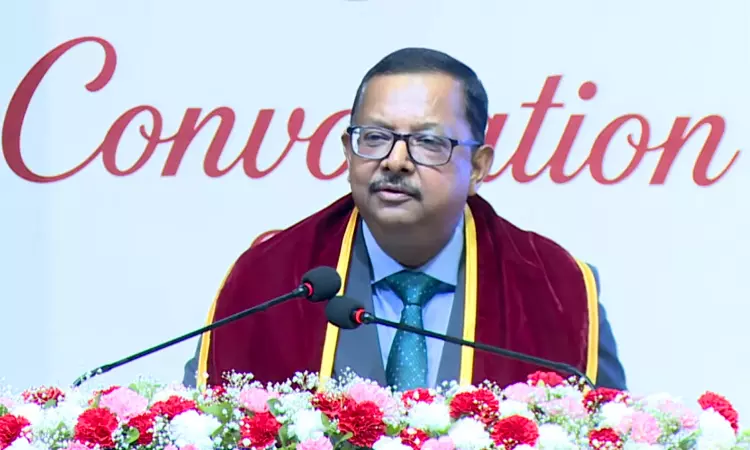
While addressing a convocation event at NLU Delhi, Supreme Court judge Justice Ujjal Bhuyan today underlined the critical role of law universities in a constitutional democracy, noting that these are places where students first encounter ideas different from their own.The judge also said that we must "shed excessive deference" to authority, including the judiciary. "Initially I had thought...
This is a premium content
Available exclusively to
Our subscribers
Subscribe Premium 
INR 1099+GST
Your support helps us to bring you more content at
an affordable subscription scheme !!!
All payment options available
While addressing a convocation event at NLU Delhi, Supreme Court judge Justice Ujjal Bhuyan today underlined the critical role of law universities in a constitutional democracy, noting that these are places where students first encounter ideas different from their own.
The judge also said that we must "shed excessive deference" to authority, including the judiciary. "Initially I had thought of saying, but struck it down, that we must shed our excessive deference to authority, be it generally or the judiciary in particular. But again that's another topic we will discuss another day, not the convocation", Justice Bhuyan remarked.
On the university's role, the judge further said, "A university is not merely an institution that transfers knowledge from one generation to the other generation. It is a place where individuals encounter ideas that may be different from their own, where established positions can be examined and questioned, where disagreements can take place through reasons rather than hostility...A healthy academic environment does not require everyone to arrive at the same conclusion. It allows different views to be expressed, examined and debated."
He was speaking at the 13th convocation event hosted by NLU Delhi for the LLM programmes. Besides him, the event witnessed the presence of Delhi High Court judge Justice Vivek Chaudhary (Member, Governing Council, NLUD).
In his address to the students, Justice Bhuyan further opined that the culture for respecting liberty and difference must begin from universities.
"If we want a democratic society that respects liberty and difference, that culture has to begin from the universities. A university, in my view, should be one of the first places where the habit of thinking freely begins. It should be a space where an idea is not accepted merely because it is familiar, and where students does not hesitate to ask difficult questions simply because the answer may be uncomfortable..."
The judge emphasized that even in moments of disagreement and differences, the core constitutional values of liberty, equality, dignity and justice must not be lost. He said that for a legal professional or academic, it is not just important to know the law, but also to understand the values behind it.
"The role of a legal professional or legal academic is therefore not simply to know what the law says, but to understand the values that give the law its legitimacy. Liberty, equality, dignity and justice are not abstract words in our Constitution. The responsibility of the legal profession and legal scholars is to ensure that even in moments of disagreement, even in moments of dissent, even in moments of conflict, these constitutional values remain at the core of our understanding of law."
Justice Bhuyan also said that the judiciary and academic are not rivals, rather, they complement each other. "A strong academic is an asset to the judiciary. While the judiciary can look towards academia for providing it with requisite intellectual input, academia can do great service by pioneering research in various fields of law, including analysis of judges themselves, their judicial work, their body of work, what they have done, and the functioning of the courts generally."
Justice Bhuyan's remarks come against the backdrop of the controversy at Hyderabad's NALSAR University of Law, where students had objected to the proposed participation of Chief Justice of India Surya Kant at the university's convocation over the CJI's remarks on student protest violence. The dispute recently spilled over to the National Law School of India University in Bengaluru, which cancelled its students' convocation.
Tags
Debby Jain
Debby Jain is a Correspondent with LiveLaw, covering the Supreme Court of India

