Post-Diwali Delhi Will Be Very Bad, Judges Cannot Stay Home To Escape Pollution: Justice Vikram Nath
Amisha Shrivastava
28 Oct 2026 2:45 PM IST
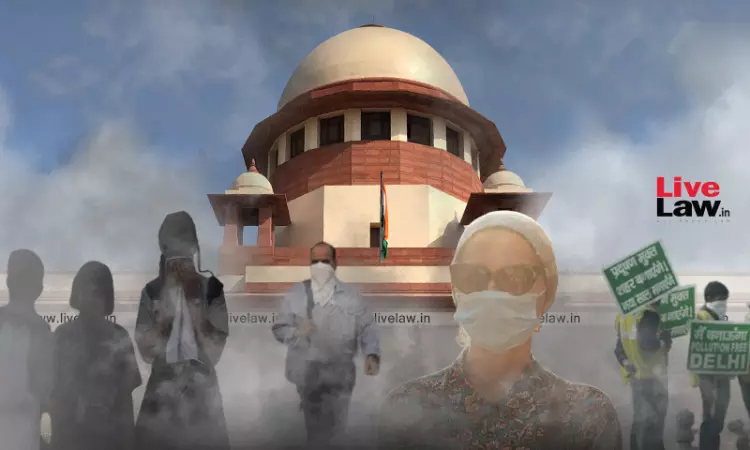
The Court has recently ruled out complete ban on firecrackers in Delhi.
The Supreme Court on Wednesday remarked that Delhi's air pollution would be significantly worse after Diwali, with Justice Vikram Nath remarking that judges could not stay at home to avoid the city's polluted air.
The observation came when the Court was fixing a date for hearing a matter. Senior Advocate Indira Jaising requested that it be listed after the Diwali vacation, on November 17, while counsel for the respondent sought a date in the first week of November.
“In a lighter note, in any case, Diwali is an extremely polluted time in Delhi. Please keep it on the 17th,” Jaising said.
Justice Nath observed that the environment would be cleaner before Diwali. “No no, but before Diwali, it would be cleaner environment. So you come before Diwali, after Diwali it will be worse”, he said.
Jaising said that there will be pollution both before and after Diwali. However, Justice Nath remarked that pollution will be much worse after Diwali. “Post Diwali it will be very bad”, he said.


Jaising said that she was willing to endure the pollution if she could appear in person, pointing out that the judges would have to come to court and suffer the pollution anyway.
“We can't sit at home. You have the privilege of sitting at home and saving yourselves from the pollution, but we can't”, Justice Nath responded, referring to the fact that advocates can appear before the court virtually but judges have to come physically in order to hold court.
Delhi's air quality deteriorated around Diwali last year, with the city's 24-hour average Air Quality Index (AQI) rising from 268 on October 18, 2025, and 296 on October 19 to 345 on Diwali, October 20. The AQI climbed further to 351 on October 21 and 353 on October 22, remaining in the 'very poor' category.
This year's Diwali falls on November 8. The Commission for Air Quality Management (CAQM) invoked Stage I of the Graded Response Action Plan across Delhi-NCR on October 21, 2026, after Delhi's daily average AQI reached 244 at 2 pm and 245 at 4 pm, both in the 'poor' category. Delhi's 24-hour average AQI stood at 197 at 4 pm on October 27, 2026, while a reading of 228 was recorded at 7 am on 28th morning.
The Supreme Court continues to monitor the issue of severe air pollution in Delhi. In the past couple years, it has passed directions to address sources of Delhi-NCR's air pollution, including vehicular emissions, industrial pollution, emissions from thermal power plants, construction and road dust, stubble burning, waste burning and fires at landfill sites, and firecrackers.
Regarding pollution in Delhi-NCR during Diwali, successive benches have taken a varying approach towards a firecracker ban.
Supreme Court's Changing Approach To Firecracker Ban
In the MC Mehta v. Union of India case concerning air pollution in Delhi-NCR, a bench of Justice Abhay Oka and Justice Ujjal Bhuyan adopted a stringent approach to firecracker restrictions in 2024 and 2025.
In November 2024, the Court criticized the authorities for failing to effectively enforce the firecracker ban and observed that no religion encouraged activities that caused pollution or compromised public health. It subsequently directed the Delhi government to consider imposing a year-round ban and sought details of the measures taken to enforce the existing restrictions.
On December 19, 2024, the Delhi Government informed the Court that it had imposed a comprehensive ban on firecrackers, covering their manufacture, storage, sale, distribution, and use. The Court was also informed that while Haryana had permitted the use of green crackers, Rajasthan had imposed a complete ban on firecrackers within its NCR areas.
On January 17, the Court extended the firecracker ban in districts of Uttar Pradesh and Haryana that fall in the National Capital Region till further orders, observing that a ban confined to Delhi would not be effective.
On April 3, 2025, the bench refused to relax the year-round ban on the manufacture, storage, sale and use of firecrackers. It rejected pleas seeking to restrict the prohibition to a few months around Diwali. It also declined to exempt green crackers, observing that their pollution impact had not been shown to be minimal.
The Court held that the ban could be reconsidered only if scientific evidence established that pollution caused by green crackers was reduced to a bare minimum. It also highlighted that people working on the streets, who could not afford air purifiers, were among those most severely affected by pollution.
On May 6, 2025, the Court directed Uttar Pradesh, Rajasthan and Haryana to issue orders under Section 5 of the Environment (Protection) Act, 1986, to enforce the complete ban across NCR.
Successor Bench Relaxes Ban For Diwali 2025
On October 15, 2025, a bench led by then Chief Justice of India BR Gavai relaxed the prohibition, permitting the sale and use of approved green crackers in Delhi-NCR for a limited period around Diwali, subject to conditions.
The Court allowed their use on October 19 and 20, between 6 am and 7 am and between 8 pm and 10 pm. It prohibited firecrackers containing barium, unapproved products and firecrackers joined in series, while restricting sales to designated locations.
The relaxation departed from the earlier bench's position that the year-round prohibition should continue unless scientific evidence demonstrated that green crackers caused minimal pollution.
Supreme Court Rules Out Complete Firecracker Ban
The Court revisited the issue of firecracker ban ahead of Diwali this year. On September 30, a bench of Justice MM Sundresh and Justice Augustine George Masih in Arjun Gopal v. Union of India indicated that it would neither impose a complete ban nor permit unrestricted use of firecrackers.
“We make it very clear. Neither we are going to agree with you for total ban. Nor are we going to allow them to do it 24 hours,” Justice Sundresh said, emphasising the need to balance religious sentiments against the health impact of pollution on children, elderly persons and those suffering from illnesses.
The Court permitted joint firecrackers (ladis) subject to technical safeguards but deferred the issue of barium-containing green crackers pending further environmental testing.
On October 12, a bench led by Chief Justice of India Surya heard the suo motu proceedings concerning Delhi-NCR air pollution and firecrackers.
Amicus curiae Aparajita Singh highlighted repeated failures to enforce restrictions, arguing that limiting firecracker use to specified hours would not be effective if the directions continued to be violated.
Justice Bagchi questioned the religious justification for bursting firecrackers, asking, “What does religion have to do with firecrackers?” The CJI, however, said that the Court would not hurt religious sentiments. He emphasised on public awareness and voluntary restraint.