



- Home
- /
- Top Stories
- /
- 'Prime Minister's Nominee Can't Be...
'Prime Minister's Nominee Can't Be Expected To Defy Him': Justice Datta Doubts Independence Of Election Commissioners' Selection Panel
Amisha Shrivastava
23 Sept 2026 6:42 PM IST
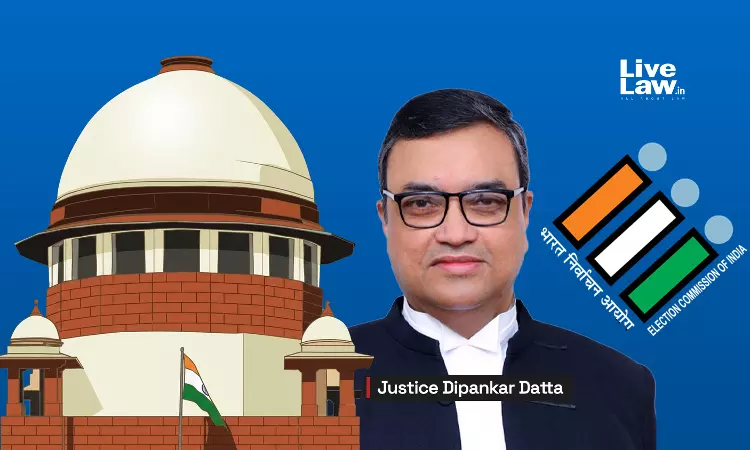
"If free and fair elections are to be ensured, it is axiomatic that the ECI must not only be an independent body but also be seen to act independently,” he observed.
Supreme Court justice Dipankar Datta today prima facie questioned the neutrality of the mechanism for appointing the Chief Election Commissioner and Election Commissioners under the 2023 law, observing that the Union Cabinet Minister nominated by the Prime Minister cannot be expected to oppose the Prime Minister in the selection process.Justice Datta prima facie observed that the...
This is a premium content
Available exclusively to
Our subscribers
Subscribe Premium 
INR 1099+GST
Your support helps us to bring you more content at
an affordable subscription scheme !!!
All payment options available
Supreme Court justice Dipankar Datta today prima facie questioned the neutrality of the mechanism for appointing the Chief Election Commissioner and Election Commissioners under the 2023 law, observing that the Union Cabinet Minister nominated by the Prime Minister cannot be expected to oppose the Prime Minister in the selection process.
Justice Datta prima facie observed that the Prime Minister-nominated Cabinet Minister could not be expected to act as an independent counterweight to the Prime Minister.
“The Minister nominated by the Prime Minister, to function as the third member on the Selection Committee chaired by the Prime Minister, cannot be expected to defy his own nominator and risk his continuation as such nominated member on the committee, for all practical purposes,” he observed.
Justice Dipankar Datta delivered his opinion on whether the challenge to the Chief Election Commissioner and other Election Commissioners (Appointment, Conditions of Service and Term of Office) Act, 2023 should be referred to a Constitutional Bench.
The petitions challenge Section 7 of the 2023 Act, which provides for a three-member Selection Committee comprising the Prime Minister as Chairperson, the Leader of Opposition in the Lok Sabha and a Union Cabinet Minister nominated by the Prime Minister.
Before deciding the issue of reference, he prima facie observed that free and fair elections require the Election Commission of India (ECI) to not only be independent but also to be seen to act independently.
The petitioners argued that the inclusion of the PM's nominee undermines the institutional neutrality of the Selection Committee, as the PM's nominee could not be expected to oppose him and support the Leader of Opposition.
Justice Datta found weight it the petitioners' argument and observed that with two members of the committee being from the executive, the executive effectively gets a veto over the selection process.
He highlighted, “When queried by this Court as to whether the Prime Minister's nominee would take a stand against the Prime Minister in case of a difference of opinion between the Prime Minister and the Leader of Opposition, 'probably no' was the answer of the learned Attorney although 'certainly no' is what the challengers say would be the ultimate outcome.”
Justice Datta observed that even the likelihood of a “no” to the Court's question was enough to affect the perception of the Selection Committee.
“The presence of likelihood of a 'no' is striking enough to colour the perception of the Selection Committee,” he observed.
The petitioners have argued that even if appointments made through the process were meritorious, the mechanism would fail the “perception test”. They compared the situation to an umpire in a cricket match being chosen by the captain of one side, arguing that even correct decisions could carry a patina of suspicion if the umpire was effectively chosen by the winning captain.
Justice Datta found the submission relevant to the constitutional requirement of free and fair elections. “If free and fair elections are to be ensured, it is axiomatic that the ECI must not only be an independent body but also be seen to act independently,” he observed.
He noted that the 2023 Act might possibly survive the direct challenge based on the exclusion of the Chief Justice of India from the Selection Committee. However, he held that the mechanism would also have to satisfy the perception test which the Supreme Court has repeatedly recognised as essential.
Justice Datta questioned whether the Selection Committee under Section 7 appeared as independent as the temporary mechanism laid down by the Supreme Court in Anoop Baranwal v. Union of India, which provided for a Committee of the Prime Minister, the Leader of Opposition and the CJI.
He also emphasised that the issue was not whether the persons eventually appointed under the 2023 Act would necessarily lack character or integrity, but whether the statutory mechanism itself generated the same public confidence as the presence of a neutral third member.
He relied on the principle of collective responsibility under Article 75(3) of the Constitution and opined that a Minister who is part of the Council of Ministers and bound by collective responsibility could not reasonably be expected to disagree with the Prime Minister in the appointment of persons to a sensitive constitutional office. He added that the presence of the Leader of Opposition consequently became “largely ornamental”.
“In such a circumstance, the inclusion of a Cabinet Minister in the Selection Committee fails to provide the independent counterweight that a neutral selector could and he (Cabinet Minister) would merely echo the voice of his leader; and, consequently, the presence of the Leader of Opposition in the Selection Committee becomes largely ornamental, without furthering the purpose of his inclusion,” he said.
Justice Datta held that the petitioners' contention that the 2023 Act vests “overwhelming selection power” in the executive and thereby undermines the appearance of independence required under Article 324 and the basic structure prima facie has substance.
Solicitor General Tushar Mehta argued that constitutional trust reposed in the office of the Prime Minister meant that decisions taken by the Prime Minister should not be doubted.
Justice Datta, however, was not convinced, and connected the argument to the actual functioning of the political system. He observed that the constitutional ideals envisaged by the Constitution had remained largely unaccomplished due a lack of intent and non-abidance with constitutional morality by ruling regimes, resulting in institutional erosion.
He further observed that political parties appeared to promote persons accused of crimes, including offences involving moral turpitude, instead of persons with spotless track records” and unimpeachable integrity and rectitude.
While he acknowledged that false cases were also instituted against public figures to malign them, he maintained that that the figures concerning criminal antecedents of parliamentarians, legislators and Ministers, if accepted, raised concern.
He made it clear that these are prima facie observations and not a final ruling on the constitutional validity of the 2023 Act in this opinion.
The two-judge bench differed on whether the challenge should be referred to a Constitution Bench. Justice Datta held that the existing constitutional jurisprudence on free and fair elections and the independence of the ECI was settled and that the 2023 Act had to be tested against those principles.
Justice Satish Chandra Sharma took the view that whether Parliament could exclude a neutral selector from the Selection Committee raised a substantial question of constitutional interpretation not previously decided.
Ultimately, the matter was directed to be placed before the Chief Justice of India for considering constitution of a Constitution Bench to decide the validity of Section 7 and the other impugned provisions of the 2023 Act.
Case no. - W.P.(C) No. 14/2024 Diary No. 146 / 2024 and connected cases
Case Title - Dr. Jaya Thakur v. Union of India and connected cases
Citation: 2026 LiveLaw (SC) 976
Click Here To Read/Download Judgment
Also from the judgment - Hope Present Collegium Makes Proper Choices In Future; Judiciary Playing Second Fiddle To Executive In Judges' Appointment : Justice Dipankar Datta
Tags

Amisha Shrivastava
Amisha Shrivastava is a Senior Correspondent with LiveLaw, covering the Supreme Court of India. She can be reached at amisha@livelaw.in

